
pall
noun pall
pɔːl
A cloth that is spread over a coffin, hearse, or tomb.
They draped a black pall over the coffin.
pall
pɔːl
読み込み中…
pɔːl
A cloth that is spread over a coffin, hearse, or tomb.
They draped a black pall over the coffin.
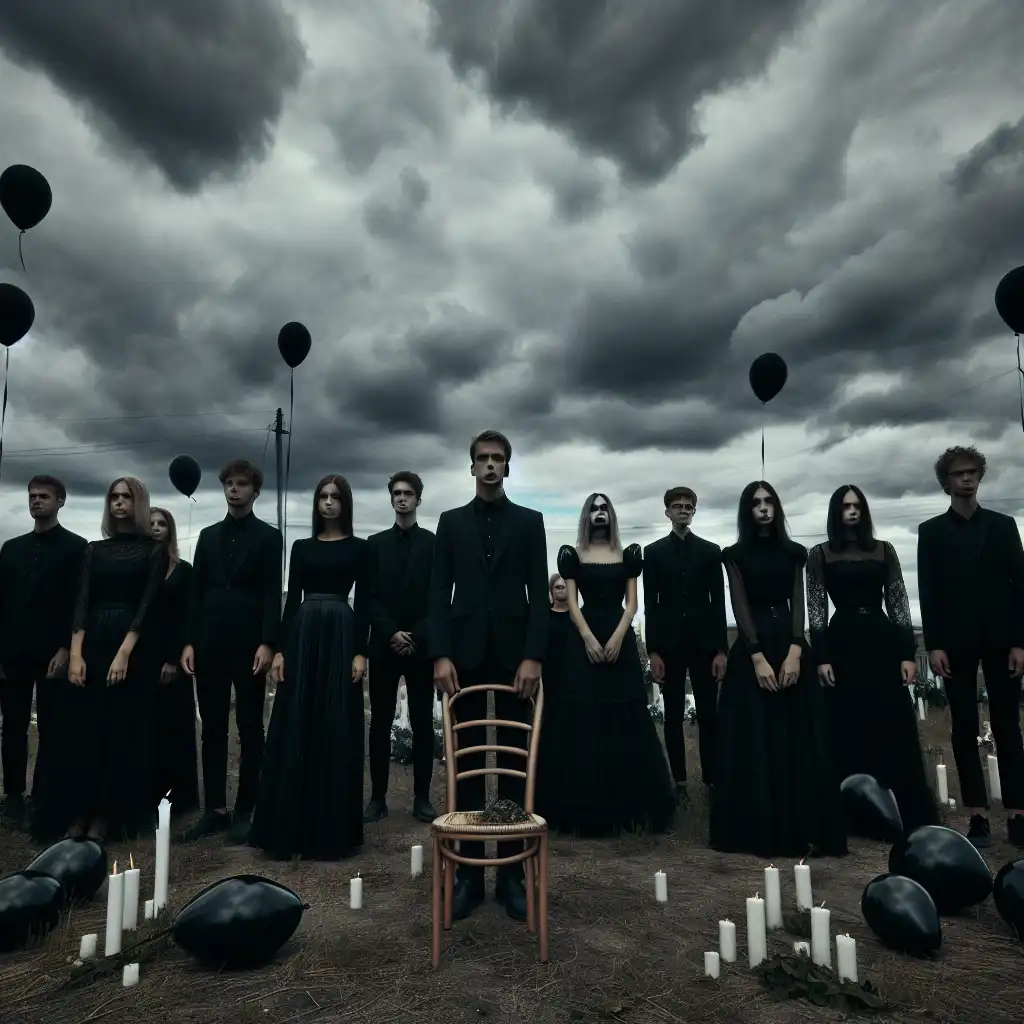
pɔːl
A feeling of sadness or gloom that affects a particular place, situation, or person.
His sudden death cast a pall over the celebrations.

pɔːl
To become uninteresting or boring, especially after a certain time or repetition.
The same old routine at work eventually began to pall.
pɔːl
To make less attractive or appealing.
His constant complaining has started to pall.
音声を読み込めませんでした。しばらくしてからもう一度お試しください。
The word 'pall' can be used to describe a strong feeling of sadness or gloominess that hangs over a situation. It is usually used to describe a situation that is bleak or dull. For example, "There was a pall of gloom over the city after the earthquake hit." It can also refer to a cloth that is used to cover a coffin during a funeral.
A cloak is a loose outer garment that is worn over other clothes to protect the wearer from the elements, and often has a hood attached to it.
A cloak is a garment worn by a person to keep them warm, while a pall is a covering used in funeral ceremonies to show respect for the deceased.
単語を開く: Cloak →Conceal means to hide something or keep it secret from others. For example, you might conceal a surprise gift for someone.
Conceal involves hiding something from others, while pall involves covering or shrouding something in a gloomy way.
単語を開く: Conceal →Cover refers to something that goes on top of another thing to protect or hide it. For example, you can cover a book with a book cover to protect it from damage, or cover a pot with a lid to keep the food inside from spilling out.
Pall refers to a heavy cloth that is used to cover a coffin at a funeral.
Cover is used to protect or hide something, while pall describes a heavy cloth used in a funeral, or a feeling of gloom or darkness.
単語を開く: Cover →Disguise means to change the appearance or identity of something or someone in order to deceive others or hide their true form.
So, while disguise is about hiding someone or something's true identity, pall is about covering or concealing it for respectful reasons.
単語を開く: Disguise →Hide means to conceal or cover something so that it can't be seen or found easily.
For example, a person could hide in a closet to avoid being seen, or an animal may hide in the bushes to avoid being caught.
So the main difference between these words is that hide describes physical concealment, while pall describes a decline in interest or excitement.
単語を開く: Hide →Mask refers to covering one's face to hide or protect it, such as a surgical mask or a Halloween mask. Pall refers to a dark or gloomy covering, such as the cloud pall over a city or the pall of grief over a funeral.
Mask is applicable in situations where a person needs to protect themselves from something, while pall is applicable in situations where there is a sense of darkness, gloom, or mourning.
単語を開く: Mask →A shroud is a cloth or a sheet used to wrap around a body for burial.
A pall is used specifically in funeral services, while a shroud is used to wrap around the body after death.
A pall also refers to a heavy sense of gloom or sadness, while a shroud is a wrapping or veil that covers something completely.
単語を開く: Shroud →A pall is a cloth covering or a thick darkness that usually represents sadness or mourning, while a veil is a light, thin cloth that usually covers the face or head of a woman during certain religious or cultural ceremonies.
A veil is used in various religious and cultural contexts, such as weddings, funerals, or prayer. It is worn by women to cover their head or face, and it has both symbolic and practical purposes.
A pall is a heavy cloth used for mourning, while a veil is a light cloth used for religious or cultural purposes.
単語を開く: Veil →Safari Live - Day 210 %\PIPE%...
YouTube で見る ↗Life would pall if it were all sugar; salt is bitter if taken by itself; but when tasted as part of the dish, it savours the meat. Difficulties are the salt of life.
Reindeer Farmers in...
YouTube で見る ↗The 'punch' of a truly weird tale is simply some violation or transcending of fixed cosmic law - an imaginative escape from palling reality - hence, phenomena rather than persons are the logical 'heroes.
How we take back the...
YouTube で見る ↗The miracle of turning inklings into thoughts and thoughts into words and words into metal and print and ink never palls for me.
I grew up pretty poor - not poor compared with people in India or Africa who are really poor, but poor enough so that the worry about money really cast a pall over your life a lot of the time.
Success soon palls. The joyous time is when the breeze first strikes your sails, and the waters rustle under your bows.
Only the long melancholy call to prayer, or the wail of women over the dead, or the barking of dogs, breaks the silence which at sunset falls as a pall over Baghdad.
From each one of them rose separate columns of smoke, meeting in a pall overhead, and through the smoke came stabbing flashes of fire as German shells burst with thudding shocks of sound. This was the front line of battle.
By the end of the millennium, despite the continuing excitement of the field, almost thirty years of a detour from chemistry to medical imaging began to pall, and I changed my focus to a field of chemical research, just in time for my past to catch up with me in the form of a Nobel Prize. All detours should be so productive!
In middle school, I had a teacher who regularly reminded students of the Monday night Young Life meetings he sponsored; on Tuesdays, he'd spend the first few minutes of class palling around with the chosen ones about all the fun and fellowship they'd experienced together.