
paean
noun paean
ˈpiːən
A song or speech that praises someone or something
The film is a paean to the art of cinematography.
paean
ˈpiːən
Cargando…
ˈpiːən
A song or speech that praises someone or something
The film is a paean to the art of cinematography.

ˈpiːən
A work of art, music or literature expressing warm admiration or devotion
Her novel can be seen as a paean to the spirit of the American pioneers.
ˈpiːən
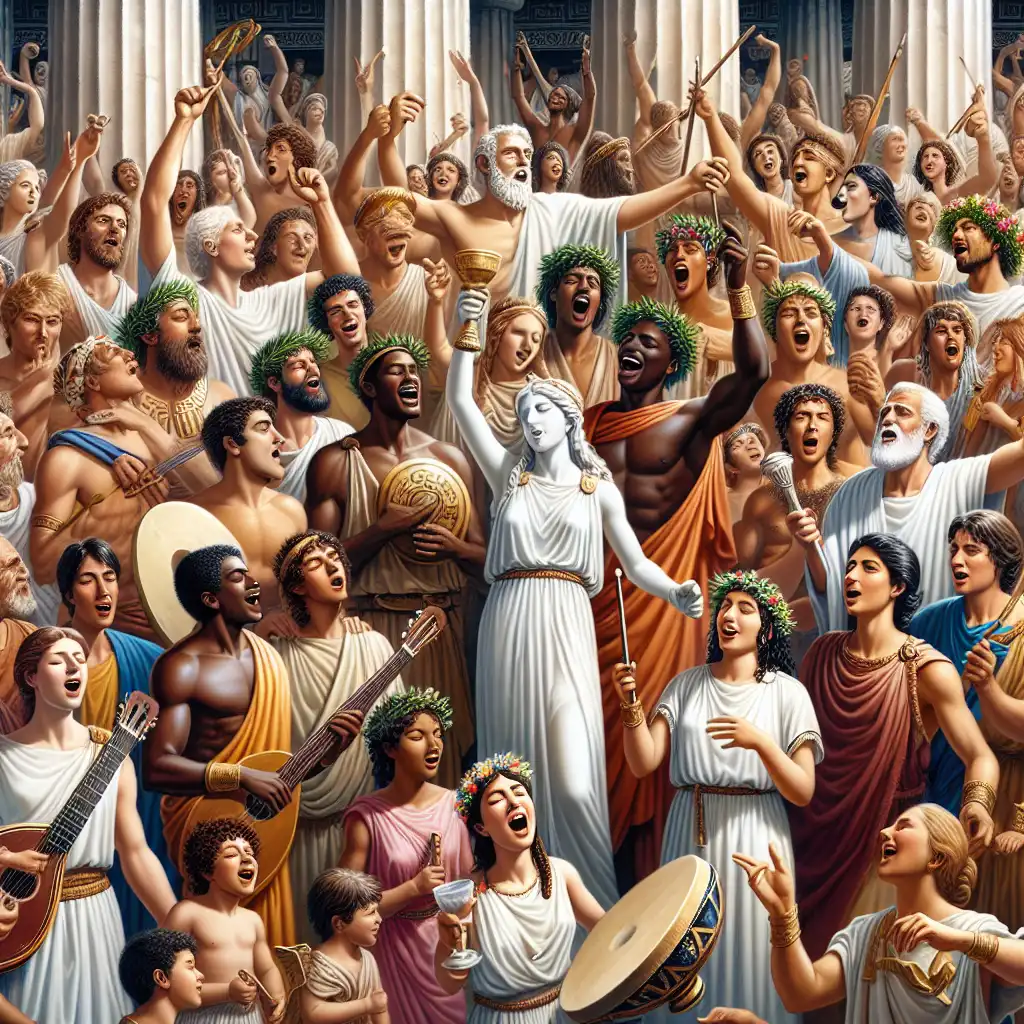
In ancient Greece, a song of thanksgiving or triumph
The people joined in the paean to celebrate the victory over the Persians.
No se pudo cargar el audio. Inténtalo de nuevo más tarde.
The word 'paean' usually means a song, speech, or a statement that shows high praise, joy or triumph. You can use it when you want to express your overwhelming happiness, joy, or admiration for someone or something. For example, you could say "We sang a paean (a song of praise) in honor of the hero who saved the day." You could also use it to describe a type of music that is full of cheerful celebration.
Acclamation refers to a loud expression of approval or praise, usually expressed by a group of people.
Acclamation describes a loud expression of approval, while paean describes a more formal expression of praise or thanksgiving.
Abrir palabra: Acclamation →Adoration and paean are two different words with similar meanings. Adoration refers to a deep and intense feeling of love, worship or admiration towards someone or something.
Both words are applicable in situations where someone wants to express their admiration towards someone or something, but adoration is more intense and personal, while paean is more formal and objective.
For example, you might express your adoration towards your favorite celebrity, but you might write a paean about their achievements and impact on society.
Abrir palabra: Adoration →Anthem and paean are both words that describe a type of celebratory song, but they have slightly different meanings.
An anthem is a song that represents a particular group or country and is usually sung at public events or gatherings. It often has a strong patriotic or nationalistic theme and is meant to inspire a sense of pride and unity among the people who hear it.
A good example of an anthem is "The Star-Spangled Banner," which is sung at the beginning of many events in the United States.
It can be used to celebrate an individual, group, or even a specific event. Unlike an anthem, a paean is not necessarily tied to a specific country or nationality.
An anthem is a song that represents a group or country and is meant to inspire pride and unity, while a paean is a song of praise or thanksgiving for a particular person, group, or event.
Abrir palabra: Anthem →Both eulogy and paean are words used to describe expressions of praise, but there are some differences in their usage.
A eulogy is a speech or piece of writing that is given at a funeral or memorial service in honor of someone who has died.
It is intended to celebrate their life and accomplishments, and to offer comfort to those who are grieving. Eulogies usually focus on the positive aspects of the person's character and achievements, and may include anecdotes or stories that illustrate their qualities.
Unlike a eulogy, it is not necessarily associated with death or mourning.
In short, eulogies are typically reserved for memorializing the dead, while paeans can be used to celebrate the living or the inanimate.
Abrir palabra: Eulogy →A hymn is a religious song that is typically sung in a place of worship such as a church, synagogue or mosque. It is a form of prayer that expresses devotion or praise to a deity.
In summary, while both hymns and paeans are songs of praise, hymns are religious in nature and sung in religious settings while paeans are not necessarily religious and can be used to celebrate any kind of success or triumph.
Abrir palabra: Hymn →An ode is a poem that celebrates a person, place, or thing in a formal and serious manner, often with elaborate language and structure.
It is typically shorter and more straightforward than an ode, and often focuses on celebrating a specific achievement or victory.
Both odes and paeans share the purpose of expressing admiration and appreciation, but odes tend to be more complex and reflective, while paeans are more direct and celebratory.
Odes are often used to honor historical figures, while paeans are more commonly associated with sporting events or military victories.
Abrir palabra: Ode →Paean refers to a song or poem praising or celebrating something or someone. It is more often used in a formal or literary context such as a piece of literature or during a formal ceremony.
Praise refers to expressing admiration or approval for someone or something, which can be done in any context, such as in everyday conversation, writing or even singing.
In simpler terms, paean is a more specific form of praise that is usually more formal and artistic than the usual praise that we give to someone.
Praise is a broader term that can be used in a wide variety of settings, whereas paean is typically reserved for more formal or literary contexts.
Abrir palabra: Praise →A tribute is an act, statement, or gift that demonstrates respect, gratitude or admiration.
A tribute can be given as a token of appreciation, recognition or remembrance.
So, in simple words, a paean is a song or hymn of praise while a tribute is an act or gift that expresses respect or admiration.
Paean is applicable in situations where there is a victory, joy or gratitude to be expressed while a tribute is applicable when you want to honor someone or something for their contributions, achievements or significance.
Abrir palabra: Tribute →A Rare Look at the...
Ver en YouTube ↗My biography of Frank Sinatra is not paean to his music but rather an illumination of the man behind the music, who once described himself as 'an 18-karat manic-depressive who lived a life of violent emotional contradictions with an over-acute capacity for sadness as well as happiness.
There's something almost adolescent about Whitman's paean to everything that was and remains good about America.