biologist
noun biologist
baɪˈɑːlədʒɪst
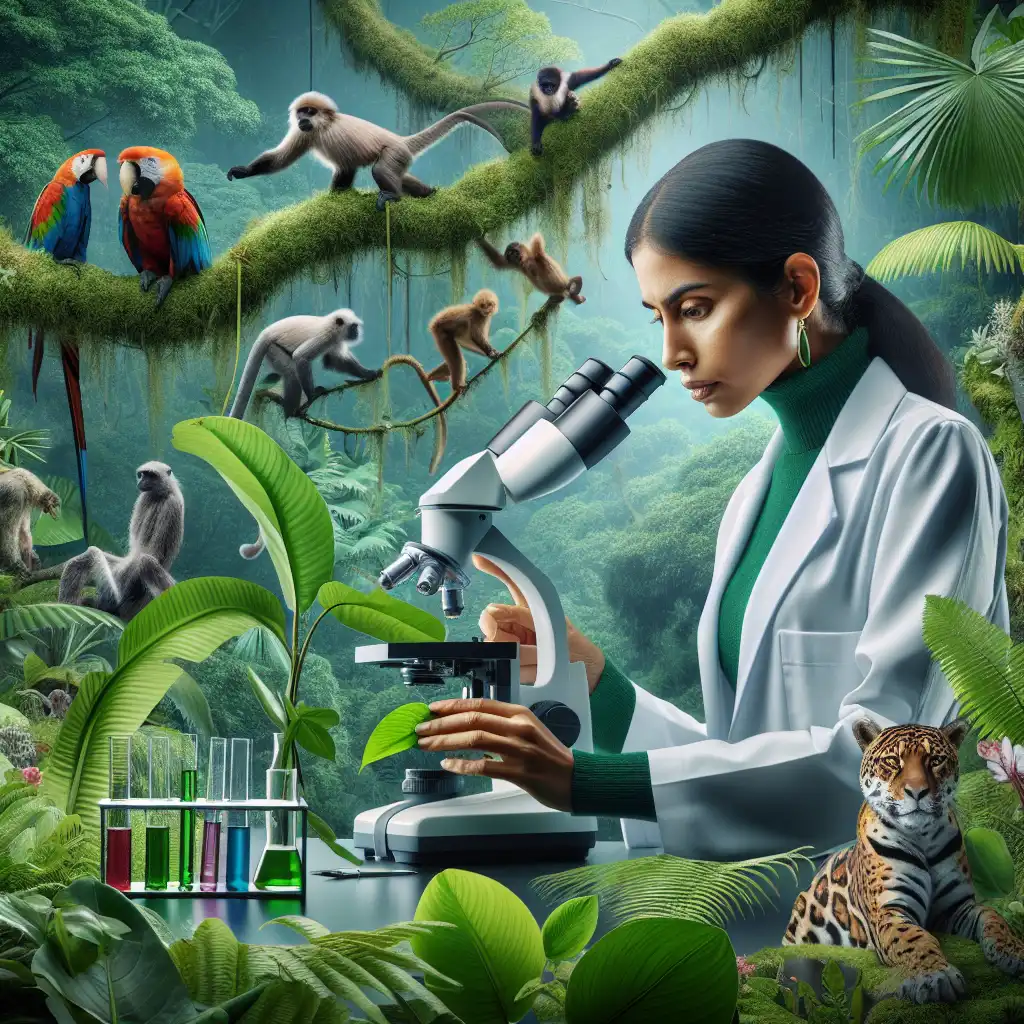
A scientist who studies living things, like plants and animals
The biologist examined the plant to understand its properties.
biologist
baɪˈɑːlədʒɪst
불러오는 중…
baɪˈɑːlədʒɪst
A scientist who studies living things, like plants and animals
The biologist examined the plant to understand its properties.

baɪˈɑːlədʒɪst
A person who studies biology at school or university but is not yet a professional.
She got a degree in biology and dreamed of becoming a biologist.
오디오를 불러오지 못했어요. 잠시 후 다시 시도해 주세요.
A biologist is someone who studies living things like plants, animals, and humans. They learn about the way different organisms work, how they interact with each other, and how to take care of them. Biologists are found in many different places, like universities, research labs, zoos, and wildlife conservation organizations. If you are interested in studying living things, then becoming a biologist might be the perfect job for you!
A botanist is a biologist who specializes in the study of plants. This includes their structure, growth, reproduction, and distribution.
Botanists may study a wide range of plant species, from tiny mosses to giant trees. They may work in fields such as agriculture, ecology, or botanical medicine.
So, while all botanists are biologists, not all biologists are botanists.
Biologists can specialize in a variety of areas, such as microbiology, ecology, or zoology, while botanists have a specific focus on the study of plants.
단어 열기: Botanist →An ecologist is someone who studies the relationships between living organisms and their environment, including the abiotic (non-living) factors like temperature, water, and soil quality.
While both biologists and ecologists have overlapping areas of interest, their focus and scope of study is different. Biologists are more concerned with the characteristics and structures of individual organisms, while ecologists are more interested in how organisms interact with each other and their environment.
단어 열기: Ecologist →An entomologist is a specialized type of biologist who studies insects. They explore the behavior, physiology, and ecology of different types of insects, as well as their relationships with humans and other animals.
Entomologists can work in a wide range of areas, including agriculture, public health, and conservation.
In summary, while both biologists and entomologists study living organisms, entomologists focus specifically on insects while biologists have a wider area of focus.
단어 열기: Entomologist →A zoologist is a specific type of biologist who focuses specifically on animals. Zoology is a branch of biology that deals with the study of animal behavior, physiology, and anatomy.
So, while all zoologists are biologists, not all biologists are zoologists.
A zoologist only studies animals.
Zoologists typically work in fields such as animal behavior, wildlife conservation and management, and animal welfare.
단어 열기: Zoologist →Anatomical structures, or physiological mechanisms with no apparent purpose present challenges to evolutionary biologists. Do such structures serve some hidden function that hasn't yet been discovered? Or are they relics of our evolutionary past, having once served some important purpose
YouTube에서 보기 ↗As a kid, I was going to be a marine biologist or an actor. When I became successful as an actor, I said, 'Well, maybe I can lend a voice to this with an equal passion.' You realize how lucky we are and how destructive we've been and what little regard we have for the natural world.
I'm a marine biologists professionally. I spent a lot of time at sea and have seen a large variety of different wildlife. This was absolutely definitely not a basking shark.
YouTube에서 보기 ↗I would be the worst biologist in the world!
and as a tree climber that's been extremely valuable and important to our project working on birds of paradise and so for me I was a biologist mostly working on birds of paradise that I could see from the ground or near the ground and there's a lot of them but there are plenty that I wouldn't have been able to have access to at all if it
YouTube에서 보기 ↗I weren't an actor, I'd be a wildlife biologist or forest ranger.
could not be explained by physics and chemistry -- that life had to be more than just mechanism. But people no longer think that. As biologists got on with the job of explaining the properties of living systems in terms of physics and chemistry -- things like metabolism reproduction homeostasis --
YouTube에서 보기 ↗I think that we scientists are seeking an understanding of the natural world. We come in various types - chemists and physicists and biologists and such - and we all have the same goal. We are making progress.
and then the product should come back right as it does in the natural world life is really good at this so there's a bunch of people biologists who study molting and who studies the shedding of
YouTube에서 보기 ↗Now I'm no biologist, but it seems to make a lot of sense that slow lives, as well as being enjoyable, are long lives. One only has to think of the example of the tortoise for proof of this theory from the animal world.
This little story highlights what biologists call the endosymbiotic theory, the current best explanation of how complex cells evolved. There's a lot of evidence that supports this theory, but let's look at three main pieces.
YouTube에서 보기 ↗Without even knowing why, we believe that to learn how to be human - which we have many years to do, for human beings have longer childhoods than any other species, a feature that to biologists and philosophers alike is one of our race's distinguishing characteristics - children must be surrounded by animal imagery.
or well coordinated legs for running if you're a fox. But what does this all have to do with evolution? Turns out biologists can use these various body symmetries to figure out which animals are related to which. For instance we saw that starfish and sea urchins have five-fold symmetry. But really what we should have said was
YouTube에서 보기 ↗I wanted to be a marine biologist when I was growing up and always wanted to be surrounded by wildlife.
leopard for years for years probably ever since i was a little kid when i first saw one i thought it was a picture of something that wasn't real a made-up animal and as you kind of dream of becoming a wildlife filmmaker and a biologist the snow leopard's pretty much the one animal that you really never think you're going to be able to see
YouTube에서 보기 ↗Anything that makes us take more seriously scientists - or economists or chemists or physicists or biologists - I think is helpful in times when things get distorted because of people not paying attention to all the facts.
and was believed to have died out during the same mass extinction event that wiped out the dinosaurs 65 million years ago. To biologists and paleontologists this creature was a very old and fascinating but entirely extinct fish forever fossilized.
YouTube에서 보기 ↗What I was concerned with was life: what are the major features that are common to all living organisms that subtly define life. So I looked at the whole problem as a chemist, as a biochemist, and as a molecular biologist.
So how did they accomplish this feat? Until recently marine biologists thought of larval fish as largely passive drifters, dispersed by ocean currents to distant locales. But in the last 20 years new research has suggested that larvae may not be as helpless as they seem,
YouTube에서 보기 ↗I just was mesmerized by all of this life everywhere I looked. And so I wanted to be a marine biologist.