bounce
verb bounce
baʊns
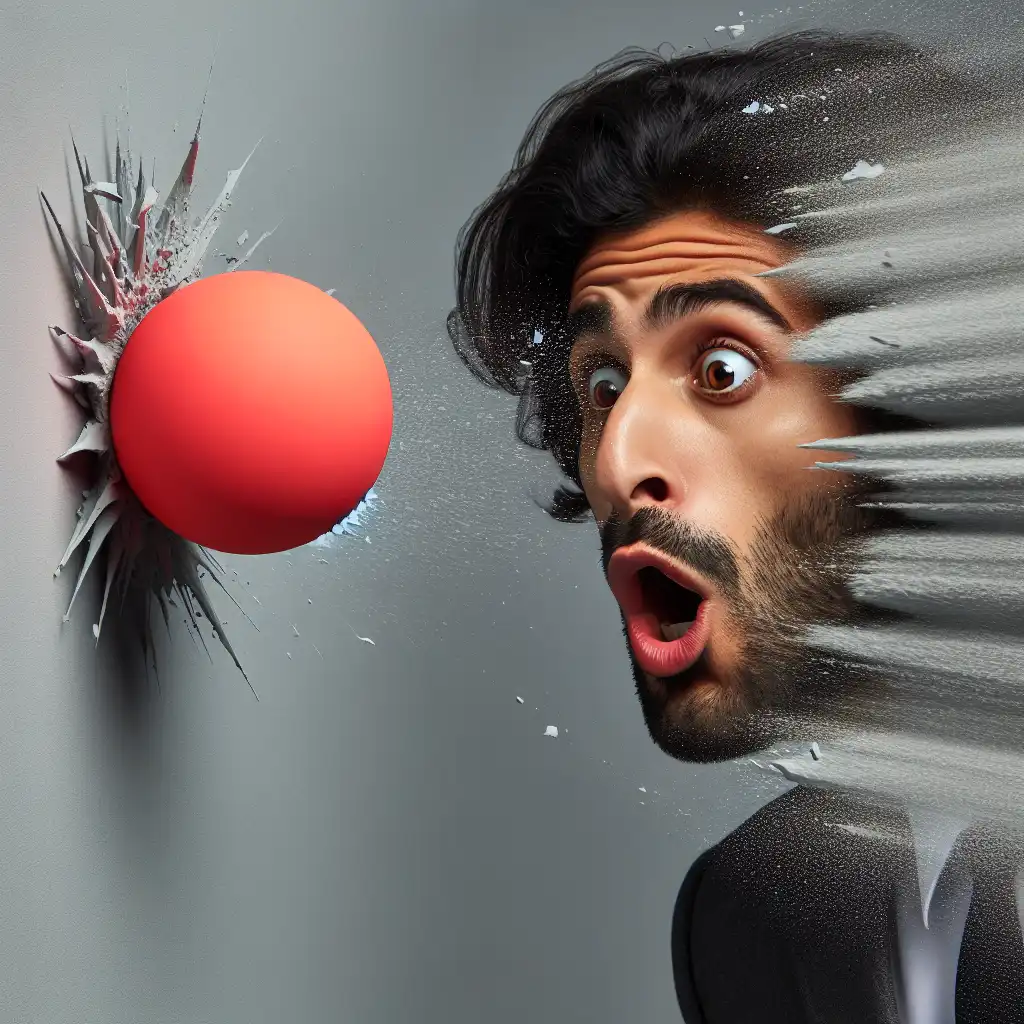
To move quickly back from a surface after hitting it
The ball bounced off the wall and hit him in the face.
bounce
baʊns
Đang tải…
baʊns
To move quickly back from a surface after hitting it
The ball bounced off the wall and hit him in the face.


baʊns
To force someone to leave a place
He was bounced from the club for unruly behavior.

baʊns
To send back an email because of an error
The email bounced because the recipient's inbox was full.
baʊns
A sudden increase or recovery
The economy had a bounce after the government introduced new policies.
Không tải được âm thanh. Vui lòng thử lại sau.
The word 'bounce' means to move up and down repeatedly, or to make something move up and down repeatedly. It can also mean to reject someone or something. For example, a ball bounces when you throw it on the ground. You can also bounce on a trampoline or a bed. When you send an email and it comes back to you, we say that the email has bounced. When someone asks you to do something and you say no, they may say that you bounced their idea. So, 'bounce' can be used to describe movement or rejection in different contexts.
Bound refers to a more general concept of movement, usually with a sense of purpose or direction. It suggests that something is moving in a particular direction, as if it were being propelled by some force.
For example, a deer might bound through a forest, moving quickly and purposefully in order to reach a particular destination.
Bounce refers to a specific type of movement that involves an object hitting a surface and rebounding, while bound refers to a broader concept of movement that suggests purpose and direction.
Mở từ: Bound →Carom describes when an object hits a surface and then deflects off at an angle. For example, in billiards, the cue ball may hit one ball and then deflect off at an angle to hit another ball.
Bounce is used when an object quickly springs back in the opposite direction after hitting a surface, while carom is used when an object deflects off at an angle after hitting a surface.
Mở từ: Carom →Hop refers to a small jump or a quick leap on one foot. It is mostly used to describe the movement of people or animals when they take a small jump or leap to move forward.
If you throw a ball, it will bounce back because of its flexibility while if you see a rabbit, it may hop away quickly on one foot to move around.
Mở từ: Hop →The words bounce and jump both refer to an upward movement, but they are different in how that movement occurs. Bounce refers to a movement that occurs when an object hits a surface, such as a ball bouncing off a wall.
Jump refers to a movement that occurs when a person or animal propels themselves upwards using their legs, like jumping over a puddle.
Bounce is used more for objects and jump is used more for people and animals.
However, there can be some overlap. For example, you might say that a basketball player jumped to catch a rebound, even though the ball bounced off the rim before they jumped.
Mở từ: Jump →Leap means to jump or spring a long way, to move quickly in one direction. For example, a dolphin leaps out of the water to grab a fish.
Mở từ: Leap →Both bounce and rebound refer to something springing back after being pushed or hit, but they have slightly different meanings.
Rebound, on the other hand, usually refers to the continuing motion after the initial bounce, like a ball bouncing up and down several times before coming to a stop.
Bounce refers to a single instance of springing back, while rebound implies a series of bounces or a more sustained bouncing motion.
Mở từ: Rebound →Both bounce and ricochet refer to the behavior of objects that hit a surface and then move away from it.
However, bounce is used when the object retains most of its original energy and continues to move in the same direction, while ricochet is used when the object changes direction after hitting the surface.
For example, if you throw a basketball at the ground, it will bounce back up in a straight line, which is a bounce. If you throw a tennis ball at a wall and it bounces off at an angle, that's a ricochet.
Bounce is used for a softer or more controlled impact, while ricochet is used for a harder or wilder impact.
Mở từ: Ricochet →The words bounce and skip both refer to the movement of objects, but there are key differences in their usage.
Skip typically refers to the action of an object moving along a surface and then briefly leaving that surface before returning to it.
For example, when you skip a stone across a pond, it bounces several times before sinking.
Skip can also refer to a physical motion or movement, such as skipping rope or skipping a step on a staircase.
Bounce usually involves a single rebounding action, while skip involves a repeated action of leaving and returning to a surface.
Mở từ: Skip →Spring refers to the action of an object returning to its original shape after being pushed or pulled. For example, a spring returns to its original shape when compressed or stretched.
Spring usually describes the force of elasticity or tension that allows objects to be stretched or compressed without breaking.
Bounce is applicable when an object rebounds off a surface with force, while spring is applicable when an object returns to its original shape after being stretched or compressed.
Mở từ: Spring →But that's far from empty. There's still plenty of matter bouncing around. Manufacturers rely on more thorough sealed vacuums for all sorts of purposes. That includes vacuum-packed food that stays fresh longer, and the vacuums inside early light bulbs that protected filaments from degrading.
Xem trên YouTube ↗The trouble with writing for the web is that writing is about getting people to forget they're reading. Anything that reminds them they are reading, or which annoys or distracts them, bounces them out of the world. And the web, it seems to me, is all bounce. A very, very difficult medium to write for.
birds are developing their feathers there are tiny bubbles of water that help push the feather out and what happens is is the water evaporates leaving holes in the feather now wavelengths travel down from the sun they bounce off in these little holes and depending on the type of wavelength
Xem trên YouTube ↗I don't believe in a recipe for success. You have to work hard; you may not always get it right - you have to bounce back from situations, and you have to be really focused and determined. It's important to have fun as well. Work shouldn't be a torture.
this is an awe-inspiring story of how if given the chance nature can bounce back on a scale you're not going to believe my name's bertie gregory and i'm a national geographic wildlife filmmaker this is resurrection island
Xem trên YouTube ↗I've been very lucky in life; you really don't get to a position that I'm fortunate enough to be in without the ball bouncing your way a couple times.
But that's really only half of the story. The real story is that the computer is on one side, making suggestions to the robot, and on the other side are the physics of the world. And that physics involves gravity friction bouncing into things.
Xem trên YouTube ↗It's really helpful to have somebody to bounce off of and that will say, 'Yeah, that's a horrible idea. You shouldn't do it.
been on the show I have come to the conclusion that every single one of my good entrepreneurs who haven't lost me money have the same six characteristics in common and so I'll share those traits with you number one resilience the ability to bounce back they are the kind of people that when they take a hit they
Xem trên YouTube ↗You can't really hit on grass. There are lots of bad bounces, so when the guy plays deep into the spot where the grass has been worn down and he doesn't leave you the time to play, you don't have time to play fast yourself.
we're not seeing most of the action that's going on. So take the colors of our world. This is light waves electromagnetic radiation that bounces off objects and it hits specialized receptors in the back of our eyes.
Xem trên YouTube ↗I kind of prefer bouncing back and forth between theater and films. It's like having the best of both worlds, both very different experiences.
as the dark universe, made of dark matter and dark energy. How do we know this? Well we know because we look at things and we see them. That might seem rather simplistic, but it's actually quite profound. All the stuff that's made of atoms is visible. Light bounces off it and we can see it.
Xem trên YouTube ↗As an actor, you get to sort of bounce back and forth in terms of the age range you play and the life experience that your characters have.
This is one of the best-known phenomena in the quantum world, quantum tunneling. The box on the left shows the wavelike spread-out distribution of a quantum entity -- a particle like an electron, which is not a little ball bouncing off a wall.
Xem trên YouTube ↗I think it's just important to be always bouncing between TV and theater, and hopefully I'll get to do movies at some point.
There's a lot of abrasion on these wires little bits of metal sticking up. They're just the sort of thing that would cut through rope really easily especially if we start bouncing on this thing as we're descending. So I reckon if we put over the top of that. That is a very improvised rope protector.
Xem trên YouTube ↗You've got a great chance in college to do all sorts of terrible irresponsible things, and you should totally do them. I mean, make huge mistakes. This is the time in your life if you screw up, it's okay because you can bounce back from it.
or how many might happen in the future. Each bounce would wipe away any record of the universe’s previous history. Which one of those scenarios will be the real one? The answer depends on the exact shape of the universe, the amount of dark energy it holds,
Xem trên YouTube ↗The doctors have said that they don't want me in the ring bouncing around or getting picked up and slammed down. They said the old head just can't survive anymore trauma.