Audio could not be loaded. Please try again later.
How to use
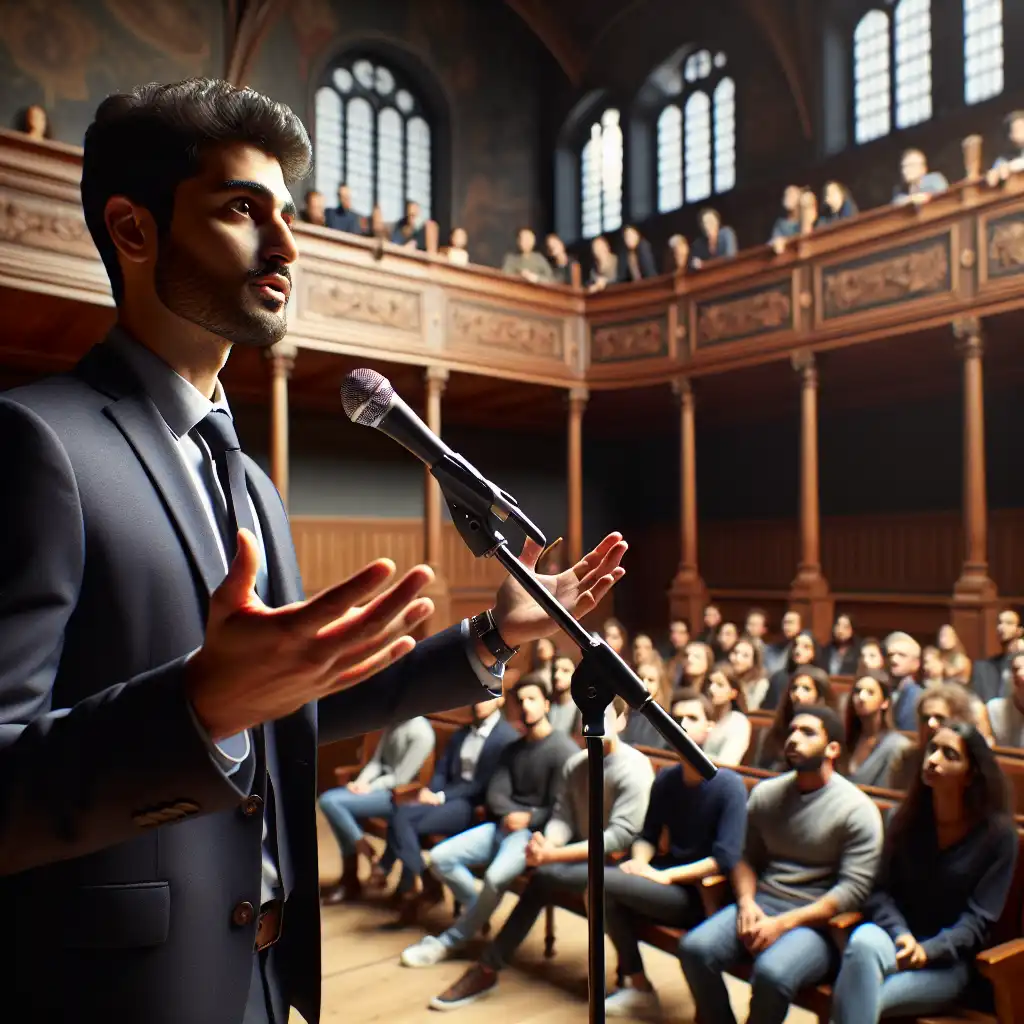
Elocution is a word used to describe the way someone speaks or reads out loud. It's used to talk about things like speech delivery, pronunciation, and tone. You might hear the word "elocution" used in a class about public speaking or in a conversation about someone's speaking skills. If you want to sound more clear and confident when speaking, learning how to improve your elocution can help!
Articulate refers to the clarity and effectiveness of one's speech or expression, while elocution specifically refers to the skill or art of clear and effective public speaking.
Articulate can be used in many contexts where one's ability to communicate clearly is important, such as in writing, conversation, or presenting ideas.
Articulate is a general term for clear communication, while elocution specifically refers to the art of public speaking.
Delivery refers to the way something is presented, such as a speech or a package being sent to someone.
It can involve factors such as tone of voice, body language, and speed of speech. Delivery is used in a variety of contexts, from public speaking to shipping items.
Delivery refers to the overall presentation of something, while elocution specifically focuses on speech and pronunciation.
Diction refers to the choice and use of words and phrases in speech or writing, while elocution involves the way that words are spoken, including pronunciation, intonation, and emphasis.
Diction is applicable when considering the meaning and effectiveness of language, including how certain words and phrases may impact a listener.
Diction deals with the words themselves, while elocution deals with how those words are spoken or expressed.
Expression refers to the conveying of emotions, feelings, or opinions through nonverbal communication such as facial expressions, body language, tone of voice, and written or spoken language.
Elocution relates specifically to verbal communication, while expression encompasses all forms of communication, verbal and nonverbal.
Oratory refers to the art of persuasive public speaking. It focuses on the communication of ideas in a persuasive and compelling way and is often used in political and social contexts.
Oratory requires the effective use of language and rhetorical devices such as metaphor, repetition, and emotional appeals.
Elocution is concerned with the technicalities of speaking, while oratory is more about the art of persuasive communication.
Pronunciation refers to the accuracy with which a person speaks or utters sounds of words. It is the way in which consonants, vowels and stress are pronounced in a language, and is applicable to everyday conversation.
In simpler terms, elocution focuses on how you say something, while pronunciation focuses on saying the right thing the right way.
Elocution is applicable in formal settings, while pronunciation is relevant in daily communication.
It is often used to refer to public speaking and speech delivery. Rhetoric refers to the art of using language effectively to persuade or influence others.
It involves techniques like using logic, emotional appeals, and figures of speech to make an argument. Rhetoric is applicable in many areas, such as politics, advertising, and literature, while elocution is more specific to public speaking and communication.
It is often used in contexts such as public speaking, theater, and debating. Elocution focuses on the delivery of a message or speech, emphasizing the techniques and style of speaking.
Speech refers to the act of expressing oneself through spoken words, whether for communication, persuasion, or entertainment.
Speech can be informal or formal, and it can be delivered in various settings, such as in conversations, lectures, or presentations.
Elocution is a more specific term that refers to the technique of speaking, while speech is a broader term that refers to the act of using spoken language to convey a message.
We were quite a middle class family, but we had access to all the good things in life, be it books or access to a club. I was outgoing and did a lot of elocution, singing and theatre.
I never took any elocution lessons, no diction lessons. I might have been a pretty decent broadcaster if I had, but what you see, I'm afraid, is what you get.
We have this wonderful language and we don't appreciate it. That's old-fashioned me, but when I went to school, everyone had elocution lessons, not to sound posh but so you could be understood.
Take some elocution lessons; you can joke with Ebonics, but the truth is, nothing beats the King's English. Learning how to speak properly, and the art of delivery can take you very far in life!
I was the first and only person in my family to go to university, and I spent two decades redesigning myself: even my voice is the product of elocution lessons.
My family was going back to England to visit my mother's grandmother, who was very ill. We went up to Liverpool and I met my great-aunt, who was just a force of nature. She was an elocution teacher and a huge enthusiast for theater and the classics. I took her amateur acting class, and she was really impressed with me.