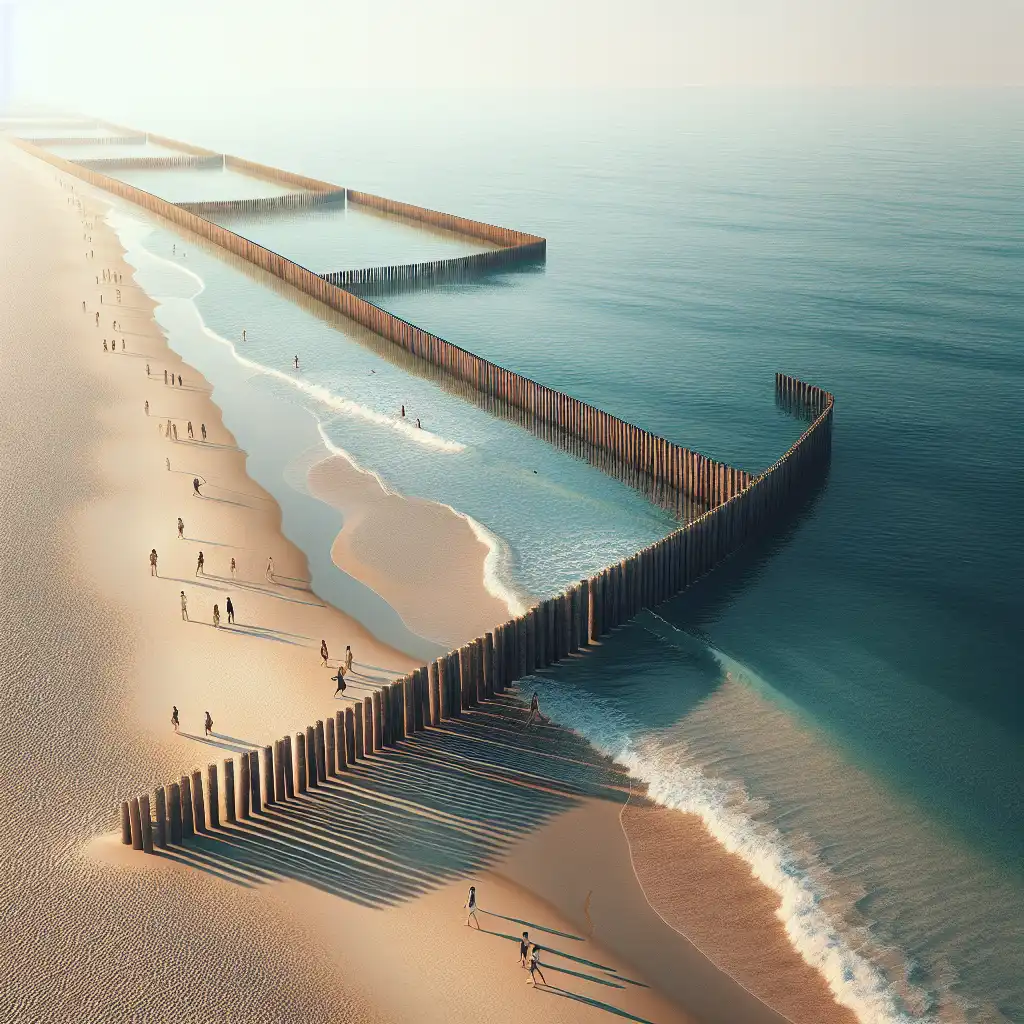
groyne
noun groyne
ɡrɔɪn
A barrier built at a right angle to the beach to reduce erosion.
The council decided to build a groyne to prevent the beach sand from washing away.
groyne
ɡrɔɪn
लोड हो रहा है…
ɡrɔɪn
A barrier built at a right angle to the beach to reduce erosion.
The council decided to build a groyne to prevent the beach sand from washing away.
ऑडियो लोड नहीं हो सका। कृपया बाद में फिर कोशिश करें।
A groyne is a structure made of rocks or concrete that juts out into the ocean or a river. Groynes are built to stop sand and other materials from being carried away by the water currents. They can be found along beaches, harbors, and riversides.
A barrier is something that blocks or stops movement or progress, like a fence or a wall.
It is typically used to prevent something unwanted from entering an area or to protect something valuable. For example, a barrier might be used to keep vehicles from entering a pedestrian walkway or to prevent flooding in a river.
A barrier is used to block movement or protect something valuable, while a groyne is used to control erosion and stabilize a shoreline.
शब्द खोलें: Barrier →Both breakwater and groyne are structures built in coastal areas to protect the shore from erosion caused by waves and currents.
A breakwater is a long wall built parallel to the coast or at a right angle to it, extending into the sea, and designed to break the force of waves before they hit the shore.
Breakwaters are typically made of concrete, rock or other materials and can be found in ports, harbors and marinas. They create calm waters behind them, providing shelter to boats and ships.
A breakwater is a large structure designed to protect a harbor or marina by breaking the force of waves before they hit the shore, while a groyne is a smaller structure designed to trap sand and prevent erosion on beaches.
शब्द खोलें: Breakwater →A bulkhead is a wall or partition used to divide or separate parts of a ship, aircraft, or building.
A bulkhead is a wall or partition that separates parts of a structure, while a groyne is a structure that is built on the beach to prevent beach erosion.
शब्द खोलें: Bulkhead →A causeway is a raised path or road that is built across water or marshy land to create a pathway or bridge.
A causeway is typically used to connect one area of land to another and is often made of concrete or stone.
A causeway is a raised path or road that connects two areas of land across water or marshy land, while a groyne is a structure built perpendicular to the shore to trap sand and prevent beach erosion.
शब्द खोलें: Causeway →A dam is a structure built across a river or stream to hold back or control the flow of water. It stores and releases water, and it's used for generating hydroelectric power.
A dam is applicable in areas where a large volume of water needs to be stored, for example, to prevent flooding, generate power or irrigation.
शब्द खोलें: Dam →An embankment is a raised structure like a wall or a mound of earth built to prevent flooding or hold back water.
In simple terms, embankments are used to protect settlements or land from water, whereas groynes are used to protect the beach from erosion.
शब्द खोलें: Embankment →Both a groyne and a jetty are structures built extending into a body of water, but they are used for different purposes.
A jetty is a structure built parallel to a shoreline and is designed to protect a harbour or marina from waves, currents, and sedimentation.
Jetty's are usually made of concrete or other materials, and can be quite large, often including berthing facilities, warehouses, or other infrastructure.
Overall, groynes are used to prevent erosion of the beach, while jetties are used to protect harbours or marinas from waves and sedimentation.
शब्द खोलें: Jetty →A pier is a structure built over water that extends from the shore. Piers are typically used for recreational purposes such as fishing, sightseeing or docking boats.
They can also be used for commercial purposes such as loading and unloading cargo from ships. Piers are usually made of wood or concrete and often have a deck, railings and other amenities for visitors.
In summary, groynes are used to prevent erosion and build up beaches while piers are used for recreational or commercial purposes over water.
शब्द खोलें: Pier →