
verbalize
verb verbalize
ˈvɜːrbəlaɪz
To express feelings or thoughts in words.
She found it difficult to verbalize her feelings.
verbalize
ˈvɜːrbəlaɪz
Chargement…
ˈvɜːrbəlaɪz
To express feelings or thoughts in words.
She found it difficult to verbalize her feelings.
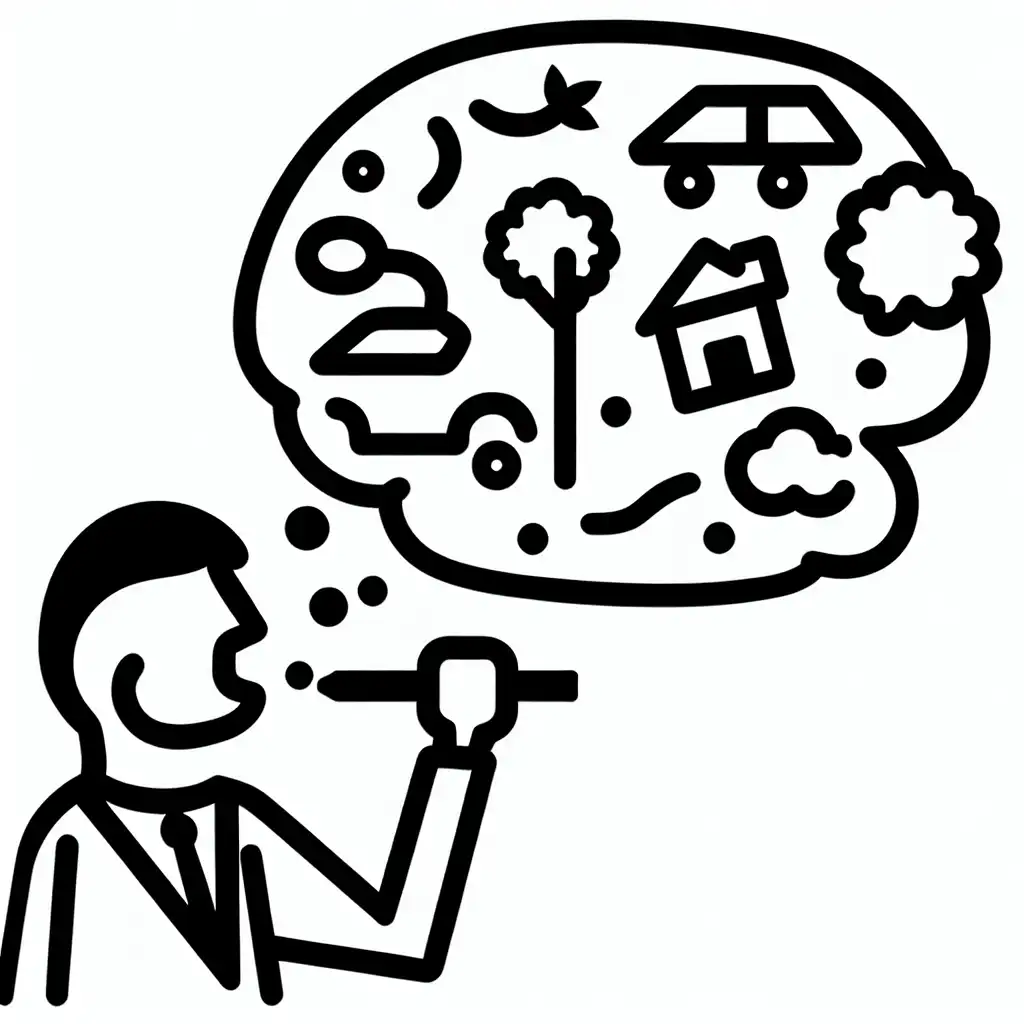
ˈvɜːrbəlaɪz
To use words to represent or describe something.
Can you verbalize what you're attempting to show here?

ˈvɜːrbəlaɪz
To speak, especially to speak using particular words.
He verbalized his disagreement with the decision.

ˈvɜːrbəlaɪz
To change a written word or phrase so it can be spoken or used in speech.
He can visualize a concept but struggles to verbalize it.
Impossible de charger l’audio. Réessayez plus tard.
The word 'verbalize' means to express your thoughts or feelings by speaking or using words. For example, if you have an idea in your mind, you can verbalize it by saying it out loud. It can also mean to communicate in words, such as when you need to explain something to someone or give instructions. So, you would use the word 'verbalize' when you want to talk about expressing yourself using words or putting your thoughts into words.
Articulate means to express thoughts or ideas clearly and effectively in speech or writing. It implies having a good command of language and being able to convey information fluently.
In summary, while articulate refers to the ability to express oneself clearly and effectively, verbalize simply refers to the act of putting thoughts or ideas into words.
Articulate is applicable when referring to someone's communication skills, and verbalize can be applicable in any situation where words are used to express ideas or thoughts.
Ouvrir le mot: Articulate →Enunciate means to pronounce words clearly and distinctly.
For example, a teacher might ask a student to enunciate their words so the class can hear them better.
So, while both words have to do with speaking, enunciate is more about how you say something, while verbalize is more about what you are saying.
Enunciate is applicable when speaking clearly is important, while verbalize is applicable when expressing yourself is important.
Ouvrir le mot: Enunciate →Express refers to conveying a thought or feeling through words, actions, or other forms of communication.
It can be used in any situation where you want to convey something to another person, such as expressing your love for someone or expressing your ideas in a meeting.
To simplify the explanation, express means to communicate something while verbalize means to put thoughts or feelings into words.
Ouvrir le mot: Express →Pronounce means to articulate or speak a word or phrase correctly, while verbalize means to express an idea or feeling in words, whether it be spoken or written.
Pronounce refers to saying a word correctly while verbalize refers to expressing thoughts or emotions through language.
Pronounce is applicable when learning new words and trying to say them correctly, for example in language classes. Verbalize is applicable when expressing thoughts, feelings, or opinions in conversation or writing, for example when writing an essay or having a discussion with friends.
Ouvrir le mot: Pronounce →Both say and verbalize refer to expressing something through spoken words.
However, say is a more common and general term that can be used in any context, while verbalize is a more formal term that is often used in academic or therapeutic contexts to emphasize the act of putting thoughts or emotions into words.
So, for example, you might say "I didn't hear what you said" in a casual conversation, but in a therapy session your therapist might ask you to verbalize your feelings in order to better work through them.
Ouvrir le mot: Say →State means to express or declare something, usually in a formal or official way. For example, a politician might state their position on a particular issue during a speech.
Verbalize means to express something in words, either spoken or written. It implies that the expression is more open to interpretation and informal than a state.
State is more formal and official, while verbalize is more informal and open to interpretation.
Ouvrir le mot: State →Utter means to give audible expression to something, such as speaking or making a sound. It is applicable in situations where someone is speaking, making noises or vocalizing.
Utter refers to making sounds or speaking, while verbalize refers to expressing something in words.
Ouvrir le mot: Utter →Vocalize means to make a sound with your voice.
Verbalize is used when referring to the act of expressing thoughts or ideas in words, while vocalize is used when referring to the act of producing sounds with your voice.
Ouvrir le mot: Vocalize →How bees can keep the...
Voir sur YouTube ↗I'm not sure when exactly I knew I was funny, but I always knew I was different. I never had an 'edit' button and would say whatever came into my head. Most of the time, what came out of my mouth was the very thing everyone else was thinking - but too polite or afraid to verbalize.
Storytellers Summit Day...
Voir sur YouTube ↗I am an actress - I am paid to verbalize other people's words, not create my own.
The world goes on, you go on and you change. You want to show the fans those changes, and you want to be able to verbalize them.
Music is feeling. You can try to verbalize it. It really just hits you or it doesn't.
The more words I learned, the more I started to verbalize my feelings. Whenever my mom or dad would compliment me by saying something like 'Good boy,' I'd immediately correct them. 'No. Good girl.
If you're ever struggling for something to say, just take a noun and verbalize it. Using simple words in new and interesting ways will creativize your presence.
Yes. I get scared sometimes if I don't know when a physical sensation is going to go away. For example, if I get a chest pain it's grandpa trying to say 'heart attack' and I verbalize 'grandpa had a heart attack' and the pain goes away. But there's sometimes that I'll verbalize and the pain is till there, and then it doesn't go away.
Sometimes, you just have to follow your heart and can't verbalize why you feel a certain way.
I never learned to verbalize an abstract musical concept. No thank you. The whole point of being a serious musician is to avoid verbalization whenever you can.
As far as 'Jane Pittman,' I don't know that I could verbalize, to this day, what I felt once I got into that role. I did a tremendous amount of research. I need to feel as though I am in the person's skin.