comet
noun comet
ˈkɑːmɪt
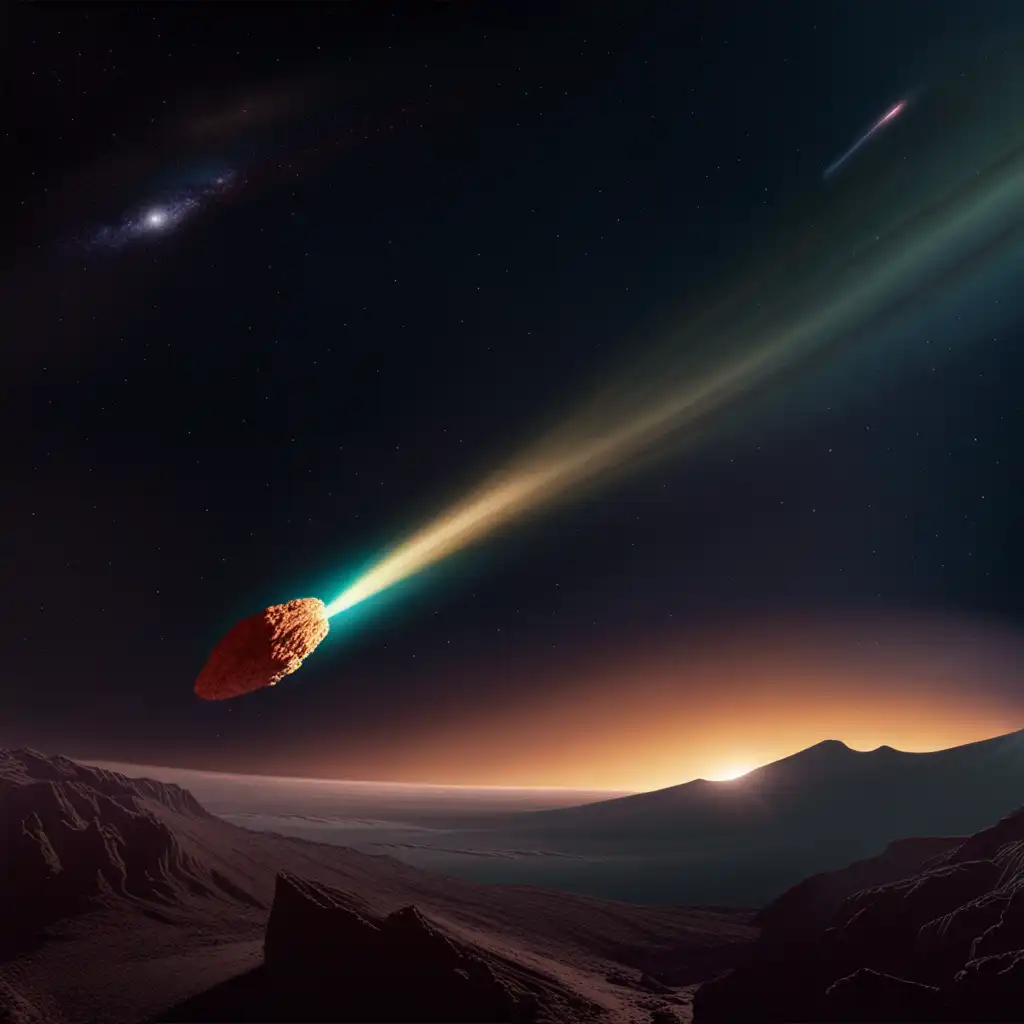
A heavenly body or ball of ice and rock that moves in space and often has a tail of light.
We are waiting for the comet to pass by earth.
comet
ˈkɑːmɪt
読み込み中…
ˈkɑːmɪt
A heavenly body or ball of ice and rock that moves in space and often has a tail of light.
We are waiting for the comet to pass by earth.
音声を読み込めませんでした。しばらくしてからもう一度お試しください。
A comet is a celestial object that is made up of ice and dust. It travels around the sun in a long, oval-shaped orbit. When it gets close to the sun, the ice and dust start to melt and create a glowing tail behind it. Comets are named after the scientists who discover them or the observatory that spotted them first. Comets are sometimes visible to the naked eye, and people can watch them fly across the sky.
Asteroids are small, rocky objects that orbit the sun, mostly in a belt between Mars and Jupiter. They are made of metals and rocks and do not have a tail.
In summary, asteroids are rocky and do not have a tail, while comets are made of ice, dust, and rocks and have a tail.
単語を開く: Asteroid →A meteor is a small and rocky object that enters the Earth’s atmosphere from space. Meteors are often called shooting stars as they appear as streaks of light in the sky.
If the meteor doesn't burn up entirely during its entry, its remaining fragments can fall to the Earth and are known as meteorites.
A comet is a celestial body that orbits the sun and has a long glowing tail, while a meteor is a rock that enters Earth’s atmosphere and appears as a streak of light.
単語を開く: Meteor →Appearing throughout historical records, these mysterious lights that came out of nowhere and disappeared after a short while were thought to be ill omens of war and famine, or the wrath of gods. But recent research has revealed that comets may be even more deeply connected
YouTube で見る ↗Small bodies in our solar system, like comets and asteroids, help us understand how the solar system formed and provide opportunities to advance exploration.
To escort and land the probe on a comet, this has been my passion for the past two years. In order to do that, I need to explain to you something about the origin of the solar system. When we go back four and a half billion years, there was a cloud of gas and dust.
YouTube で見る ↗For most of the history of our species we were helpless to understand how nature works. We took every storm, drought, illness and comet personally. We created myths and spirits in an attempt to explain the patterns of nature.
asteroids and comets are leftovers from the birth of the solar system a cosmic rubble pile that humans used to write off as barren and uninteresting they were more interested in big things like planets but not anymore astronomers have huge questions about how we got here like why does earth have water and life and how
YouTube で見る ↗I'm going to set up a foundation for the world. I'm going to take the money and start building cities all over the world. I'm a comet.
and they look a lot like these microbial tubules we also study impact craters these are observed on every planetary body in the solar system and they're created when an asteroid or comet hits the planet or a moon they have a very
YouTube で見る ↗Just as the system of the sun, planets and comets is put in motion by the forces of gravity, and its parts persist in their motions, so the smaller systems of bodies also seem to be set in motion by other forces and their particles to be variously moved in relation to each other and, especially, by the electric force.
dinosaurs disappeared you know somewhere on earth a very big impact must have happened by an asteroid or a comet in fact there was so much iridium scientists realized the asteroid must have been a staggering 10 kilometers in diameter
YouTube で見る ↗I've had experiences in my life that leave no doubt in my mind about the fact that God exists. I'm quite willing to debate people who don't think so because I want them to explain to me how did our solar system get so organized and how is the universe so complex and yet well-organized that we can predict 70 years hence when a comet is coming?
being the first planet to form, attracted and destroyed space debris that would've helped the other planets grow in size. Today that force may serve as a shield by attracting comets and asteroids onto Jupiter's own surface,
YouTube で見る ↗Most people have already seen a cosmic collision. If you've seen a shooting star ever, you've seen a cosmic collision, because a shooting star is not a star. It's a tiny dust or pea sized fragment of an asteroid or a comet hitting our atmosphere and burning up as it hits in, as it comes in.
Abiogenesis -- the creation of life from nonlife -- that's the second barrier. The basic building blocks of life aren't unique to amino acids have been found in comets, complex organic molecules in interstellar dust clouds, water in exoplanetary systems.
YouTube で見る ↗It was not an asteroid or comet, because it would have killed everything.
And so somebody else said, well how about a huge swarm of comets that are passing by this star in a very elliptical orbit? Well it ends up that this is actually consistent with our observations.
YouTube で見る ↗I have worn myself thin trying to find out about this comet, and I know very little now in the matter.
potentially dozens of dwarf planets at least 170 moons and countless comets and asteroids Without the sun's gravity these celestial bodies would drift off into deep space
YouTube で見る ↗It shouldn't be so difficult to determine what a planet is. When you're watching a science fiction show like 'Star Trek' and they show up at some object in space and turn on the viewfinder, the audience and the people in the show know immediately whether it's a planet or a star or a comet or an asteroid.
above human the reason that the comet was the indicator was that it was something that you could see anywhere in the world and he felt that the next level would give him a sign in that way
YouTube で見る ↗Animal Kingdom' is a significant comet, and it's cast a tail. It's very hard to see anything post that happening without that.