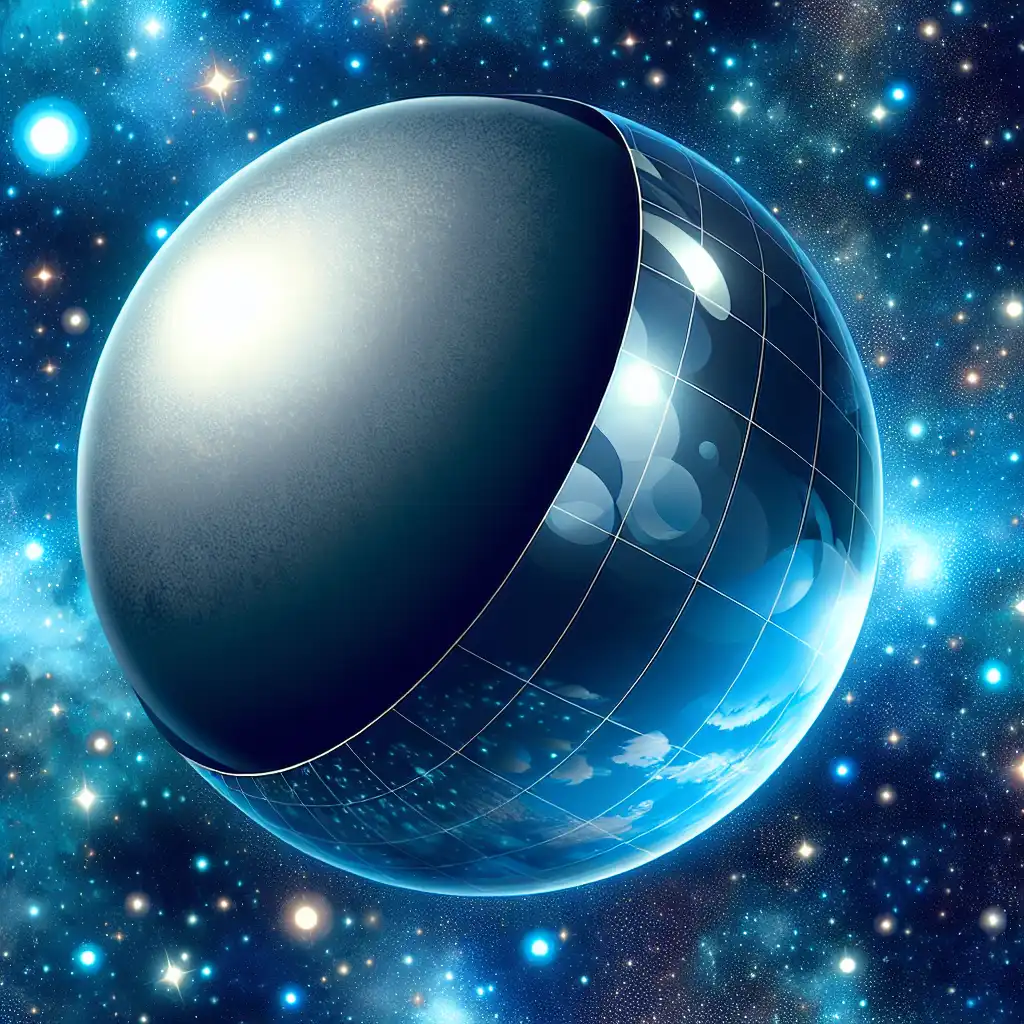
spherical
adjective spherical
ˈsfɪrɪkl
Shaped like a sphere (a perfect round object)
The planet Earth is not perfectly spherical, it's actually an oblate spheroid.
spherical
ˈsfɪrɪkl
Loading…
ˈsfɪrɪkl
Shaped like a sphere (a perfect round object)
The planet Earth is not perfectly spherical, it's actually an oblate spheroid.

ˈsfɪrɪkl
Connected with or relating to a sphere (mathematics)
Spherical geometry is a type of geometry that studies spheres and their properties.

ˈsfɪrɪkl
Belonging or relating to the celestial sphere (Astronomy)
Stars appear to be located on the inner surface of a spherical shell.
Audio could not be loaded. Please try again later.
The word 'spherical' means round like a ball or sphere. You can use it when describing objects that are round and three-dimensional in shape, like planets, balloons or marbles. For example, "The Earth is a spherical planet" or "She rolled a spherical ball towards me". It is important to use this word in the right context so people understand what you are talking about.
Bulbous and spherical are both words used to describe shapes, but they are slightly different. Bulbous refers to a shape that is round and plump, like a bulb or a balloon.
Bulbous is typically used to describe organic shapes, like plants or animals, that have a rounded and slightly flattened appearance.
Bulbous is more rounded and plump while spherical is perfectly round in shape. The words are used to describe different types of shapes, depending on what you are talking about.
Open word: Bulbous →Circular refers to a two-dimensional shape that is round and flat, like a circle.
Circular is used when we're talking about something that is flat and round, while spherical is used when we're talking about something that is round in all directions.
Open word: Circular →Curvilinear means something that is made up of or characterized by curved lines or curves. This could refer to shapes like a curved line on a graph or a curved road.
Curvilinear describes two-dimensional objects that exhibit curved lines, while spherical describes three-dimensional objects that are shaped like a sphere.
Open word: Curvilinear →The words globular and spherical both describe shapes that are round like a ball, but they are not exactly the same.
Globular usually describes shapes that are somewhat round, but not perfectly round like a sphere. Imagine a ball of yarn or a cluster of grapes - these are globular shapes.
So if something is perfectly round, you would use the word spherical to describe it. But if something is round, but also a bit lumpy or irregular, you would use "globular.".
Open word: Globular →Hemispherical means half-spherical, or shaped like half of a ball. It is applicable when describing objects that have a rounded shape that is cut in half, like a dome or a bowl.
To sum up, spherical refers to perfectly round objects while hemispherical refers to objects that are rounded but cut in half.
Open word: Hemispherical →Rotund and spherical both refer to something that is round, but the difference between them is the way they are round.
Rotund describes something that is round and plump or fat, usually referring to people or animals. Spherical describes something that is perfectly round, like a ball or globe, with no flat or uneven parts.
If you want to describe a person or animal that is round and chubby, you would use rotund, but if you want to describe a perfectly round ball or planet, you would use spherical.
Open word: Rotund →Round means something is circular or shaped like a circle, and can refer to any objects that have a circular shape.
For example, a basketball can be described as round because it has a circular shape, but it is not spherical because it has raised bumps on its surface.
A globe is both round and spherical because it is a perfect ball shape with no bumps or irregularities.
Round is a more general term that can apply to a wide range of shapes, while spherical is a more specific term that only applies to a perfectly round, ball-like shape.
Open word: Round →Spheroid refers to a shape that is similar to a sphere, but with flattened or elongated poles, like an egg or a rugby ball.
Spheroid is applicable in situations where something needs to resemble a sphere but needs to take into account the flattening or elongation at the poles, like modeling the shape of the earth or other planets.
Open word: Spheroid →Wombats Poo Cubes! %\PIPE%...
Watch on YouTube ↗First of all, we must note that the universe is spherical.
Solar System 101 %\PIPE%...
Watch on YouTube ↗Bubbles are round for the same reason that planets are spherical. The universe itself is like bubbles.
Exploring other...
Watch on YouTube ↗If you're in a motion-capture studio, you have spherical, reflective markers, which are picked up by cameras that emit infrared - it reflects it, and then the cameras pick up the data.
Tomás Saraceno: Would...
Watch on YouTube ↗Karl Pilkington has the roundest head, I think, in the world. It's not technically a deformity, but I've never seen anything quite that spherical.
Photosynth 2: Exploring...
Watch on YouTube ↗While American football is very structured and linear and static - where everyone lines up, and there's a burst, and it happens - soccer is like the cosmos. It's like constellations. It's bodies moving in space. It's a very spherical game.
How simple ideas lead to...
Watch on YouTube ↗GoPro's capture devices and Kolor's software will combine to deliver exciting and highly accessible solutions for capturing, creating, and sharing spherical content.
Margaret Wertheim: The...
Watch on YouTube ↗I was not allowed to take spherical trigonometry because I'd sprained my ankle. Because I'd sprained my ankle, I had an incomplete in gym, phys ed. And the rule was that if you had an incomplete in anything, you were not allowed to take an overload.
Sophisticated Mountain...
Watch on YouTube ↗Math education has changed over the years. In the 19th century, they taught spherical trigonometry because one of the biggest applications of mathematics was navigating the ocean. This is no longer so relevant.
Humanity's Search for...
Watch on YouTube ↗My cerebral cortex, the gray matter that MIT neuroscientist Steven Pinker likens to 'a large sheet of two-dimensional tissue that has been wadded up to fit inside the spherical skull,' is riddled instead of whole.
Graham Hawkes: Fly the...
Watch on YouTube ↗In 1880 at the Military Hospital at Constantine, I discovered, on the edges of the pigmented spherical bodies in the blood of a patient suffering from malaria, filiform elements resembling flagellae which were moving very rapidly, displacing the neighbouring red cells.