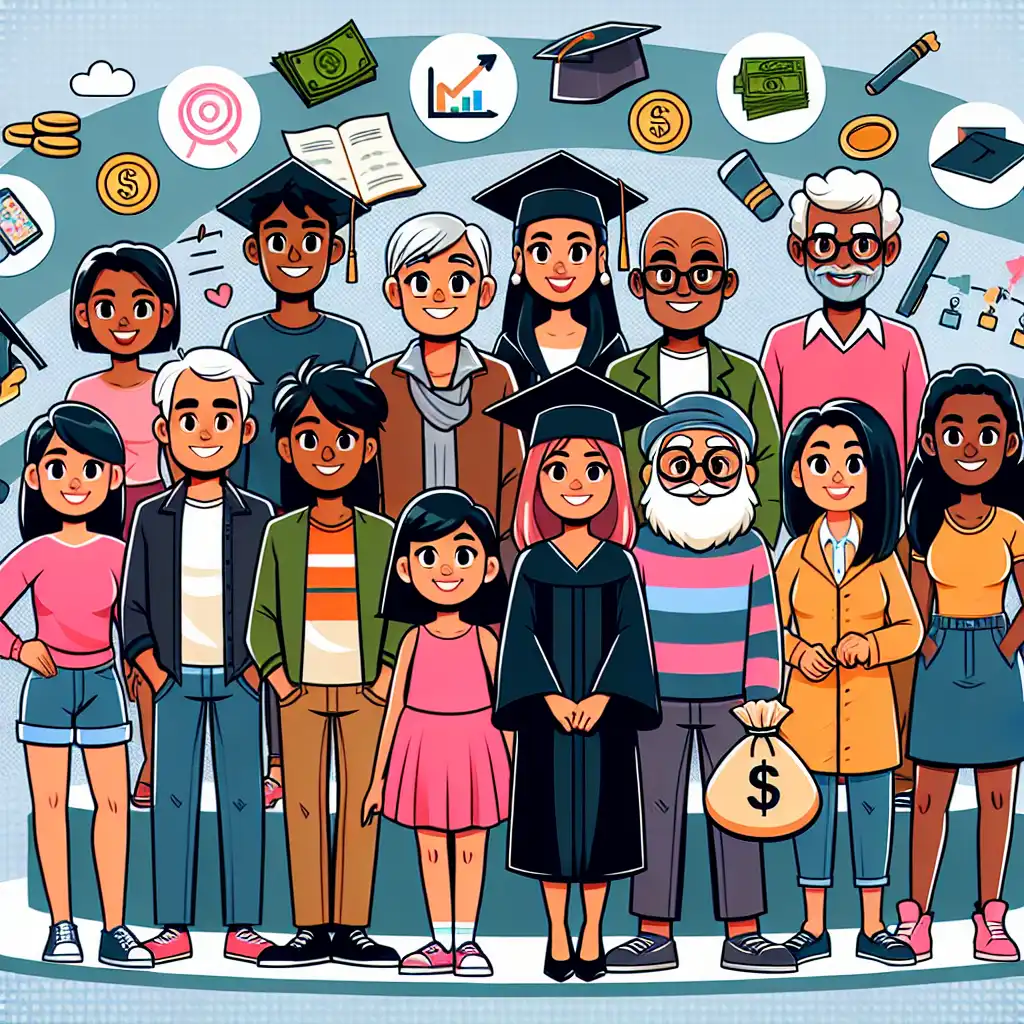
A group of people in a society, such as old people or young people, who are similar in some way, especially because of their age, income, or education level
Advertisers are looking for a new way to reach the teen demographic.
No se pudo cargar el audio. Inténtalo de nuevo más tarde.
Cómo se usa
'Demographic' is a word used to talk about groups of people who share common characteristics, like age, gender, or location. For example, if we want to know how many people aged 25-34 live in a particular city, we might look at the demographic data for that area. It's a word that's often used in business, marketing, and research to understand different groups of people better.
Anthropological refers to the study of human societies and cultures, while demographic refers to the statistical characteristics of human populations, such as age, gender, race, and income.
Anthropological research focuses on understanding the unique beliefs, practices, and customs of different cultures, while demographic research focuses on analyzing the size, growth, and distribution of populations.
Anthropological studies are often conducted through participant observation and qualitative analysis, while demographic studies rely heavily on quantitative data collection and analysis methods.
Census refers to the official count of a population, usually conducted by the government to determine things like the number of people living in a certain area, their age, gender, and ethnic backgrounds.
A census is a specific count of people, while demographics refer to a broader set of characteristics that describe a population.
Constituent refers to a person or group of people who live in a particular area or community and are represented by a government official or elected representative.
For example, if you live in a district in which an elected representative serves, you are a constituent of that representative.
While constituent describes a relationship between a government official and the people they represent, demographic describes a group of people based on shared characteristics.
Constituent is applicable in a political context, while demographic is often used in marketing, research, and social studies.
The term ethnographic refers to the study of people and their cultures, customs, and beliefs. Ethnographic research usually involves observing and interacting with people in their natural environment, and can uncover insights into how different groups of people think and behave.
In simpler terms, demographic data is about the facts and figures of a group of people, while ethnographic research is about understanding their way of life and beliefs.
Demographic data is useful for marketing and business decisions, while ethnographic research is helpful for understanding different cultures and societies.
The term population refers to the entire group of people living in a particular area, city, country, or the world. Demographic refers to the characteristics of the people in a particular population, such as age, gender, income, education, ethnicity, religion, and more.
For instance, if we say the population of a particular city is 2 million, it means there are two million people living in that city.
Population refers to the number of people living in a particular area, while demographic refers to the various characteristics that define the people in that area.
Segment refers to smaller groups of people within a larger demographic that share specific needs, preferences, or behaviors.
For example, within the demographic of "millennial women," a company might identify a segment of "fitness enthusiasts" who are more likely to respond to messaging about gym memberships and workout gear.
In simpler terms, demographic is the big picture, while segments are smaller groups within that picture that have unique characteristics or behaviors.
Sociological refers to the study of social behavior, relationships, and institutions. It is concerned with understanding how society works and the various factors that contribute to social issues and changes.
In simpler terms, demographic is about the numbers and facts of a group of people, while sociological is about understanding their behavior and interactions within society.
Demographic data can be helpful in understanding sociological patterns and trends, but the two terms refer to different aspects of social analysis.
Statistical refers to information that is collected and analyzed using numbers and data. Statistical information can include things like averages, percentages, or graphs.
Demographic information can be used to identify target audiences for products or services, while statistical information can be used to analyze trends or patterns in large sets of data.
Demographic information focuses on the characteristics of a group of people, while statistical information focuses on the numbers and data associated with that group.
I can't make a song for a particular person or demographic. If I love it, I'm gonna do it. I have to perform it for the rest of my life. A song is like a tattoo - you can never get away from it.
I talked to lots of people who are vaccine-hesitant, and I actually was one myself until I got further into this project, and most of them actually are in my demographic: so well-educated people with advanced degrees who are upper middle-class and have read quite a bit on the subject.
Low interest rates are usually attributed to low inflation, weak economic growth and super easy monetary policy. But there's another deep-seated factor that doesn't get much attention: demographics.
As the lone black host at two different all-sports stations, black callers and listeners dominated my show. Black advertisers did not. The show was financially supported primarily by white businesses, and the largest demographic for listener growth was white males.
I don't want to be a part of the demographics. I want to be an individual. I wear each of my films as a badge of pride. That's why I cherish all my bad reviews. If the critics start liking my movies, then I'm in deep trouble.
It's actually kind of cool that women have taken to me. Because now I have a whole different demographic when it comes to the audiences. I have women who come out and support my movies, and that is a huge demographic for me, which is great because some actors don't have a female base at all.
I don't do 'political correctness,' whatever that means. I write the stories I want to write, featuring the characters I want to feature. I don't touch demographic bases to appease this group or that. I write what I want. Full stop.