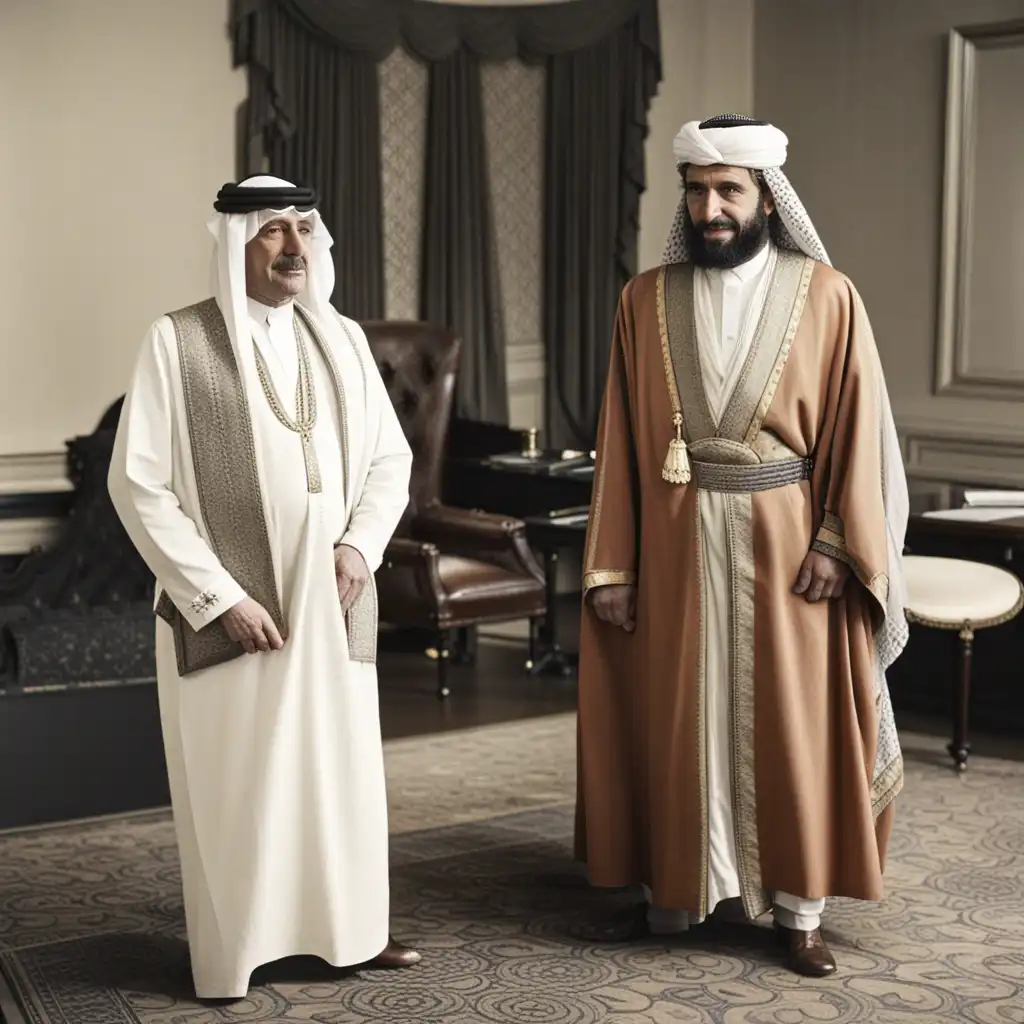
emir
noun emir
eˈmɪr,eɪˈmɪr
A prince or leader in Islamic countries.
The emir of Qatar visited the United States for political discussions.
emir
eˈmɪr,eɪˈmɪr
加载中…
eˈmɪr,eɪˈmɪr
A prince or leader in Islamic countries.
The emir of Qatar visited the United States for political discussions.
音频无法加载,请稍后再试。
An emir is a title for a ruler or leader in certain Arab countries. It is similar to a king or a prince. The word "emir" is commonly used in Middle Eastern countries such as Qatar, UAE, Saudi Arabia, and Oman. You may come across this word in news articles or books related to the Middle East.
Both words refer to leaders, but chief is a more generalized term that can refer to any type of leader or head of a group, while emir specifically refers to a leader in Islamic societies.
For example, a chief could be the leader of a police department or the head of a tribe, while an emir is a leader of a Muslim community or a political leader in Muslim countries.
Chief is a more universal term, while emir is a culturally specific term used in Islamic societies.
打开单词: Chief →An emir is a title for a leader or ruler in Arabic-speaking countries, similar to a prince or governor.
A king is a more powerful title given to a monarch who rules over a kingdom or country.
The main difference between the two is in their level of authority and the scope of their rule. An emir's power is usually limited to a smaller region or city, while a king typically rules over an entire country or kingdom.
For example, the UAE is led by a group of emirs who govern each of its seven emirates, while countries like the United Kingdom and Saudi Arabia have kings who reign over their entire territory.
An emir is like a regional leader or governor, while a king is a more powerful monarch who rules over a larger area.
打开单词: King →Emir typically refers to a leader in Arabic-speaking countries, and is often used to refer to those who lead a tribe or a group of people.
Leader is a more general term that can refer to someone who holds a position of authority or influence in any context or setting.
So, while an emir is always a leader, not all leaders are emirs. The term emir is more specific and applicable to certain cultural and political contexts, while leader has a broader and more universal usage.
打开单词: Leader →It can also refer to a military commander. Monarch is used to refer to a king or queen who rules over a country or nation.
In simpler terms, an emir is a leader of a smaller region, while a monarch is a leader of an entire nation. For example, the leader of Dubai is an emir because Dubai is just one city in the United Arab Emirates, while the Queen of England is a monarch because she rules over the entire country of England.
打开单词: Monarch →Emir refers to a leader or ruler of a Muslim state or region, while the word prince generally refers to a male member of a royal family.
Emirs are usually associated with countries or areas that have a Muslim majority population, while princes can be found in a variety of countries and cultures.
The difference between emir and prince is that emir usually implies a religious or cultural element, whereas prince implies a more generic sense of royal authority.
打开单词: Prince →Ruler is a broader term used for any person who holds power or authority over a particular area, regardless of the religion or culture of that area.
It is applicable to any country, regardless of its religion or culture. For example, the ruler of the United Kingdom is Queen Elizabeth II, while the emir of Qatar is Sheikh Tamim bin Hamad Al Thani.
打开单词: Ruler →The words Emir and Sheikh both originated from Arabic, and they are titles that refer to leaders in Muslim communities.
On the other hand, Sheikh is a title used for a leader of a tribe or a religious leader, and it is more commonly used in religious contexts.
So, while both titles refer to leaders, Emir is more related to politics and administration, and Sheikh is more related to religion and community leadership.
打开单词: Sheikh →Emir refers to a ruler or leader of a small Islamic state or tribe, while sovereign refers to a monarch or ruler of a country.
An emir typically governs over a small area or community, while a sovereign has complete authority over a nation. Emir is commonly used in the Middle East, while sovereign is used worldwide.
打开单词: Sovereign →Both emir and sultan are titles used in Islamic cultures, but they have different meanings.
An emir is a leader or ruler of a smaller territory or state, such as a province or city. Emirs are usually appointed by a higher authority, such as a sultan or a caliph.
A sultan is a higher-ranking title given to a ruler of a larger state or empire.
A sultan is often seen as a more prestigious title than an emir, and sultans are usually fully independent rulers who do not answer to another higher authority.
So, in short, emir is applicable to a smaller territory or province, and is a lower-ranking title. Sultan is applicable to a larger state or empire, and is a higher-ranking title.
打开单词: Sultan →History vs. Tamerlane...
在 YouTube 上观看 ↗Amir Khan is a great fighter, I have a lot of respect for him.
Hope and justice for...
在 YouTube 上观看 ↗You know, I accept some things with a laugh. Amir Khan was supposed to be a killer, and look what I did to him. Then it gets back to me that people thought I was lucky. Well, I must be lucky my whole life then, because I keep winning.
I want bigger fights. Amir Khan doesn't want to listen to me. Why? It's getting boring.
As it is, Al Jazeera is mostly funded by grants from the emir of Qatar-Sheik Hamad bin Khalifa al-Thani, whose family has ruled the country since the mid-1800s.
Amir Khan is a very good fighter, but he has been knocked out a few times when he has stepped up.