emission
noun emission
ɪˈmɪʃn
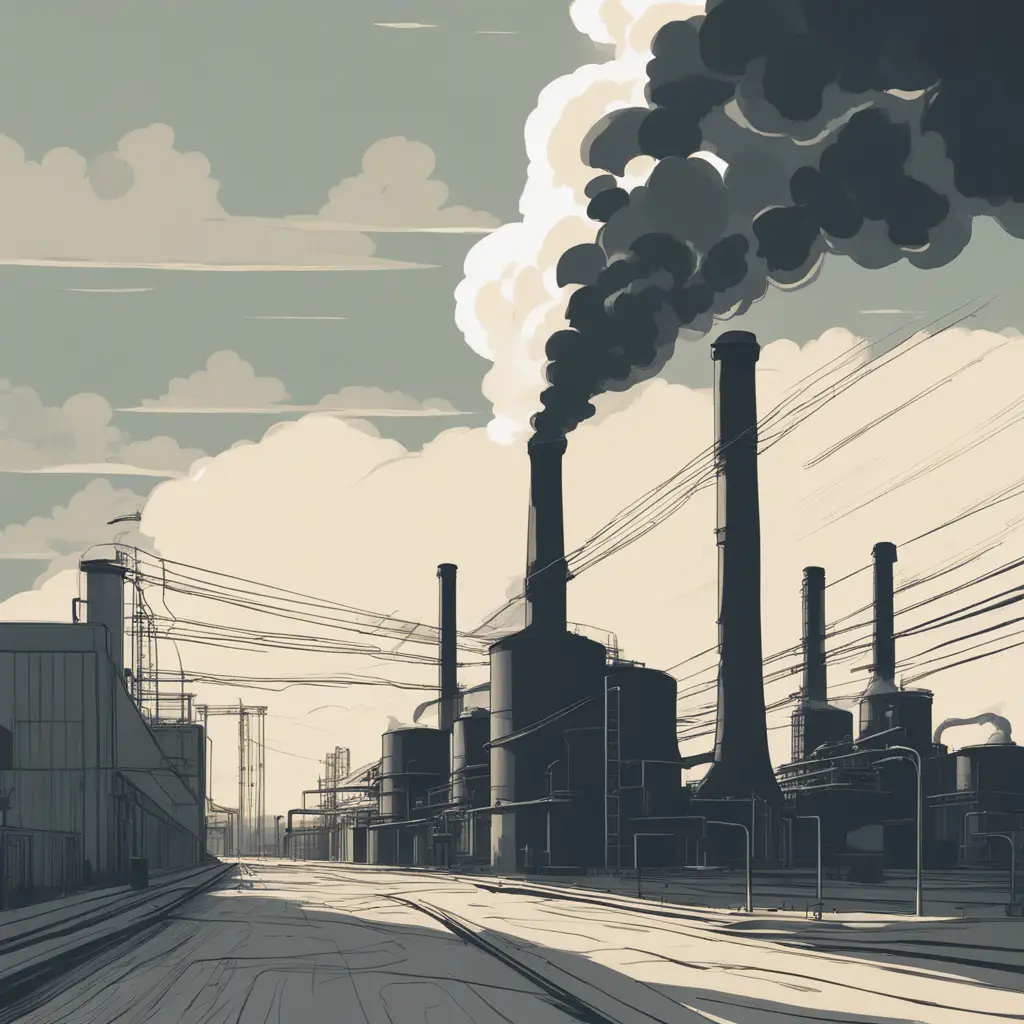
The act of sending or giving out something such as energy or gas.
The factory is trying to reduce its carbon emissions to help the environment.
emission
ɪˈmɪʃn
लोड हो रहा है…
ɪˈmɪʃn
The act of sending or giving out something such as energy or gas.
The factory is trying to reduce its carbon emissions to help the environment.

ɪˈmɪʃn
Something such as gas or radiation that is sent out.
The car emitted a cloud of exhaust emissions from its tailpipe.

ɪˈmɪʃn
A payment or fee that is sent or given out.
The central bank contemplates another emission of notes.
ऑडियो लोड नहीं हो सका। कृपया बाद में फिर कोशिश करें।
The word 'emission' refers to the release or discharge of something, usually a gas or a substance, into the environment. This word is often used when talking about pollution or environmental issues, such as emissions from cars, factories, or power plants. For example, the emission of greenhouse gases contributes to climate change. Overall, 'emission' is a technical term used in science and engineering contexts, and it's important for understanding environmental issues and policies.
Discharge refers to the release of something that was contained, like a gas, liquid, or object. For example, a hospital may discharge a patient after they have recovered from an illness, or a gun may discharge a bullet when the trigger is pulled.
Discharge is a more general term that can be used in many different contexts, while emission is more specific to pollution and environmental damage.
शब्द खोलें: Discharge →Effusion refers to the process of a gas or liquid slowly passing through a small opening or hole, such as the release of air from a balloon.
In simpler terms, effusion is a slow release of a substance while emission is a sudden or rapid release of a substance.
Effusion is applicable when there is a small opening or hole involved, while emission is applicable to larger scale release or discharge.
शब्द खोलें: Effusion →Emanation and emission are similar words that refer to the act of something coming out of another thing.
Emanation typically refers to something that is coming out of a source naturally or as a result of its inherent properties.
For example, the scent of a flower is an emanation because it naturally comes out of the flower.
Emanation describes something that comes out naturally, while emission is often used to describe something that is actively released.
शब्द खोलें: Emanation →Exhalation refers to the act of breathing out air from the lungs. This term is generally used in the context of humans and animals who exhale to remove carbon dioxide from their body.
Emission is applicable to the release of pollutants or other substances from a source or object, while exhalation describes the process of breathing out air by living organisms.
शब्द खोलें: Exhalation →Emission and expulsion are both related to the act of releasing something from a particular object or system, but they are used differently.
Emission is used when referring to the release of gases or other substances through a process such as, "the car's exhaust system reduces emissions of harmful gases." Expulsion is used when referring to the removal of something or someone from a place, group, or organization through force or authority, such as "the student was expelled from school for breaking the code of conduct."
शब्द खोलें: Expulsion →Outflow refers to the movement or flow of something outwards, such as water outflow from a dam or the outflow of air from a balloon.
Emission is used when something is being released or discharged into the environment, while outflow is used when something is flowing outwards from an area or container.
शब्द खोलें: Outflow →Output refers to the amount or quantity of something produced, such as the number of cars produced in a factory or the amount of electricity generated by a power plant.
Emission refers to the release of pollutants or gases, while output refers to the amount or quantity of something produced.
शब्द खोलें: Output →Emission and release both refer to the act of letting something out.
However, emission is mostly used to describe the release of harmful gases or particles, while release has a broader meaning and can refer to letting out anything.
For example, a car emits harmful gases, but someone can release a balloon into the air. Emission is mostly applicable in the context of pollution and environmental issues, while release can be used in various situations.
शब्द खोलें: Release →decreased harmful emissions, and minimized unproductive and stressful driving time. But accidents can and will still happen, and when they do, their outcomes may be determined months or years in advance by programmers or policy makers. And they'll have some difficult decisions to make.
YouTube पर देखें ↗I believe those that produce the least emissions in autos will also be those who have the greatest success worldwide.
currently it is our ongoing emissions that are driving global temperatures up but if tipping points are crossed that could spiral beyond human control if we imagine a map of the world it
YouTube पर देखें ↗Irish research will contribute to global progress and have the potential to help all countries realise the potential of their land sectors in addressing climate change - this means reducing emissions, adapting to impacts, and enhancing and improving carbon sinks.
That's more than the emissions from all electricity and industry, or from all the world's planes trains and automobiles. Most agricultural emissions come from tropical deforestation, methane from animals and rice fields, and nitrous oxide from over-fertilizing. There is nothing we do that transforms the world more than agriculture. And there's nothing we do that is more crucial to our survival.
YouTube पर देखें ↗Norway has had a carbon tax in place for a long time. This has not slowed down industrial development. Rather, it has encouraged innovation and the development of solutions that reduce emissions and bring down operating costs.
carbon dioxide greenhouse emissions for being put into the atmosphere how many light bulbs does it take to make a difference one one this goal will help save dogs cats water buffalo redwood
YouTube पर देखें ↗Without international participation, jobs and emissions will simply shift overseas to countries that require few, if any, environmental protections, harming the global environment as well as the U.S. economy.
that you know that that that that issue about what whether humanity can find a way of reducing our carbon output cities have a role to play in that absolutely right by building up we don't build out and I think the evidence on carbon emissions within the US and elsewhere
YouTube पर देखें ↗We want an economy that grows health and wellbeing, not debt and carbon emissions. An economy that prepares and protects us from shocks to come, rather than making them worse. An economy that shares resources to meet all our needs, regardless of background. An economy that lets us live.
leading to a massive reduction in smog. Similarly regulations on vehicle emissions and gas content in the US reduced the volatile compounds in the air and smog levels along with them. Smog remains a major problem around the world.
YouTube पर देखें ↗I have advocated an entirely different approach than cap and tax, which would be worldwide in application and which emphasizes technology as a way of reducing total emissions.
like this, that we realized the whole world was wiping its noses on our old-growth forests. Did you know that deforestation like this around the world causes more greenhouse gas emissions than all the trains planes and automobiles combined? Yeah I'm really upset about this,
YouTube पर देखें ↗Nuclear power can continue to help us reduce our greenhouse gas emissions, but we must do everything we can to make it safer.
The oil produced from either method produces more greenhouse gas emissions than any other oil. This is one of the reasons why it's called the world's dirtiest oil. It's also one of the reasons
YouTube पर देखें ↗To reduce the risk of a global environmental catastrophe, and to avoid reversing the course of human progress, the world must urgently bend the curve of global emissions away from fossil fuels.
and mid-ocean ridges which are underwater chains of volcanic mountains no matter their shape or size all volcanoes emit gas and molten rock the journey of these emissions begins deep underground in the earth's core
YouTube पर देखें ↗Our pollution out of carbon emissions is still very, very low compared to the world.
extinction although much remains to be learned about global warming many organizations advocate cutting greenhouse gas emissions to reduce the impact of global warming consumers can help by saving energy around the house switching to compact
YouTube पर देखें ↗The growth in emissions is coming from the developing world. So if we are going to get out of this, it's going to come out of a process of cooperation and collaboration. That's why it really requires a paradigm shift.