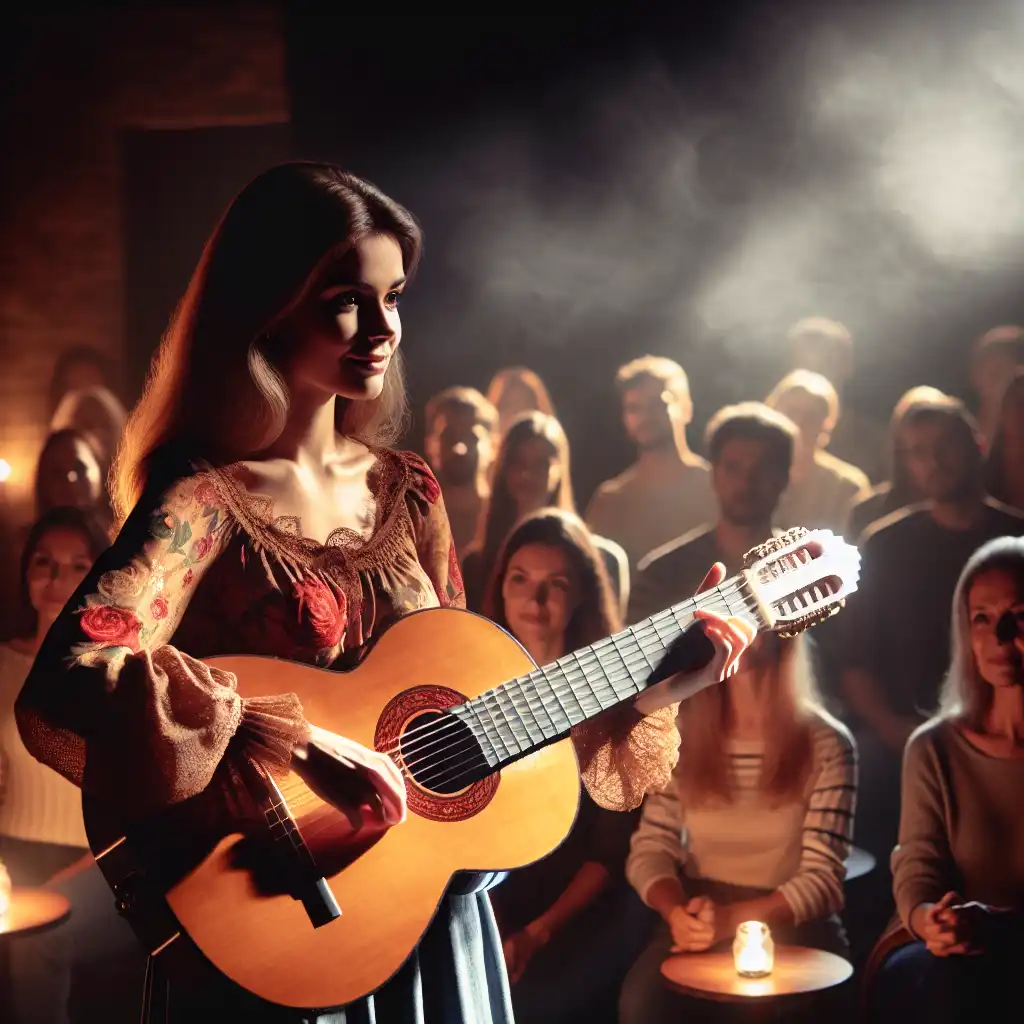
balladeer
noun balladeer
ˌbæləˈdɪr
A person, particularly a singer, who sings ballads
The audience was mesmerized with the romantic tunes of the renowned balladeer.
balladeer
ˌbæləˈdɪr
Cargando…
ˌbæləˈdɪr
A person, particularly a singer, who sings ballads
The audience was mesmerized with the romantic tunes of the renowned balladeer.
No se pudo cargar el audio. Inténtalo de nuevo más tarde.
A balladeer is a person who sings songs that tell a story. They usually play a guitar or some other instrument while they sing. They often perform in cafes, bars, or other small venues. The word 'balladeer' can also refer to the type of songs they sing, which are called ballads. It is a word that is used to describe a musician who tells stories through their songs.
A bard is a poet, storyteller, or musician who belongs to a particular historical tradition in Celtic cultures. Bards were revered figures who were responsible for preserving the history and culture of their people through their songs, poems, and stories.
A balladeer focuses on singing ballads, while a bard is a wider term for a cultural figure who performs poetry, stories, and songs in a particular tradition.
Balladeers are usually associated with folk music and simple melodies, while bards are more associated with aristocratic cultures and court life.
Abrir palabra: Bard →Lyric on the other hand, refers to a type of poetry or song that expresses the writer's emotions or feelings.
Lyrics are often associated with popular music and can have a more complex structure that includes verses and a chorus.
A balladeer is someone who writes or sings ballads while a lyric refers to the words that express the emotions or feelings in a poetry or song.
Abrir palabra: Lyric →A minstrel is a performer who typically sings or recites poetry while accompanying themselves on a musical instrument, such as a lute or guitar.
Historically, minstrels performed in medieval courts and later in taverns and public places. They entertained audiences with stories, jokes, and music.
The main difference between the two is that balladeers focus on singing narrative songs, while minstrels focus on reciting poetry and telling stories.
It is important to note that the term minstrel has a controversial history as it has been associated with blackface performances and racism in the past.
Abrir palabra: Minstrel →A songster is a more general term that can refer to any singer or songwriter who performs a range of different types of songs.
A balladeer is a specialist in ballads while a songster is a more general term for a singer/songwriter who is versatile and can perform different types of songs.
Abrir palabra: Songster →A troubadour is a poet-musician from medieval times who composed and sang songs about chivalry and courtly love.
A troubadour was a poet and musician who was a part of a specific social class in medieval Europe. Troubadours were known for singing about the ideals of chivalry and courtly love, two popular concepts in the Middle Ages.
A balladeer sings ballads, which are storytelling songs that can cover a variety of topics, while a troubadour was a specific type of musician in medieval Europe who wrote and sang poems about chivalry and courtly love.
Abrir palabra: Troubadour →I am a balladeer. People fall in love to ballads, and that is what makes the world go round.
I do sing ballads, but I'm not a balladeer. I'm not the next Celine Dion.
It's true that I'm not known as a crooner or balladeer. I'm known for a more crusading or quixotic temperament.
I'm kind of a pop balladeer because I love the art of storytelling. I call myself 'HBO for the ears'; I sing little movies.
In a way, I created Utopia as a platform for me to become more of a guitar player and less of the kind of balladeer that people were taking me for.
Uncle Dave Macon was a great balladeer and banjo player from the early part of the 19th century... He would take a social problem or something that he was looking at and make up a clever little song about it, you know, in a language everyone understood, a man of the people.