abrogate
verb abrogate
ˈæbrəɡeɪt
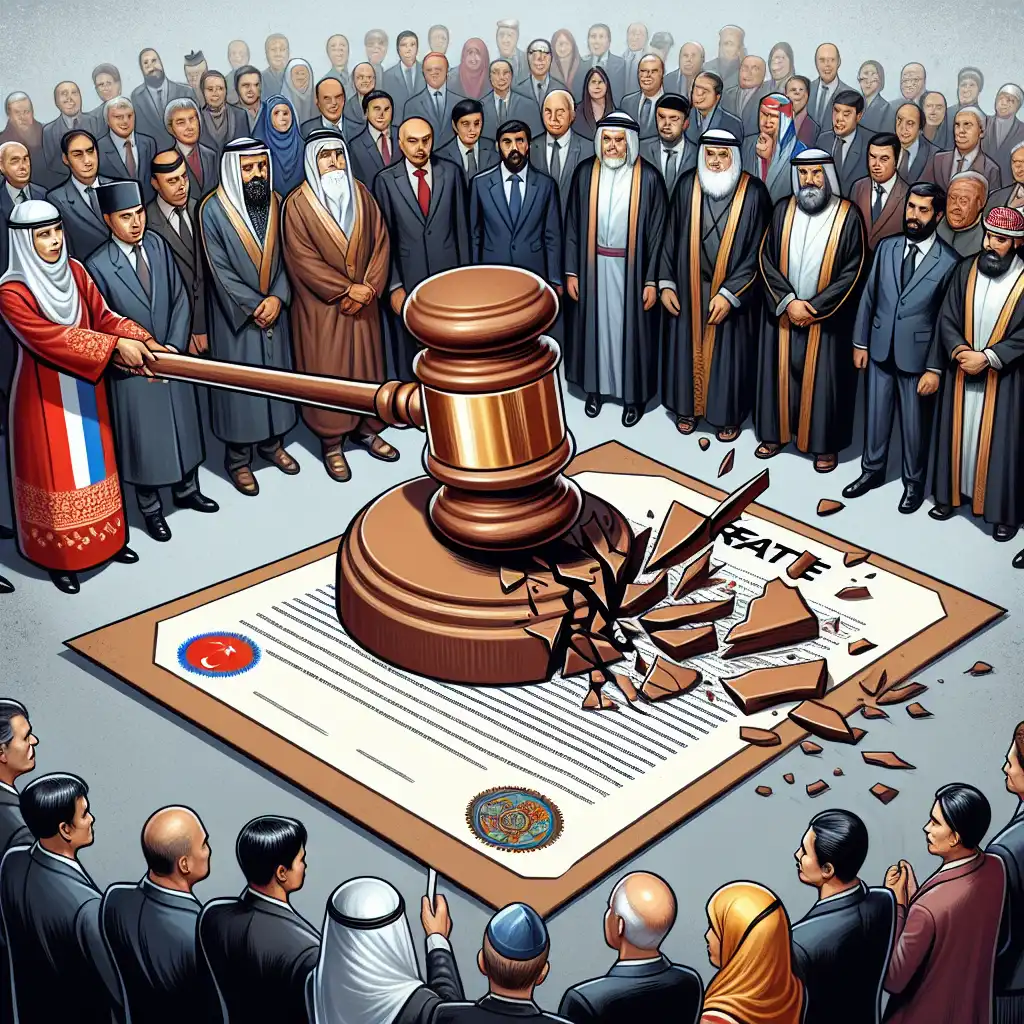
To officially end or cancel something, especially a law or agreement.
The government decided to abrogate the treaty.
abrogate
ˈæbrəɡeɪt
読み込み中…
ˈæbrəɡeɪt
To officially end or cancel something, especially a law or agreement.
The government decided to abrogate the treaty.

ˈæbrəɡeɪt
To avoid doing or answering something directly.
He tried to abrogate his responsibilities as a father.
音声を読み込めませんでした。しばらくしてからもう一度お試しください。
The word 'abrogate' means to officially cancel or get rid of something, usually a law or an agreement. For example, a government may abrogate a treaty with another country if they feel it is no longer beneficial or if the other party has not fulfilled their obligations under the agreement. It is a formal and serious word that is usually used in legal or political contexts.
Abolish and abrogate both refer to the act of repealing or ending something.
However, abolish is typically used to refer to the elimination of a law or system altogether, while abrogate is generally used to refer to the nullification of a particular agreement or treaty.
For example, a government might choose to abolish slavery, meaning that it is no longer legal in that country. A country might decide to abrogate a trade agreement with another country, which would mean that the terms of the agreement are no longer legally binding.
Abolish is used to refer to ending a law or system, while abrogate is used to refer to nullifying a specific agreement or treaty.
単語を開く: Abolish →Annul means to make something null and void, as though it never happened in the first place.
In simpler terms, abrogate means to cancel or undo something, while annul means to declare it completely void and non-existent.
単語を開く: Annul →It is usually used in legal or formal contexts, where the cancellation or revocation is done by a higher authority. For example, a government may abrogate a treaty between two nations.
Cancel means to call off, delete or revoke something that has been scheduled or agreed upon.
It is usually an act of a person or an institution, where a previously made plan is terminated. For example, a person may cancel a flight reservation.
In simpler terms, abrogate is used when a higher authority revokes or ends something important, like a law or treaty. Whereas cancel is used for when an individual or an organization terminates a plan or agreement.
単語を開く: Cancel →End means to bring something to a conclusion or stop it from continuing. It's applicable in almost every situation when you want to describe something coming to an end or stopping, like a conversation, a book, or a relationship.
End is applicable when something comes to a conclusion or is stopped, while abrogate is applicable when a law or agreement is repealed or done away with.
単語を開く: End →Invalidate means to make something legally or officially invalid or not enforceable. This means that the thing being invalidated is still technically in place, but it is no longer valid or legally binding.
For example, a court might invalidate a contract if it was signed under duress.
Abrogate means to completely get rid of something, while invalidate means to make something legally invalid or unenforceable.
単語を開く: Invalidate →Both abrogate and nullify mean to invalidate or cancel something, but there is a slight difference in their usage.
Nullify is generally used when something is made void or worthless because of a legal, factual or logical defect, such as an agreement, contract, or decision.
For example, a judge can nullify a contract if it contains illegal clauses, or a political leader can nullify an election if fraud is found.
Nullify is used when something is declared void due to a mistake or irregularity, while abrogate is used when something is intentionally revoked or abolished.
単語を開く: Nullify →Abrogate means to completely eliminate, invalidate or cancel a legal agreement, treaty or law, whereas repeal means to repeal or cancel a certain law or act.
Repeal is a milder term and is used for making changes or revoking certain parts of a law or act. Both terms are applicable in legal contexts, but abrogate is usually used for more serious instances, while repeal is more commonly used for minor changes.
単語を開く: Repeal →Revoke means to take back or withdraw something, such as a license or privilege. This could be used in both formal and informal contexts.
For instance, a driver's license may be revoked if someone repeatedly violates traffic rules or drives under the influence of alcohol or drugs.
In simpler words, abrogate means to abolish or cancel something legally, while revoke means to take back or withdraw something.
単語を開く: Revoke →Why I love a country...
YouTube で見る ↗We've got technological wonders around us, and we've used them to abrogate all responsibility for everything in our lives.
Telephone, n. An invention of the devil which abrogates some of the advantages of making a disagreeable person keep his distance.
Just as Donald Trump is abrogating America's responsibility to lead the fight against climate change, Theresa May is evading Britain's role.
God leaves to Man the choice of Forms in Government; and those who constitute one Form, may abrogate it.
For Obama, the Trans-Pacific Partnership agreement - unilaterally abrogated by Trump - was part of the 'pivot to Asia,' a re-assertion of the role of America in that part of the world.
Like a horrible nightmare, the abrogation of equal rights weighs upon us all, but especially upon those Jews who, like me, had surrendered themselves to the dream of assimilation.
You know, it's ironic to me that Christians want to keep the Ten Commandments in our schools, because Christianity has abrogated four of the Ten Commandments. For example, the Sabbath day according to the Ten Commandments is Saturday, not Sunday. And the reason is because God rested, not because Jesus was resurrected.