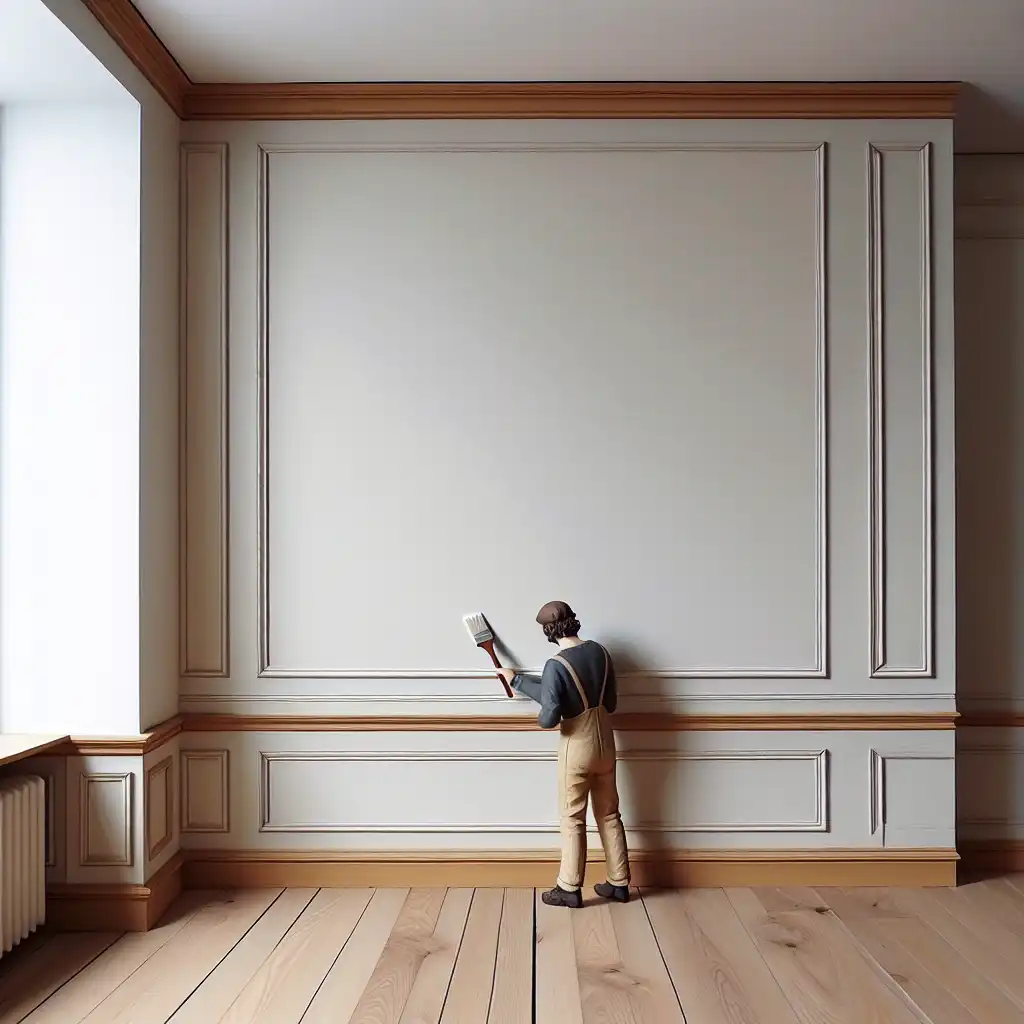
baseboard
noun baseboard
ˈbeɪsbɔːrd
A narrow wooden board running along the bottom of an interior wall.
She asked the painter to be careful not to mark the baseboards when painting the walls.
baseboard
ˈbeɪsbɔːrd
Loading…
ˈbeɪsbɔːrd
A narrow wooden board running along the bottom of an interior wall.
She asked the painter to be careful not to mark the baseboards when painting the walls.

ˈbeɪsbɔːrd
A board forming the base of something.
The baseboard of his computer needed to be replaced due to a malfunction.
Audio could not be loaded. Please try again later.
The word "baseboard" refers to the wooden or plastic board that runs along the bottom of a wall, next to the floor. It is used to cover the gap between the floor and the wall and can add a decorative touch to a room. It is commonly found in houses, apartments, and other buildings. When talking about home decor or interior design, the term "baseboard" may come up frequently.
Architrave and baseboard are both architectural elements used in building design, but they are located in different parts of a room or building.
An architrave is a decorative molding or trim that frames the top of a door or window.
It is typically located above the opening and is used to add visual interest and detail to the room. Architects and designers often choose architraves that complement the style of the room or building.
Architrave and baseboard are both decorative elements that can enhance a room's appearance, but an architrave is used at the top of a door or window, while a baseboard is located at the bottom of a wall.
Open word: Architrave →Case refers to the decorative trim used around doors and windows. It covers the gap between the window or door frame and the wall, creating a finished look.
Baseboard is used at the bottom of the wall while case is used around doors and windows to create a finished appearance.
Open word: Case →A cornice is an architectural feature that is installed where the ceiling meets the walls.
A baseboard is installed at the bottom of a wall to cover the joint between the wall and floor, while a cornice is installed at the top of the wall to cover the joint between the ceiling and wall.
Open word: Cornice →It is used to cover the joint between the wall surface and the flooring. Fascia refers to a board that runs along the roofline or eaves of a building.
It is used to cover and protect the exposed edge of the roof and give it a finished appearance. In simpler terms, baseboards are for floors and walls, while fascia is for roofs.
Open word: Fascia →Baseboard is a type of molding that is fixed at the bottom of a wall, where the wall meets the floor.
Molding refers to any decorative trim used to enhance the appearance of walls, ceilings, furniture or other architectural features.
It comes in various shapes and sizes, such as crown molding, casing molding, chair rail molding, and panel molding.
Molding can add character, visual interest, and style to an otherwise plain and boring space.
Baseboard is a specific type of molding used to finish off the bottom of a wall, while molding is an umbrella term that refers to any decorative trim used to enhance the appearance of a room or a piece of furniture.
Open word: Molding →Both baseboard and plinth are architectural terms that refer to the bottom part of a wall.
A plinth is a block or slab of stone or other material that is used as the base of a column or statue.
A plinth provides a stable foundation for the object on top of it and can also be decorative.
A baseboard is used to cover the gap between a wall and the floor, while a plinth is used as a foundation for an object.
Open word: Plinth →Baseboard and skirt are two different things used in construction.
Skirt refers to a decorative board or molding that is attached to the lower part of the walls, often found in the exterior of a building or a room.
Skirts can be made of wood, cement, or PVC.
The baseboard is an interior feature while a skirt is an exterior feature. Baseboards are mainly functional, while skirts are primarily decorative.
Open word: Skirt →Trim refers to any decorative molding used to finish the edges of walls or other surfaces, such as around doors and windows.
Trim can take many forms, including crown molding, chair rails, and picture rails.
Baseboard is specifically the molding at the bottom of a wall, while trim refers to any decorative molding used around walls and other surfaces.
Open word: Trim →