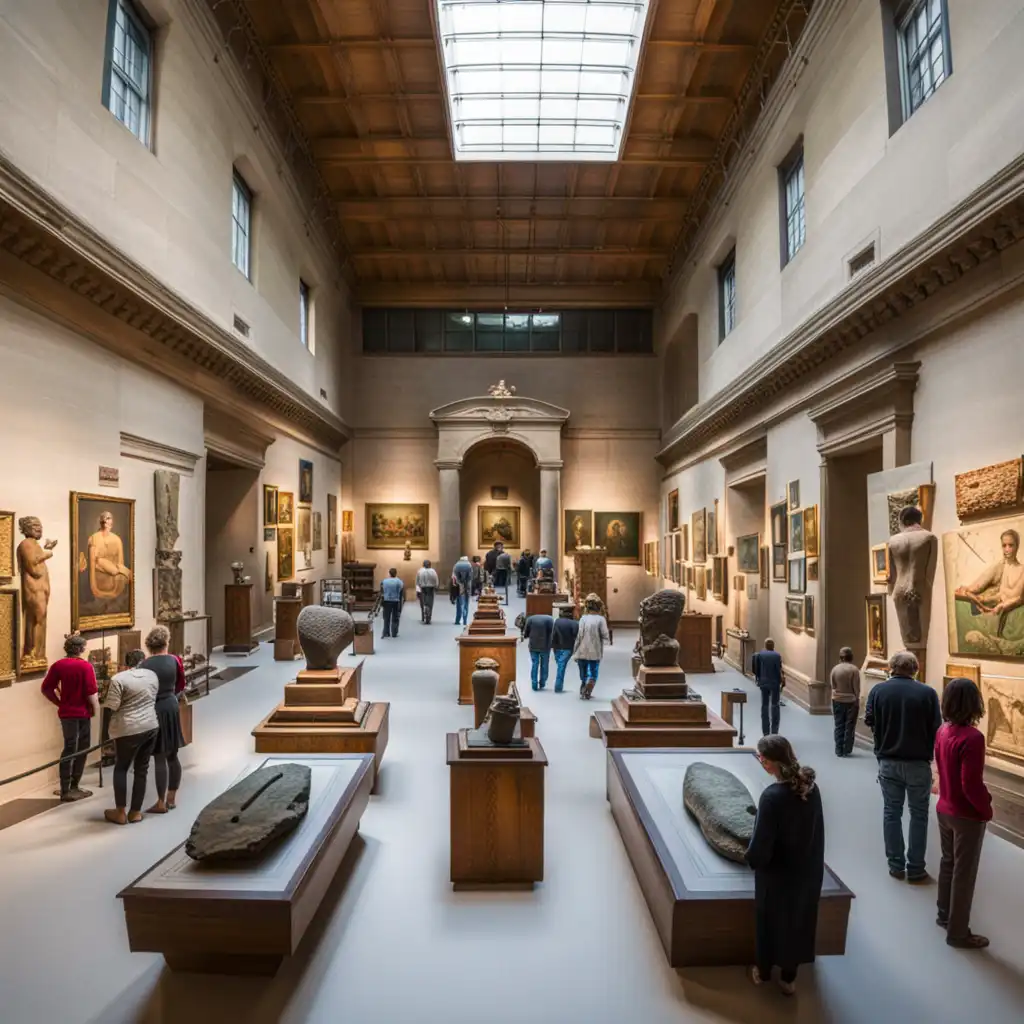
museum
noun museum
mjuˈziːəm
A place where old, valuable, or important objects are kept and shown to the public.
I visited an art museum last weekend.
museum
mjuˈziːəm
Loading…
mjuˈziːəm
A place where old, valuable, or important objects are kept and shown to the public.
I visited an art museum last weekend.
Audio could not be loaded. Please try again later.
A museum is a place where you can see things from the past or things that are very special. For example, you might find old cars, clothes, and artifacts from different cultures. Museums are usually quiet places where you can learn about history and art. People often visit museums to see things that they may never see anywhere else. You can usually find museums in big cities or near famous landmarks.
An archive is a collection of valuable historical documents, records, or data. Archivists collect, organize, and preserve these materials so that they can be studied by researchers and historians to gain a better understanding of the past.
Archives are usually maintained by organizations such as universities, government agencies, or private companies.
Unlike archives, museums focus on displaying physical objects rather than documents or data. They often provide educational programs or tours to help visitors learn more about the exhibits.
So, in simple terms, an archive is a place where important papers and documents are stored for research purposes, while a museum is a place where historical and cultural objects are on display for public viewing and education.
Open word: Archive →A collection refers to a group of similar items or objects that belong to a person or organization. It could be anything from stamps, coins, books or artwork.
A museum is a public place where collections of historical, cultural or scientific items are displayed for people to learn from and enjoy.
A collection is a private group of items while a museum is a public place where collections are displayed for the education and enjoyment of the general public.
Open word: Collection →Display generally refers to a visual representation of something, such as showcasing an item or a collection of items for people to see.
Displays can appear in many places, such as retail stores or exhibitions.
A museum can have various displays, but its main purpose is to educate visitors about the items on display and their cultural or historical significance.
A display can be found in many different locations and is a showcase of items, while a museum is a specific type of institution that aims to educate visitors by presenting cultural, artistic, or historical artifacts and information.
Open word: Display →An exhibit is a collection of objects or items that are displayed for people to see.
Exhibits can be found in many places, including museums, art galleries, and science centers.
Exhibits can be temporary or permanent, and they can focus on different themes or topics.
A museum can have many exhibits, but it is also a larger institution with various departments, such as collections management, research, and education.
An exhibit is a display of objects, while a museum is a place where exhibits are curated and displayed.
Exhibits can be found in many different contexts, while museums are specific institutions dedicated to preserving and sharing cultural and historical artifacts.
Open word: Exhibit →An exhibition is a temporary display of objects or artworks in a specific location, such as a gallery, cultural center, or event space.
Exhibitions can be curated by individuals, organizations, or institutions and can be focused on art, history, science, or any other topic.
In summary, exhibitions are temporary displays of specific themes, artists, or collections, while museums are permanent institutions that collect, preserve, and display a broad range of cultural and historical objects.
Open word: Exhibition →A gallery is a place where art is exhibited for sale, while a museum is a place where art and other historical artifacts are displayed for educational and preservation purposes.
Galleries are often commercial establishments that sell art, and they may exhibit works of different artists, genres, or styles.
Visitors can browse and purchase the art displayed in the gallery.
In summary, galleries focus on exhibiting art for sale, while museums focus on promoting education and preserving cultural history.
Open word: Gallery →A repository is a place where things are stored or kept for safekeeping, preservation, or research purposes.
A repository can also be used for documents, records, and other archival materials that need to be maintained and preserved for future generations.
In summary, museums are places where people can go to learn about history and culture through observing and interacting with exhibits, while repositories are places where valuable or important items are stored and preserved for future generations.
Open word: Repository →A showroom is a space used to display products or merchandise for sale. Showrooms are typically commercial establishments operated by businesses to promote and market their products to potential customers.
A museum is a place to learn about history, art, and culture, while a showroom is a place to buy things. Museums are applicable for educational purposes while showrooms are applicable for commercial purposes.
Open word: Showroom →When you think of natural history museums, you probably picture exhibits filled with ancient lifeless things, like dinosaurs meteroites,
Watch on YouTube ↗Our universities and museums are respected around the country.
it was almost as if a museum specimen had been carefully laid out on the sea floor
Watch on YouTube ↗Art should be created for life, not for the museum.
We also have a classroom hives project, where -- this is a nonprofit venture -- we're spreading the word around the world for how honeybee hives can be taken into the classroom or into the museum setting behind glass, and used as an educational tool. This hive that you see here has been
Watch on YouTube ↗Egypt really is one of the worlds greatest open-air museums.
Nadia's help the museum agreed to let me inspect the seized antiquities
Watch on YouTube ↗Every museum is full of nice things. That's the opposite of before. It was important things or serious things. Now we have interesting things.
a missed it in the fashion industry because while at boss tyrunt a commercial business I also embody the art world make films installations and I show them in galleries and museums interestingly this condition has given me the freedom to be an immigrant within various disciplines
Watch on YouTube ↗When I was growing up, my mother would take me to plays and museums, and we'd talk about life. Those times helped shape who I became.
As you can see we have a lion here and a gladiator, and well the janitor ought to be in this wing clearly. Moving on hurry along. The next step in the evolution of museums occurred in the Renaissance, when the study of the natural world was once again encouraged
Watch on YouTube ↗Of course art world ethics are important. But museums are no purer than any other institution or business. Academics aren't necessarily more high-minded than gallerists.
and the deepest shipwrecks. The ocean is like a huge underwater museum that constantly adds to our knowledge about humanity. With only a fraction of it explored, discoveries are sure to continue long into the future.
Watch on YouTube ↗If you look at the paintings that I love in art history, these are the paintings where great, powerful men are being celebrated on the big walls of museums throughout the world. What feels really strange is not to be able to see a reflection of myself in that world.
Historically speaking, the public appreciation of visual art in terms other than traditional religious or social function is a relatively new concept. Today we fetishize the fetish so to speak. We go to museums to see art from the ages,
Watch on YouTube ↗Even if you can't afford to travel the world, you can take your children to the museum, zoo or local park. And don't be afraid to take them to grown-up spots. Eating out in a restaurant teaches children how to be quiet and polite and gives them the pleasure of knowing you trust them to behave.
mission to find this frog took five years to find the first one and and it was incredible you know that was my frog that was one that one really wanted to work with I got special permission to collect them brought them back to the museum they bred them for the first time in the world
Watch on YouTube ↗I like going to museums and stuff, but I also like going out and doing lots of physical activity like camping and hiking. I like doing stuff that I've never done before. Curiosity is a big thing. Usually it means that people are intelligent and that they want to learn stuff about the world.
the video games for a really long time, and that's what museums do. They also preserve artifacts for posterity. In absence of the code because you know, video game companies are not very forthcoming in some cases, in absence of that we acquire the relationship with the company. We're going to stay with them forever. They're not going to get rid of us.
Watch on YouTube ↗If you're gonna do museums, some of the best in the world are in D.C.