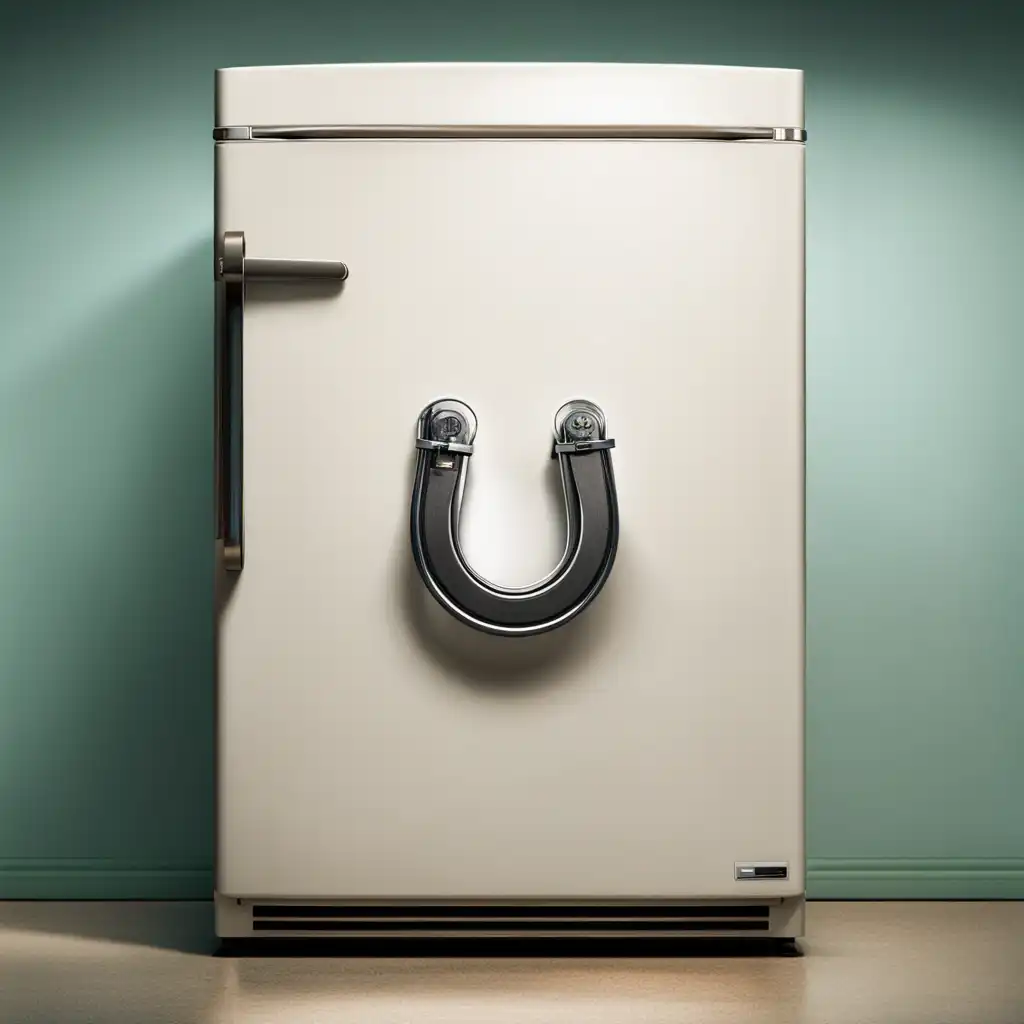
A piece of iron or other material which has its component atoms so ordered that the material exhibits properties of magnetism, such as attracting other iron-containing objects or aligning itself in an external magnetic field.
The refrigerator door is kept closed by a small magnet.
ऑडियो लोड नहीं हो सका। कृपया बाद में फिर कोशिश करें।
उपयोग कैसे करें
A magnet is a special rock that has the power to attract some kinds of metal, like iron. You might use a magnet in your classroom to pick up small metal pieces like paperclips. Magnets are also used in many machines to help them work, like in a computer hard drive.
An electromagnet is a type of magnet that is created by passing an electric current through a coil of wire. The magnetic field is produced by the motion of electric charges, in this case, electrons flowing through the wire.
A magnet is static and does not require any external source of energy or current to function, while an electromagnet is powered by electricity.
Electromagnets can be turned on and off, making them more versatile in their applications.
Magnets are commonly used in everyday items such as speakers, refrigerators, and magnetic locks. Electromagnets have a wide range of applications, such as in electric motors, MRI machines, and lifting heavy loads in cranes.
A lodestone is a naturally magnetized rock that can attract iron and other metallic objects, whereas a magnet is a man-made object that can produce a magnetic field which attracts or repels magnetic materials.
Lodestones were used by sailors in the past to navigate because they would always point towards the North Pole.
Nowadays, compasses have replaced their use. Lodestones are also used in various scientific and educational demonstrations.
Overall, lodestones occur naturally while magnets are man-made and have a wider range of applications.
A magnet is a physical object that produces a magnetic field, which can attract or repel other magnetic materials. Magnetic refers to the ability of a material or object to be attracted to a magnet or to produce a magnetic field.
For example, a refrigerator magnet is a magnet because it produces a magnetic field that allows it to stick to the metal surface of a fridge.
The metal surface is magnetic because it is able to be attracted to the magnet.
Similarly, a compass needle is a magnetic object because it is moved by the Earth's magnetic field.
The word magnet is used to refer to a specific object or device that produces a magnetic field, while magnetic describes the properties of materials or objects that interact with magnetic fields.
the magnets fly out. Magnets are constantly trying to flip over so that the opposite poles meet. So how can we make magnetic levitation more stable? And more importantly how can we do it on a large scale?
as well as whether the particle is matter or antimatter. While the two are normally indistinguishable, their opposite charges enable them to be detected with the help of a magnet.
I recognise life is like a magnet. Positive and negative are on the opposite sides of the magnet. You can try to cut the negative part off, but it's still there. When you accept both of them, it's like, 'You know what? Don't get too identified with success or too identified with failure - just be cool with them.
now magnets are everywhere there in computers televisions hi-fi's fans washing machines stereo equipment tape players absolutely everywhere right down to the humble fridge magnet and they
I truly believe Accenture is a magnet for top talent in the new, not only because of the work we do for clients but because our culture supports employees who want to make a difference in the community where we live and work.
because of some biological "Oh we don't have magnets in our beaks or in our scales." No; if your language and your culture trains you to do it, actually you can do it. There are humans around the world who stay oriented really well. And just to get us in agreement
really a kid magnet it's freedom trust and responsibility so we need to help teachers change we need to help teachers see that authentic project-based learning is not only in the students interest it's in the teachers interest
It's a process that not only happens in the biological and chemical world, but is a phenomenon that can be seen from magnets to snowflakes, robotics, social networks, the formations of cities and galaxies, to name just a few. In biology and chemistry, self assembly is everywhere,
The unthankful heart... discovers no mercies; but let the thankful heart sweep through the day and, as the magnet finds the iron, so it will find, in every hour, some heavenly blessings!
I'm not talking about that kind of attraction. See they have mass and since they have mass, they will move towards each other. They are attracted to each other. Maybe one more thing might help. Have you ever played with two magnets? You know the magnets with the north and the south poles?
Called the heliosphere this force field protects the planets from harmful cosmic radiation It's caused by the sun's plasma pushing electrically charged particles toward the Stars poles This process turns the Sun into a giant magnet
And we re-create the conditions that were present less than a billionth of a second after the universe began up to 600 million times a second inside that detector -- immense numbers. And if you see those metal bits there -- those are huge magnets that bend