clapper
noun clapper
ˈklæpər
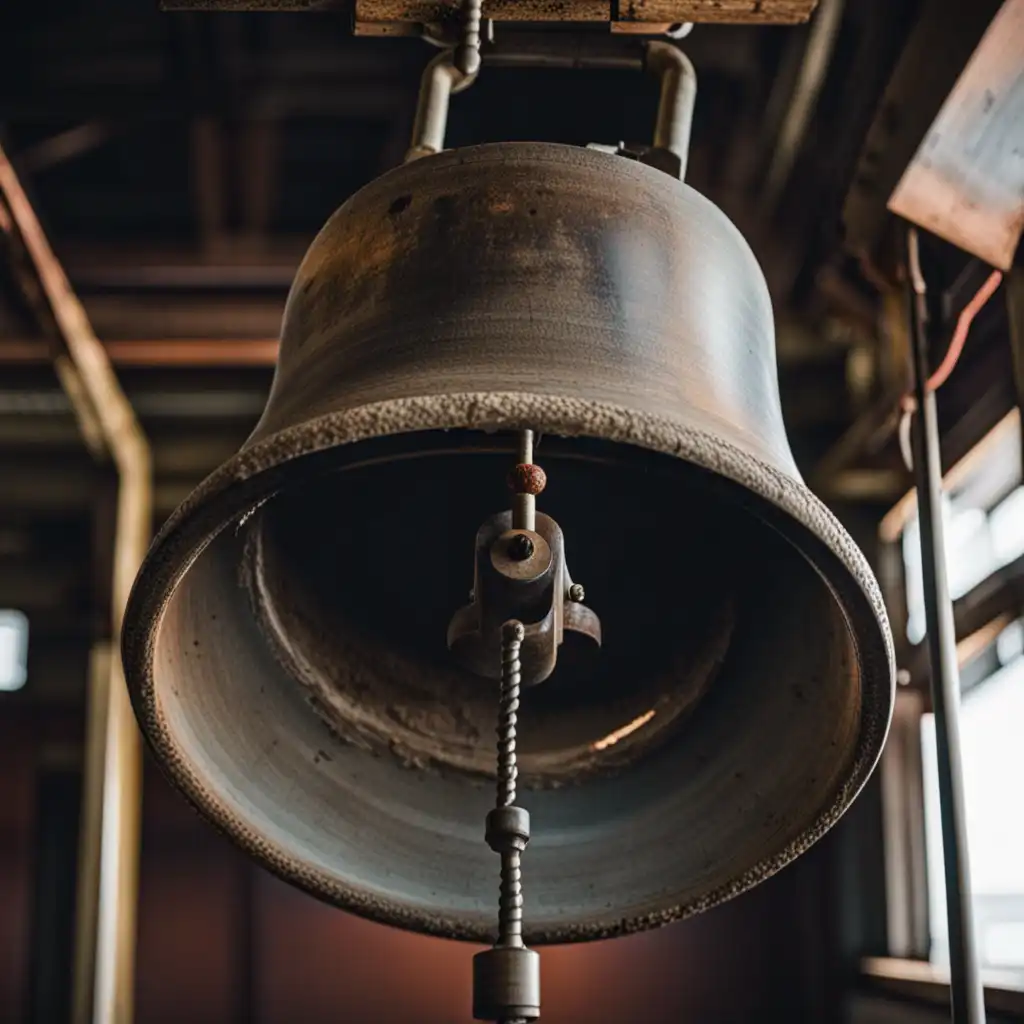
A device inside a bell that makes it ring.
The bell will not make a sound, as the clapper is broken.
clapper
ˈklæpər
Chargement…
ˈklæpər
A device inside a bell that makes it ring.
The bell will not make a sound, as the clapper is broken.

ˈklæpər
A person who applauds or cheers.
Every performer appreciates a good clapper in the audience.

ˈklæpər
A device used in movie production to mark the start of a scene or take.
Before each shot, the director's assistant clapped the clapper.
Impossible de charger l’audio. Réessayez plus tard.
The word 'clapper' has a few different meanings, but most commonly it refers to a piece of metal or wood that swings back and forth inside a bell, making it ring. You might hear the word 'clapper' used when talking about church bells, school bells or even handbells that musicians play. 'Clapper' can also be used to describe someone who talks a lot or who applauds loudly, but this is less common.
A bell is a hollow instrument made of metal or another hard material that produces a ringing sound when struck or set in motion.
It is typically used for signaling, announcing the time, or as a musical instrument. The bell is the actual instrument that produces the sound.
A clapper is the part of the bell that strikes it to produce the sound.
It is usually a small piece of metal or wood that hangs inside the bell and swings back and forth when the bell is rung.
The clapper is necessary for the bell to produce sound but is not the bell itself.
The bell is the instrument, and the clapper is the part that produces the sound by striking the bell.
Ouvrir le mot: Bell →Chime refers to a set of musical bells or a bell-like sound produced by striking metal tubes or rods of different sizes.
So, while chime is used to refer to the sound or the set of musical bells, clapper is the part of the bell that produces the sound by hitting the side of the bell.
Ouvrir le mot: Chime →A gong is also a percussion instrument, but it is a large round metal disk that is struck with a mallet to produce a deep and resonant sound.
A gong is typically used in orchestras and ensembles, as well as in meditation and ceremonial settings.
A clapper is a smaller instrument that produces a sharp sound, while a gong is a larger instrument that produces a deep and powerful sound.
Ouvrir le mot: Gong →A hammer is a tool with a heavy metal head attached to a wooden or metal handle.
A clapper produces sound, while a hammer is used for physical work.
Ouvrir le mot: Hammer →A knocker is a piece of metal or wood that is mounted on a door or gate and used to announce one's presence by striking it.
Knockers are found on external doors, such as front doors or gates. They are used by visitors to signal their arrival or to get someone's attention.
Knockers are often designed to be decorative as well as functional.
The main difference between the two words is their location and purpose. Clappers are used inside bells to make a ringing sound, while knockers are attached to doors or gates to signal visitors.
Ouvrir le mot: Knocker →Clapper describes the part of a bell that produces sound. Peal refers to a series of loud and continuous ringing sounds made by multiple bells or by a single bell ringing repeatedly.
Peal describes the sound produced by bells. Clapper is applicable when talking about the physical part of a bell that strikes it to produce sound, while peal is applicable when talking about the loud ringing sound itself.
Ouvrir le mot: Peal →Ringer refers to a person or device that causes a bell to ring. A clapper is a part of the bell that is responsible for producing sound, while a ringer can be a person, machine, or any other device that makes the bell ring.
Clapper refers to a part of a bell, while ringer refers to something that makes the bell ring.
Ouvrir le mot: Ringer →A striker is a piece of metal that is used to strike a percussion instrument, such as a gong or a xylophone, to create sound.
However, generally, a clapper is used in a bell, while a striker is used in other percussion instruments.
Ouvrir le mot: Striker →I would like to have a 'Lost' clapper board with the numbers and the clock at the top.
I don't have continuity people. I don't have clapper boards. I don't have monitors. I shoot very fast, I shoot a lot, and we just keep on going.
I am writing a book called 'The History of Australia in Hundred Objects.' It's of things we have invented in Australia. And you know, some of them are amazing. We invented the clapper boards used in films. We invented those cranes - those big long cranes used on construction sites.