
cerebral
adjective cerebral
səˈriːbrəl
Related to the brain or intellectual activity
The game is popular among people with cerebral interests.
cerebral
səˈriːbrəl
読み込み中…
səˈriːbrəl
Related to the brain or intellectual activity
The game is popular among people with cerebral interests.
səˈriːbrəl
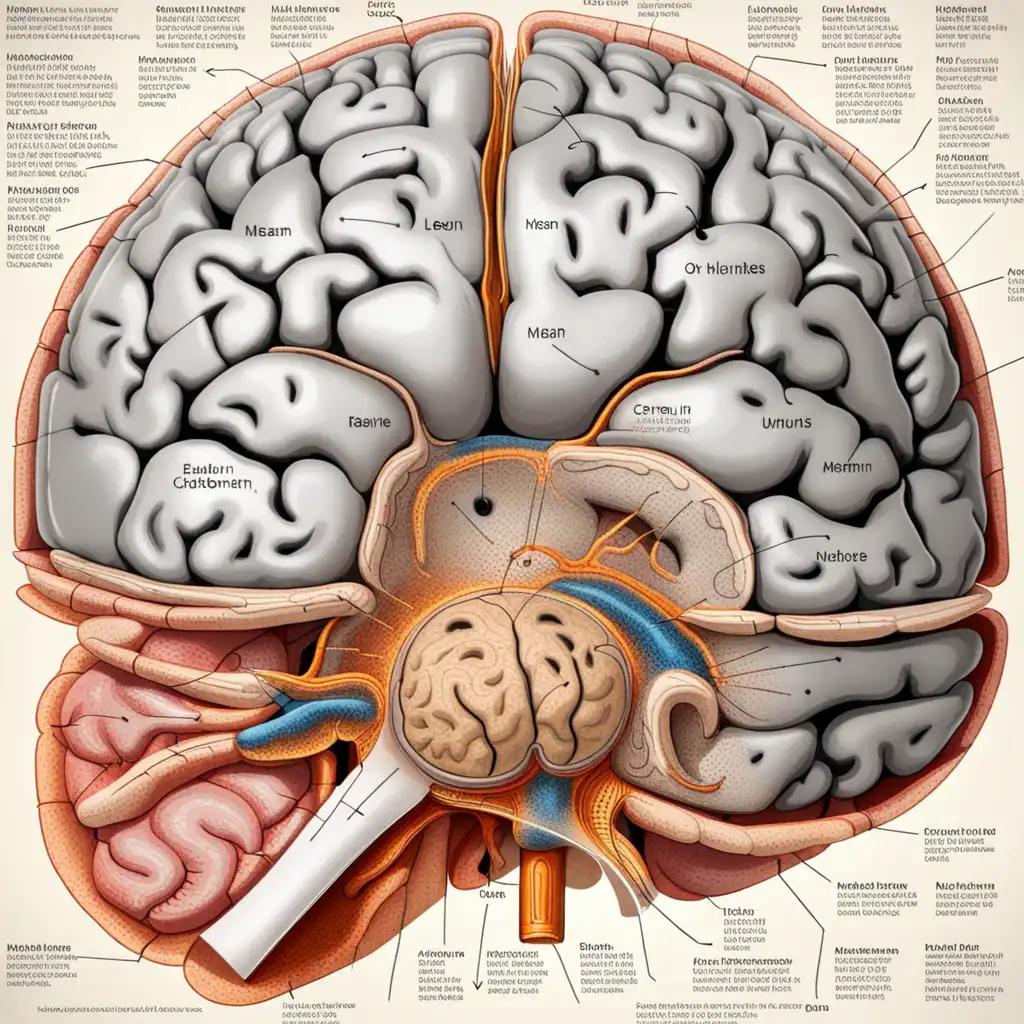
Specifically related to the cerebrum, the frontal part of the brain responsible for thought and sensory integration
The scan shows a lesion in the cerebral hemisphere.
音声を読み込めませんでした。しばらくしてからもう一度お試しください。
The word 'cerebral' is used to describe something that relates to the brain, thinking or intelligence. It can also be used to describe a person who is very rational and uses a lot of intellect in their decisions. For example, "Her writing style is very cerebral", "The cerebral part of the brain controls memory and thinking", "He is a cerebral person who always thinks things through before making a decision." Overall, it is used to describe something or someone who uses their brainpower a lot.
Both brainy and cerebral imply intelligence or intelligence-related attributes.
However, brainy is generally used to describe a person who is naturally smart, intelligent or clever with a quick and sharp mind.
Brainy is mostly used to describe individuals while cerebral describes complex mental processes or intellectual pursuits.
単語を開く: Brainy →Cerebral and cognitive are both related to the brain, but they have different meanings.
Cognitive refers to mental processes such as learning, perception, and problem-solving, like cognitive development in infants.
Cerebral is applicable when talking about the physical brain, while cognitive describes mental abilities and processes.
単語を開く: Cognitive →Erudite refers to someone who has a lot of knowledge and expertise in a particular subject. For example, a professor may be described as erudite because they have a lot of knowledge and information on a subject.
In summary, both words refer to intellect and knowledge, but cerebral describes something deep and thoughtful, while erudite describes someone who is knowledgeable and well-educated in a particular subject.
単語を開く: Erudite →Intellectual refers to things that are related to the intellect or the ability to reason, think critically and solve problems.
It is often used to describe people who engage in intellectual pursuits, such as academia or the arts.
Both words can describe things related to the mind, but cerebral is more focused on abstract concepts and mental processes, while intellectual is more focused on critical thinking and problem-solving.
単語を開く: Intellectual →Cerebral refers to something related to the brain or intellect, while mentally refers to something related to the mind or mental state.
Mentally is applicable in a wider range of contexts, including emotional states (such as happiness, sadness, or anxiety), psychological conditions (such as depression or schizophrenia), and broader aspects of mental health and well-being.
For example, a person who is mentally healthy is likely to be able to manage stress, have positive relationships, and experience a general sense of well-being.
単語を開く: Mentally →Rational, on the other hand, describes something that is based on reason or logic. It suggests that someone is able to think logically and make decisions based on logical thinking rather than emotions.
So while cerebral is related to thinking and intellect, rational is related to decision-making and logic. Both of these words can be used in a variety of situations, but cerebral is more often used to describe people's personalities or interests, while rational is used more to describe decisions or arguments.
単語を開く: Rational →Scholar refers to a person who has advanced knowledge in a particular field, usually through higher education and research.
A scholar may specialize in a certain subject and may be an expert in it.
Cerebral can describe a type of thinking or intelligence, whereas scholar describes a person who has attained a high level of knowledge and expertise in a specific field.
単語を開く: Scholar →Both cerebral and thoughtful refer to using one's mind to think, but there are differences in their usage.
Thoughtful: This word refers to someone who thinks carefully about others and behaves kindly towards them.
It is often used to describe someone who is considerate of others' feelings and needs. For example, a person who sends a thank-you card to a friend who supported them during a difficult time can be described as thoughtful.
単語を開く: Thoughtful →and a highly developed hippocampus and cerebral cortex. It is the hippocampus strongly associated with emotion that aids recollection by encoding important experiences into long-term memories. The ability to distinguish this importance makes elephant memory
YouTube で見る ↗Football's always been cerebral. The most important thing is thinking fast.
So what does? We can't do anything about getting older or the genes we've inherited. So far we haven't changed our brain's destiny. What about sleep? In slow-wave deep sleep our glial cells rinse cerebral spinal fluid throughout our brains,
YouTube で見る ↗The last few years I've had to force myself to go out and be more involved the world because I can get a bit more cerebral and escape into characters and the world of characters. But now I guess I escape into stories about 'Wilfred.
is very rewarding to people it's very difficult physically but it's also a very kind of cerebral support it's slow and methodical and you have to think
YouTube で見る ↗The thing about Sondheim is that it does get very cerebral. You do need a faculty with words and a love for the lyrics to not just pull it off, but to have an appreciation for it.
the elasticity from your shoulders down to your soles to recreate one body loading as you're pushing around and flying around but we even more passionate about the earth applications this young gentleman has cerebral palsy so we dream about inventing an enhanced
YouTube で見る ↗There are times when I prefer a cerebral moment with an artist, and I'll just enjoy the wit of a Picabia or a Duchamp. It amuses me that they thought that what they did would be a good way of making art.
and that surfaces are breathing. At higher doses the visual world can appear to melt, dissolve into swirls, or burst into fractal-like patterns. Evidence suggests these drugs also act on the cerebral cortex.
YouTube で見る ↗I think I'm a very cerebral player.
in the middle of the cerebral hemisphere and then out to other regions of the brain. But smell because it evolved before most of your other senses, takes a direct route to these different regions of the brain, where it can trigger your fight-or-flight response, help you recall memories or make your mouth water. But even though we've all got the same physiological set-up,
YouTube で見る ↗He is far too intelligent to become really cerebral.
affecting multiple parts of the brain— the brainstem cerebral hemispheres and the nerves themselves. But we don't know for sure what exactly triggers each step, why some people get migraines and not others, why so many more women do than men, or why people’s migraine patterns sometimes change over their lifetimes.
YouTube で見る ↗I'm quite a cerebral person. Often I feel quite stuck in that.
does not necessarily have more neurons than a more modest-sized brain. Maybe the human brain actually has the most neurons of any brain regardless of its size, especially in the cerebral cortex. So this to me became the important question to how many neurons does the human brain have,
YouTube で見る ↗I like the cerebral process.
and compare the ideal solutions to those problems to the way that we actually behave. As a side effect, I get to see how applying a little bit of computer science can make human decision-making easier. I have a personal motivation for this. Growing up in Perth as an overly cerebral kid
YouTube で見る ↗I'm more cerebral than I want to be.
There is the brain stem in between the cerebral cortex and the spinal cord. And it is within that region that I'm going to highlight now that we have this housing of all the life-regulation devices
YouTube で見る ↗I'm not a particularly cerebral writer. I unabashedly go for the belly.