Impossible de charger l’audio. Réessayez plus tard.
Comment l’utiliser
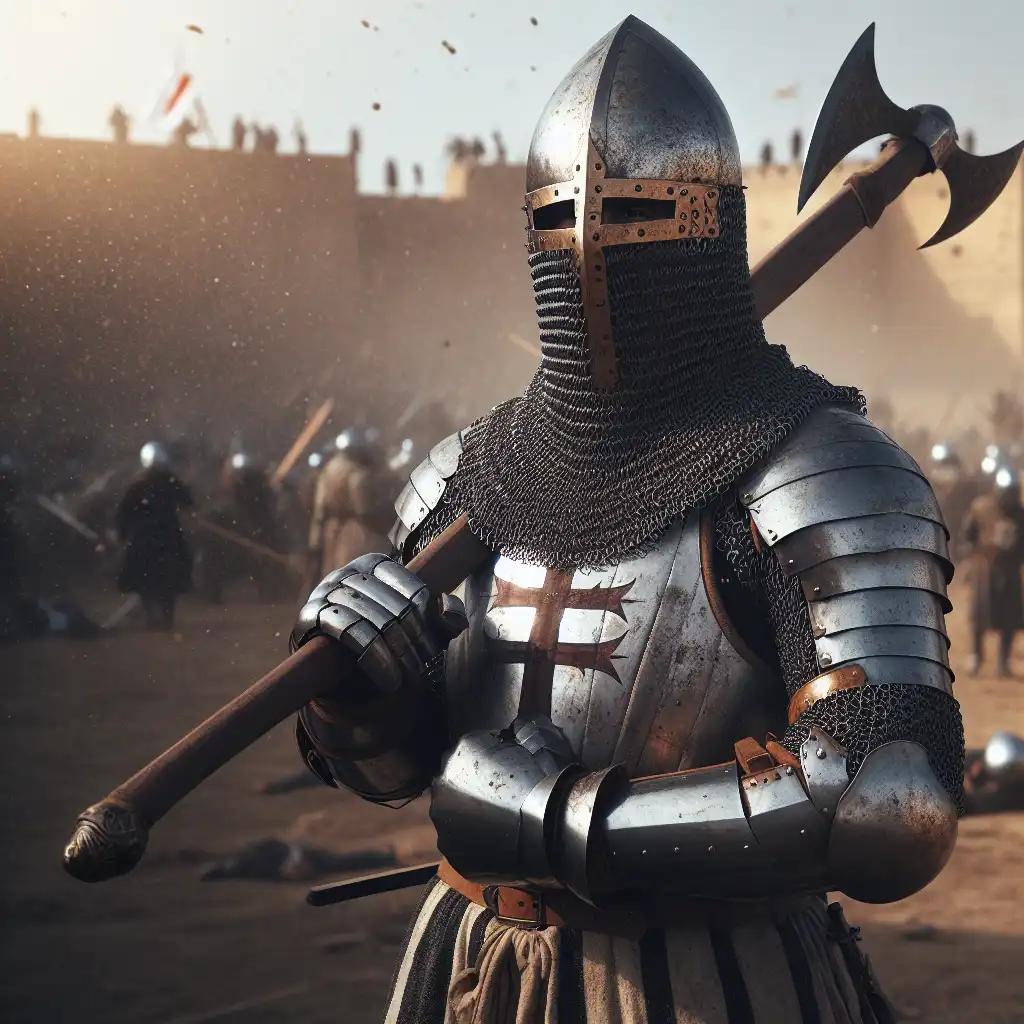
The word 'poleaxe' refers to a type of weapon that was used in the past for fighting. It is a long-handled axe that was used in battles and wars to strike the enemies. Nowadays, it is not commonly used as it is not legal to use it for attacking someone. The term is still used in historical contexts, museums, and literature to describe the weapon or as a term of reference.
Both halberds and poleaxes are medieval weapons that were commonly used by foot soldiers.
A halberd is a two-handed pole weapon that has a long pole with a pointed blade at the top, as well as an axe blade and a hook or spike on the side.
Halberds were popular in the 14th and 15th centuries and were mainly used by foot soldiers.
A poleaxe is similar to a halberd but has a shorter pole and a larger, more crescent-shaped axe head. The poleaxe was designed for use against armoured opponents, such as knights.
The main difference between a halberd and a poleaxe is that the former has a pointed blade, axe blade and hook or spike, while the latter has a shorter pole and a larger, more crescent-shaped axe head with a spike on top.
Both weapons were used by foot soldiers, but the halberd was more versatile, while the poleaxe was designed for use against armoured opponents.
Partisan refers to a strong supporter of a particular party, cause, or person.
Partisan can refer to a supporter or a weapon, while poleaxe specifically refers to a type of weapon. Partisan is applicable when talking about politics or support for a particular cause, while poleaxe is applicable when discussing medieval weapons or warfare.