
voyager
noun voyager
ˈvɔɪɪdʒər
A person who travels from one place to another, especially for exploration or discovery.
Christopher Columbus was a famous voyager who traveled across the Atlantic Ocean.
voyager
ˈvɔɪɪdʒər
불러오는 중…
ˈvɔɪɪdʒər
A person who travels from one place to another, especially for exploration or discovery.
Christopher Columbus was a famous voyager who traveled across the Atlantic Ocean.
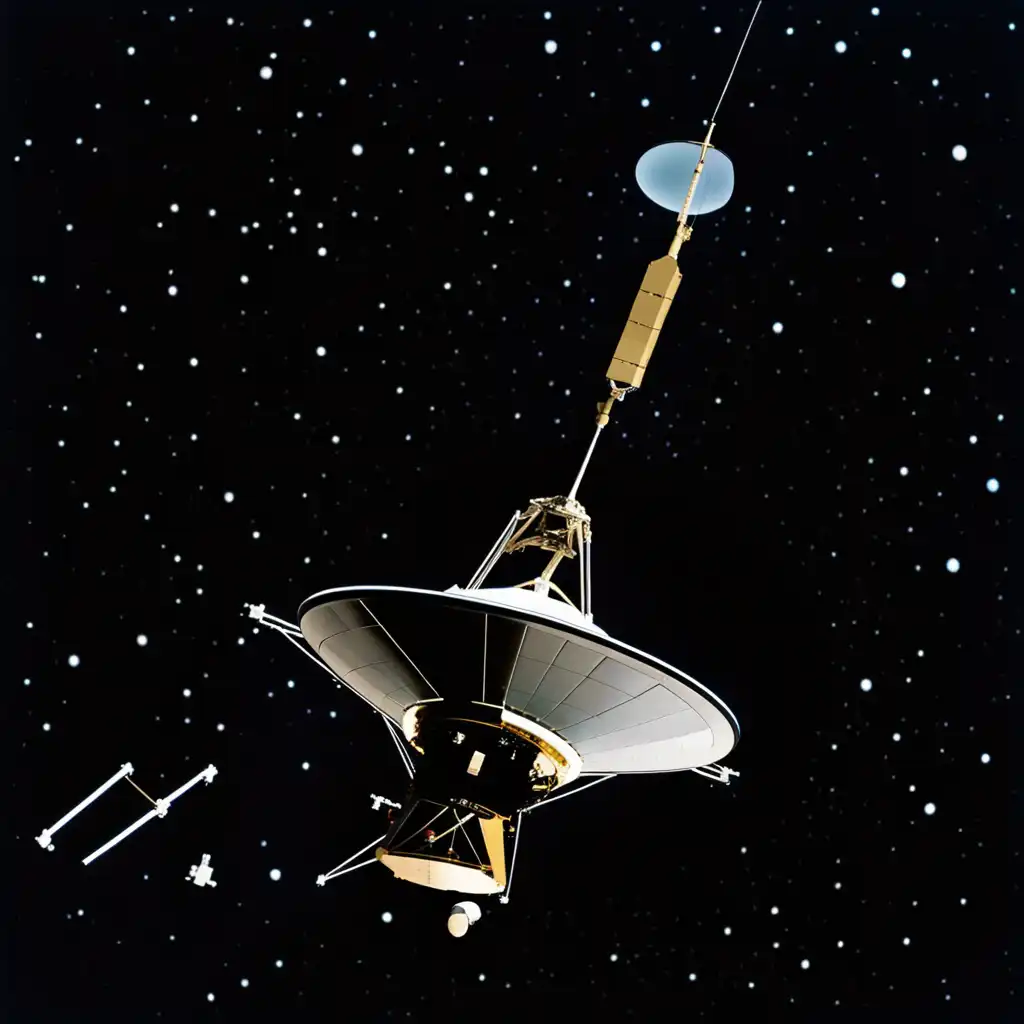
ˈvɔɪɪdʒər
The name of two spacecrafts, Voyager 1 and Voyager 2, launched by NASA.
In 2012, Voyager 1 became the first man-made object to enter interstellar space.

ˈvɔɪɪdʒər
A model of large aircraft made by Boeing for long international flights.
The Voyager is a key part of any international airline's fleet due to its long range capabilities.
오디오를 불러오지 못했어요. 잠시 후 다시 시도해 주세요.
The word 'voyager' is often used to describe a person who is traveling or exploring new places, especially on a long journey. It can also refer to a spacecraft or a person who is on a spacecraft traveling through space. For example, if someone is planning to go on a trip to another country, they might be called a voyager. Or if someone is talking about the Voyager 1 spacecraft that was launched by NASA, they might use the word 'voyager'.
An adventurer is someone who seeks out exciting and often dangerous experiences, typically for personal gain or satisfaction.
In summary, adventurers seek excitement and adrenaline, while voyagers seek knowledge and understanding. Both types of people may travel and explore new places, but their motivations and attitudes towards the experience are different.
단어 열기: Adventurer →An explorer is someone who travels to new and unknown places in order to discover and learn about them. They may be seeking new lands, resources or information.
Explorers may travel by foot, horse, ship, or other means.
In short, explorers are focused on discovering new things, while voyagers are focused on reaching a specific destination.
However, these terms can overlap in certain contexts, such as when an explorer embarks on a journey to reach a previously undiscovered land or when a voyager is exploring new environments on their journey.
단어 열기: Explorer →A navigator is someone who helps steer a ship or aircraft, and uses maps and instruments to determine its position and course.
Navigators help ensure the ship or aircraft reaches its intended destination safely and efficiently.
A navigator is focused on directing a journey and ensuring it is executed properly, while a voyager is focused on experiencing and discovering new things along the way.
단어 열기: Navigator →Pilgrim typically refers to someone who is on a religious journey, often to a holy site or shrine. It is applicable when talking about someone who is making a spiritual pilgrimage, such as traveling to Mecca as a Muslim or to Jerusalem as a Christian.
Pilgrim is focused on religious travel, while voyager is focused on exploration and discovery.
단어 열기: Pilgrim →A tourist is someone who travels for pleasure or sightseeing, usually for a short period of time. They typically visit popular tourist destinations and stay in hotels or resorts.
While a tourist might visit a beach resort in Hawaii and spend most of their time lounging on the sand, a voyager might explore the remote villages and culture of a lesser-known island in the Pacific.
In general, anyone can be a tourist, but being a voyager requires a certain mindset and attitude towards travel.
단어 열기: Tourist →Both travel and voyager refer to going on a trip or journey, but there is a slight difference in how they are used. Travel usually refers to the act of going from one place to another, while voyager suggests a sense of adventure and exploration.
For example, you might say "I am traveling to New York for business." This implies that you are going there for a specific purpose, such as a meeting or conference.
Travel is a more common and broad term that can be used in a variety of contexts, while voyager is more specific and suggests a certain type of travel.
단어 열기: Travel →Wander refers to someone who moves about aimlessly or without a specific destination in mind. It implies a more leisurely and spontaneous journey.
Voyager is applicable when someone sets out on a journey with a clear intention or objective, while wander is applicable when someone is simply wandering without any definite plan or purpose.
단어 열기: Wander →A wayfarer refers to someone who travels on foot or by other means, often on a less structured travel route, with an emphasis on the experience of the journey itself.
Both words can describe travelers, but voyager is typically used to describe someone who is traveling with a specific goal or destination in mind, while wayfarer describes someone who is traveling more for the journey and exploration than for a specific destination.
단어 열기: Wayfarer →poorly understood and the stuff of legends. But it is made also of dramatic landscapes like this huge underground chamber, and it is rich with surprising biological and mineralogical worlds. Thanks to the efforts of intrepid voyagers in the last three centuries --
YouTube에서 보기 ↗Voyagers discover that the world can never be larger than the person that is in the world; but it is impossible to foresee this, it is impossible to be warned.
You'll notice a theme in these examples is the robot uprising and the dystopic view of what robots will do to the world. To depart from that I'd like to give an example of what I think are my two favorite robots in history. Voyager 1 was a robot.
YouTube에서 보기 ↗I think music is a big, big wide world, and I am voyager on this particular ship in this sea of wild music, and I'm gonna dive in and find as many fish as I can and catch them all. I love music.
Some historians believe the voyagers moved from place to place to avoid overpopulation. Others that they were driven by war. Voyages became less frequent by around 1300 A.D.
YouTube에서 보기 ↗The first voyagers to the stars will be creatures whose life cycle is matched to the voyage: the aeons involved in traversing the galaxy are not daunting to immortal beings. By the end of the third millennium, travel to other stars could be technically feasible. But would there be sufficient motive?
The planet is our canoe, and we are the voyagers. True navigation begins in the human heart. It's the most important map of all.
YouTube에서 보기 ↗Support space-resource and industrial infrastructure. Multibillion-dollar satellites or voyagers to Mars and beyond, if we don't live off the land, we will always only be visitors or wire stringers in territories we do not inhabit or control.
terms of technological achievement nobody can match us in terms of achievement and exploration we are on Mars we are on the moon you know when Voyager left the solar system page one storm for the first time in the history of humanity not only had we visited
YouTube에서 보기 ↗I am a voyager - and the voyage cannot mean that I stay at home.
also found for the first time measured directly the fact that from the Sun there's a million mile per hour wind blowing radio outward creating a huge bubble around the Sun called the heliosphere and today the two voyagers are on the journey to interstellar space
YouTube에서 보기 ↗Certainly one of the more common experiences in the jazz field is discovering someone new. Improvising musicians are capable of being musical travelers, voyagers. We want to join in on whatever we hear. There is a freedom to wander the musical landscape.
when the space-hardened voyagers 1 & 2 flew past in 1979 on their way to the outer solar system Jupiter's great mysteries only deepened how were these powerful magnetic storms generated inside a giant ball of gas why
YouTube에서 보기 ↗My undergraduate degree was in history, and I wish I had been smart enough to really excel at maths, physics, chemistry or biology because... the voyagers and adventurers and real contributors - that's where they come from.
- We're featuring my interview ocean voyager Nainoa Thompson. And I had to ask him how the ancient Polynesians navigated
YouTube에서 보기 ↗We need to begin thinking about building permanence on the Red Planet, not just have voyagers do some experiments, plant a flag and claim success. Having them go there, repeat this, in my view, is dim-witted. Why not stay there?
through an obstacle course of rings hopes and dreams of thousands of scientists and engineers arresting on the next few moments we've been to saturn twice before with the voyager 1 and voyager 2 spacecraft
YouTube에서 보기 ↗I use the period between Christmas and New Year to potter about, think and completely change my mindset. In that easy no-man's-land between Boxing Day and New Year, loins are girded and mettle readied. It is time, as we voyagers bid farewell to the old year, to fare forward.
- One. - And then a blinding pillar of fire. - Liftoff. We have a liftoff. - A mighty voyager leaves the Earth behind to explore the vast universe among the stars. Launching a rocket into space
YouTube에서 보기 ↗Companies that have the capability to settle space don't have the ambition and companies that have the ambition don't have the capability. Voyager was founded to do something about that.