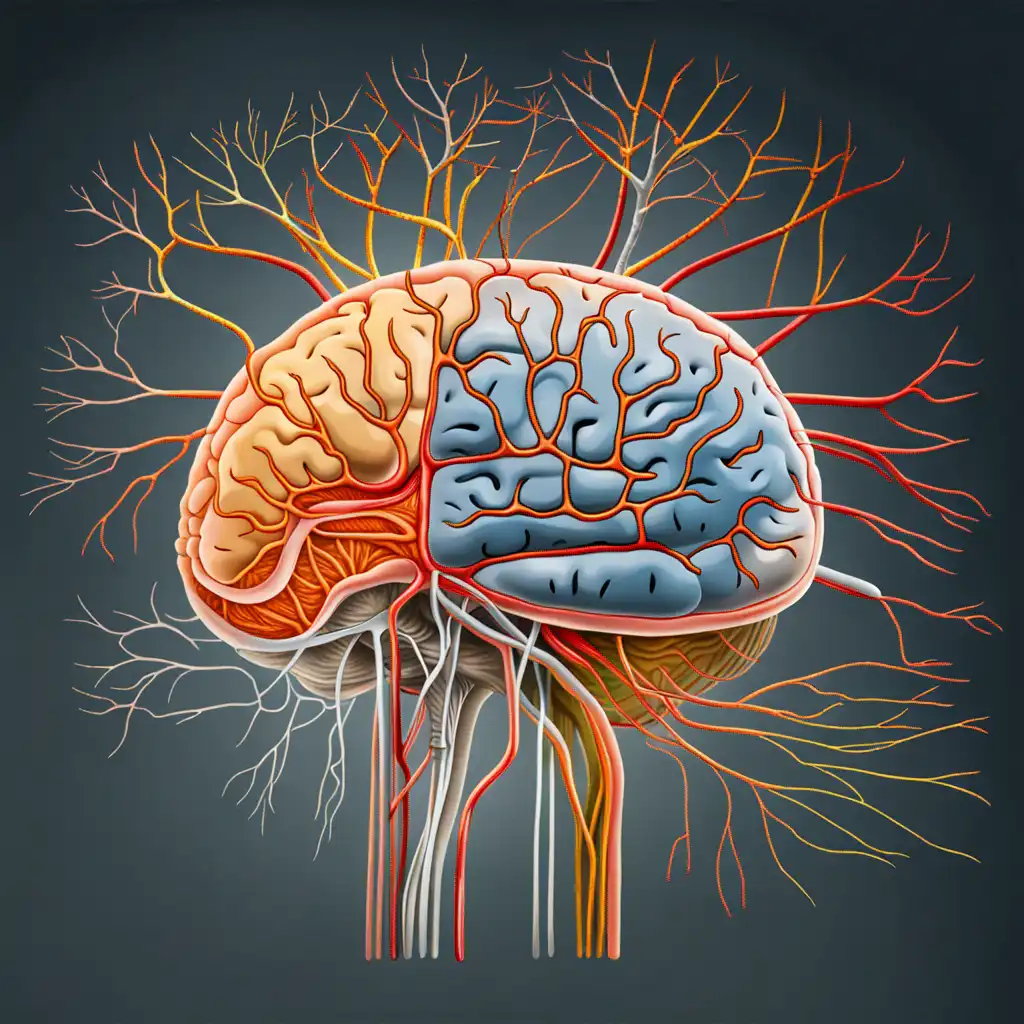
neural
adjective neural
ˈnʊrəl
Relating to nerves or the nervous system.
The brain is a complex neural system.
neural
ˈnʊrəl
読み込み中…
ˈnʊrəl
Relating to nerves or the nervous system.
The brain is a complex neural system.

ˈnʊrəl
Relating to a computer model designed to simulate the behavior of the brain.
She's programming a neural network.
音声を読み込めませんでした。しばらくしてからもう一度お試しください。
The word "neural" refers to anything related to the nervous system, which is the part of our body that helps us think, move, and feel. We use the word "neural" when talking about things like neural networks (a type of computer system modeled after the human brain), neural pathways (the routes that messages travel in the nervous system), or neural stimulation (using electricity or other methods to affect the nervous system). Basically, if something has to do with the nerves in our body, we might describe it as "neural."
Cerebral refers to the brain or the mind, while neural refers to the nerves or the nervous system.
Cerebral is applicable when talking about things related to the brain, like psychology or cognitive processes. For example, when someone is using their intellect to solve a problem, we might say they're engaging in a cerebral activity.
So, overall, the main difference between these two words is that cerebral is related to the mind or brain, while neural is related to the nerves or nervous system.
単語を開く: Cerebral →Nervous is related to our emotions and feelings. When we are nervous, we feel anxious, scared, or worried about something.
Neural is related to our nervous system- a complex network of nerves that control and coordinate the functions of our body.
Neural refers to the neurons or nerve cells that make up our nervous system.
In simpler terms, nervous refers to our emotions, while neural refers to our nervous system. We use nervous to describe how we feel while neural describes the functions of our body.
単語を開く: Nervous →Neuralgia refers to a type of pain that occurs along the path of a nerve. Neuralgia is a medical condition that causes severe, shooting or stabbing types of pain, usually along the nerves of the face, head, and neck.
Neural is a general term to describe things related to the nervous system, while neuralgia is a medical term for a specific type of nerve pain.
単語を開く: Neuralgia →Neural refers to anything related to nerve cells, while neurological refers to anything related to the nervous system. Neural is more specific and refers only to the cells themselves, while neurological encompasses the entire system and how it functions.
Neural is often used in the context of brain function, while neurological describes diseases or conditions that affect the nervous system as a whole.
For example, a scientist might study neural pathways in the brain, while a doctor might diagnose a patient with a neurological disorder such as multiple sclerosis.
単語を開く: Neurological →Synaptic refers to the connections between neurons, which allow them to communicate with one another. Synapses are the tiny gaps between neurons where chemical or electrical signals are passed from one neuron to another.
So, in short, neural is a more general term that can be applied to anything related to neurons, while synaptic refers specifically to the connections between neurons.
単語を開く: Synaptic →This process is important because our neural pathways serve as a map for everything we do. Using functional magnetic resonance imaging, scientists have discovered that the brain's pruning ability is disrupted in people with bipolar disorder. That means their neurons go haywire
YouTube で見る ↗Now that neural nets work, industry and government have started calling neural nets AI. And the people in AI who spent all their life mocking neural nets and saying they'd never do anything are now happy to call them AI and try and get some of the money.
to solve real-world ai um you you you know because you said what are the road networks designed to to work with they're designed to work with a biological neural net our brains and with uh vision our eyes and so in order to make it work
YouTube で見る ↗Deep neural networks are responsible for some of the greatest advances in modern computer science.
The endocrine system is a series of glands that use information carried by the nervous system to help regulate the body's processes Thanks to this neural connection endocrine glands such as the thyroid are aware of the amount of hormones and other chemicals They need to produce these chemicals are then distributed throughout the body by way of the cardiovascular system the
YouTube で見る ↗If you want to make information stick, it's best to learn it, go away from it for a while, come back to it later, leave it behind again, and once again return to it - to engage with it deeply across time. Our memories naturally degrade, but each time you return to a memory, you reactivate its neural network and help to lock it in.
this one strike and he tends to have a little bit more of a feisty character than his brother he's gonna be a change I can see already see what I mean about being straw be aren't you yeah that's good you got spirit so this is one we call in spot this neural chat was the first one born and he was the one that
YouTube で見る ↗It is literally the case that learning languages makes you smarter. The neural networks in the brain strengthen as a result of language learning.
comes a condition of military service in a possible future neural tech not narrow technologies could enable people across society to overcome depression to boost our physical health to learn complex
YouTube で見る ↗I think the brain is essentially a computer and consciousness is like a computer program. It will cease to run when the computer is turned off. Theoretically, it could be re-created on a neural network, but that would be very difficult, as it would require all one's memories.
who showed the same levels of cognitive function and neural processing at the start, found that those who were exposed to a period of music learning showed enhancement in multiple brain areas compared to the others. This recent research about the mental benefits of playing music has advanced our understanding of mental function,
YouTube で見る ↗All novels attempt to cut neural routes through the brain, to convince us that down this road the true future of the novel lies.
and it helps us perform with more ease speed and confidence. So what does practice do in our brains to make us better at things? Our brains have two kinds of neural grey matter and white matter. The grey matter processes information in the brain,
YouTube で見る ↗Having been trained as a computer scientist in the '90s, everybody knew that AI didn't work. People tried it. They tried neural nets, and none of it worked.
such as neural prosthetics and wearable robots that could become extended parts of our bodies. Or the slightly more radical idea of mind uploading, which dangles the possibility of immortal life without a body
YouTube で見る ↗Practicing is not only playing your instrument, either by yourself or rehearsing with others - it also includes imagining yourself practicing. Your brain forms the same neural connections and muscle memory whether you are imagining the task or actually doing it.
Thanks to the phenomenon of neuroplasticity, new synaptic buds are formed allowing new connections between neurons, and strengthening the neural network where the information will be returned as long-term memory. So why do we remember some things and not others? Well there are a few ways to influence
YouTube で見る ↗A brain scan may reveal the neural signs of anxiety, but a Kokoschka painting, or a Schiele self-portrait, reveals what an anxiety state really feels like. Both perspectives are necessary if we are to fully grasp the nature of the mind, yet they are rarely brought together.
An inhalation that could move water over gills followed by a rapid closure of the glottis preventing water from entering the lungs. That's supported by evidence which suggests that the neural patterning involved in generating a hiccup
YouTube で見る ↗When I'm writing, my neural pathways get blocked. I can't read. I can barely hold a conversation without forgetting words and names. I wish I could wear the same clothes and eat the same food each day.