farmland
noun farmland
ˈfɑːrmlænd
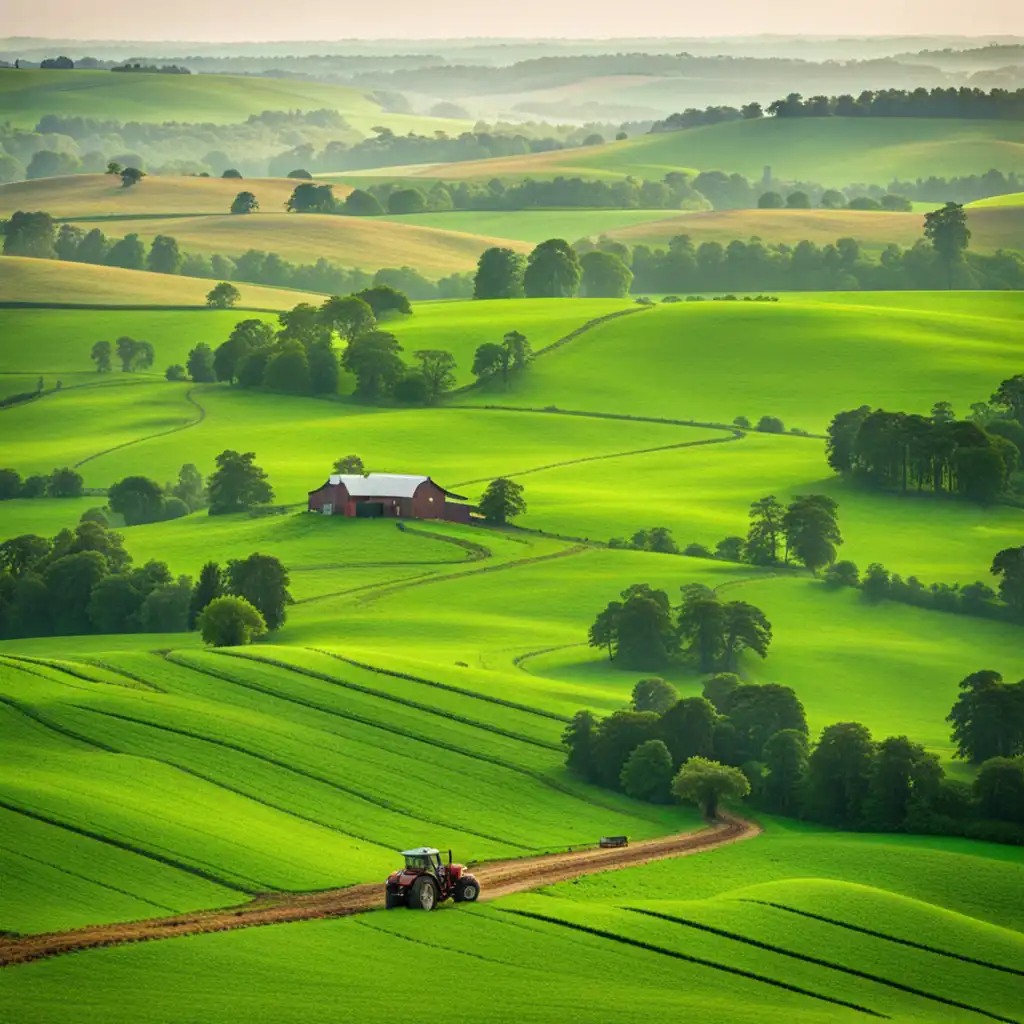
Land that is used for or suitable for farming.
The vast majority of the countryside is used as farmland.
farmland
ˈfɑːrmlænd
Chargement…
ˈfɑːrmlænd
Land that is used for or suitable for farming.
The vast majority of the countryside is used as farmland.
Impossible de charger l’audio. Réessayez plus tard.
Farmland refers to a type of land that farmers use to grow crops or raise animals. It's an area of land that is mostly used for agriculture. Farmers work on farmland to produce food for people and animals. The soil on farmland is usually fertile, which means it is good for growing crops. Farmland can be found in rural areas all over the world. It's important because it helps keep us fed and provides jobs for farmers.
Acreage refers to the amount of land or property in total, usually measured in acres.
If someone says they own 10 acres of land, that would be referring to their acreage. But if someone says they own 10 acres of farmland, it would mean they own 10 acres of land that is specifically used for farming.
Acreage can describe any type of land, while farmland is specifically used for farming purposes.
Ouvrir le mot: Acreage →Countryside refers to the rural or open spaces outside of cities and towns.
It can include areas with forests, meadows, hills and valleys, and sometimes even small towns or villages. Countryside is a general term used to describe any rural region.
In essence, countryside refers to any rural or open space, while farmland refers to the actual land used for farming. Countryside includes areas that are not farmland, such as forests or uninhabited areas, while farmland specifically refers to land that has been cultivated for agriculture purposes.
Ouvrir le mot: Countryside →Ants Use Grubs as Glue...
Voir sur YouTube ↗Farmfree production promises a far more stable and reliable food supply that can be grown anywhere, even in countries without farmland. It could be crucial to ending world hunger.
Jonathan Foley: The...
Voir sur YouTube ↗Human settlements are like living organisms. They must grow, and they will change. But we can decide on the nature of that growth - on the quality and the character of it - and where it ought to go. We don't have to scatter the building blocks of our civic life all over the countryside, destroying our towns and ruining farmland.
Can we create the...
Voir sur YouTube ↗Maine is the best place in the country to live and to raise our family. And it's because of our people and our approach to life. No fuss - no frills - just the stuff that really counts. The beauty around us. Our connection to our mountains and lakes and ocean and farmland.
The Water Crisis %\PIPE%...
Voir sur YouTube ↗My parents came from very humble families. My grandfather had a construction business coming from farmland, and my grandmother could never read or write. We were very spoiled. We had a nice house - and then, all of a sudden, we had nothing.
Through the shattered...
Voir sur YouTube ↗My grandpa was a big cowboy in his values and the way he lived his life. For our family, the ranch represented our family time when we got to drive down through all that desert farmland and Grandpa would wake us up at 5 A.M. to feed the horses if we wanted to earn the right to ride them later. I always had so much fun.
Beautiful Butterfly...
Voir sur YouTube ↗Growing Greener doesn't produce money for farmland preservation or open space preservation.
Marla Spivak: Why bees...
Voir sur YouTube ↗I grew up in Columbus, Indiana, a kind of industrial and farmland place.
3 reasons why we can win...
Voir sur YouTube ↗A lot of people don't know, but New Jersey has, like, 700,000 acres of farmland.
Caterpillar Cocoon...
Voir sur YouTube ↗We have serious challenges regarding climate change, unsustainable use of natural resources, water scarcity, loss of biodiversity, forests and farmland. Not to mention the huge inequality still prevailing in several parts of the planet.
Ants Adopt a Butterfly %\PIPE%...
Voir sur YouTube ↗I grew up in suburban New Jersey in a transitional area that was surrounded by farmland that wasn't being cultivated.