jiggle
verb jiggle
ˈdʒɪɡl
To move or cause to move with quick, short movements up and down or from side to side.
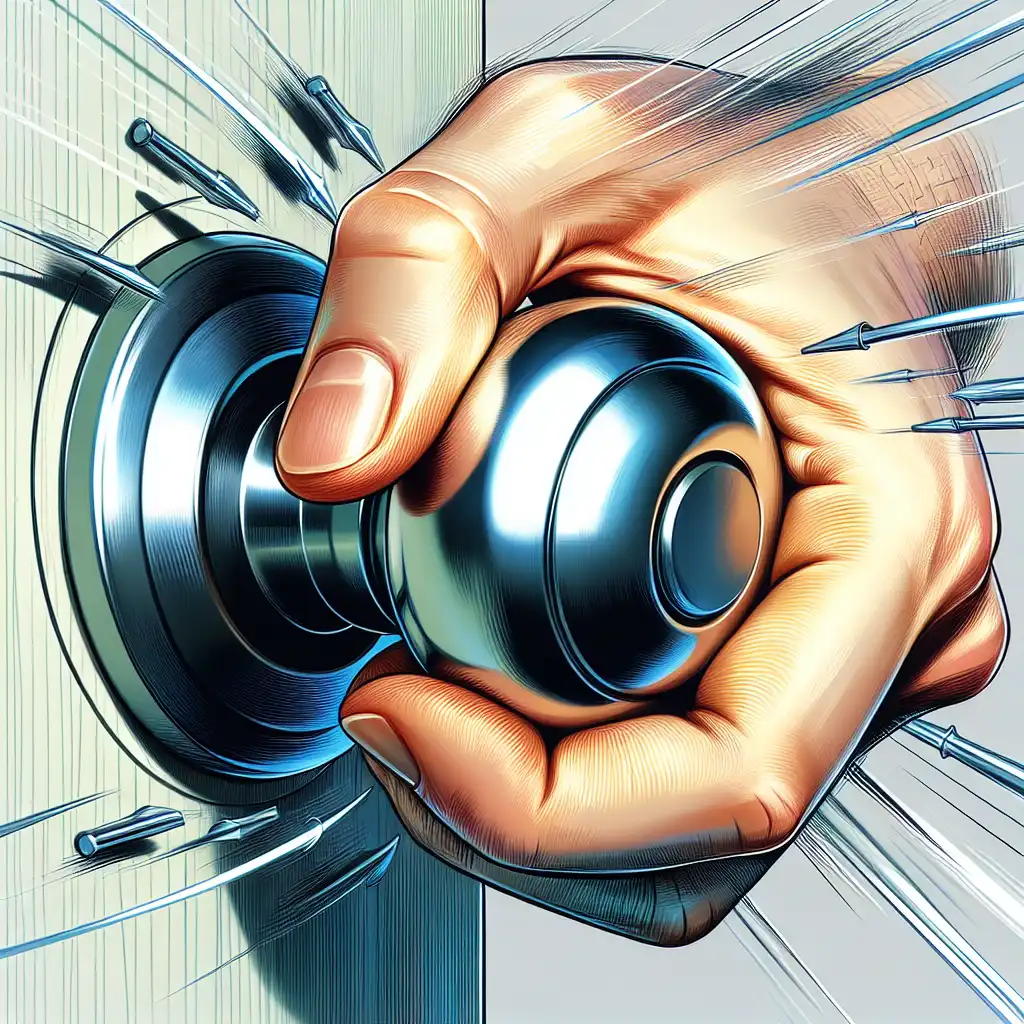
She jiggled the doorknob to see if it was locked.
jiggle
ˈdʒɪɡl
Đang tải…
ˈdʒɪɡl
To move or cause to move with quick, short movements up and down or from side to side.
She jiggled the doorknob to see if it was locked.
ˈdʒɪɡl
A jiggling movement.
The car gave a little jiggle when it started.
Không tải được âm thanh. Vui lòng thử lại sau.
The word 'jiggle' means to shake or move quickly and lightly from side to side or up and down. We use the word 'jiggle' when we talk about something that is loose and moves slightly when we touch it. For example, a bowl of jello may jiggle when we move it, or a loose tooth may jiggle when we touch it. We can also use the word 'jiggle' to describe the motion of our bodies when we dance or bounce around.
Jig refers to a type of dance, often accompanied by music.
It can also be used as a verb, meaning to dance a jig or to move up and down quickly.
Jiggle means to move or cause to move up and down or side to side with small quick movements.
Both words are applicable in different contexts. Jig is used mostly in relation to dance or music, while jiggle describes movement or motion, such as an object that shakes or vibrates slightly.
For example, you might say "let's do a jig to this traditional Irish music" or "the drill bit can be attached to a jig to ensure accurate drilling." Whereas, for jiggle, you might say "the dessert on the plate jiggled when I put it down" or "the car's wheels jiggled on the bumpy road."
Mở từ: Jig →Quiver refers to a shake or trembling that is more pronounced and may involve a larger range of motion. Jiggle is appropriate for describing minor movements, such as the shaking of a loose doorknob.
Quiver is appropriate for describing more intense movements, such as the trembling of an animal in fear or excitement.
Mở từ: Quiver →The words jiggle and shake both refer to movements where something is moved back and forth, but they are used in slightly different ways.
Shake is a more forceful movement, often used when talking about larger objects or movements. For example, a person might shake a rug to get the dirt off or a dog might shake its fur after getting out of the water.
So, in short, jiggle is for smaller, faster movements while shake is for larger, more forceful movements.
Mở từ: Shake →Shiver means to shake or tremble with cold, fear, excitement, or emotions.
It can describe the feeling of shivering when you step out into the cold weather or when you get scared by a sudden movement.
Jiggle describes quick, small movements while shiver describes a trembling or shaking feeling, often due to cold or fear.
Mở từ: Shiver →Tremble means to shake involuntarily due to fear, excitement, or weakness.
It usually describes a more intense movement, such as when someone is trembling with fear or when the ground is trembling during an earthquake.
Jiggle describes a light and rapid movement, while tremble describes a stronger and more involuntary movement.
Mở từ: Tremble →Both jiggle and twitch describe movements.
Twitch is also a verb that means to make a sudden and involuntary movement. It usually describes a brief, quick movement, like when you accidentally touch something hot and your hand twitches away.
Example: "The cat's tail twitched as it watched the mouse run by."
If you want to describe a small movement that is more continuous and rhythmic, use "jiggle." If you want to describe a brief and sudden movement, use "twitch."
Mở từ: Twitch →Jiggle and vibrate both refer to movements that happen quickly and repeatedly.
Vibrate usually refers to larger and more rhythmic movements. Vibrations can be caused by any number of things, such as machinery, music, or even earthquakes.
For example, a phone set to vibrate mode will make a constant and regular buzzing noise until it is turned off.
Jiggle tends to be used for small and irregular movements, while vibrate tends to be used for larger and more regular movements.
Mở từ: Vibrate →The difference between jiggle and wiggle is that jiggle is a rapid and jerky movement while wiggle is a slow and smooth movement.
Wiggle is applicable when describing a slower and more fluid movement, such as when a snake moves its body from side to side.
Mở từ: Wiggle →When talking about testable claims, respect them enough to ask these good questions. Challenge and see how you can examine them together, because there's this idea that you can't respect a belief and still challenge it but that's not true. When we jiggle the lock when we test the claim,
Xem trên YouTube ↗I don't like the way my arms jiggle.
fall over there's no way to help it who cares if paper towels hit the floor I do care if something glass does just open it up and see this is not going to cut it let's get you down there anything that may cause a problem those'll jiggle they won't be bad
Xem trên YouTube ↗I'm toned, but I'm not cut. I like a little jiggle!
Ice is crystalline, and so are diamonds, and salt. If you heat these materials up enough and melt them, the atoms can jiggle freely and move randomly, but when you cool them back down, the atoms reorganize themselves, reestablishing the crystal.
Xem trên YouTube ↗I have a king bed, one of those memory-foam mattresses that doesn't jiggle as you get in or out. Even if you cleaved it down the middle with a pickax, the thing wouldn't tremble. It's practically earthquake-proof.
People equate health to a picture in a magazine of a 6-foot-tall thin woman with her skin rolls Photoshopped and her waist edited to be tiny, so when they see bodies that jiggle and move around like they do, they assume it's wrong.