meteorite
noun meteorite
ˈmiːtiəraɪt
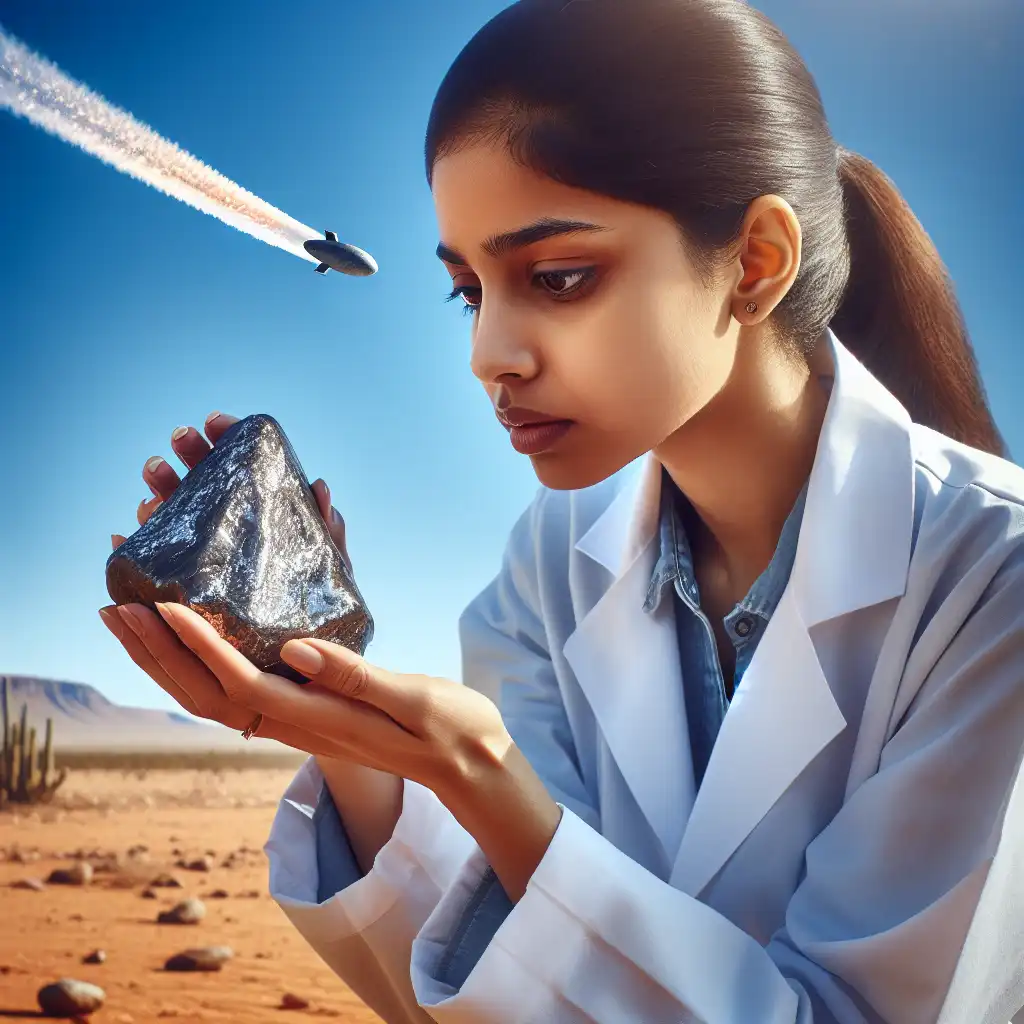
A piece of rock or metal from space that has landed on Earth.
The scientist found a meteorite in the desert.
meteorite
ˈmiːtiəraɪt
Đang tải…
ˈmiːtiəraɪt
A piece of rock or metal from space that has landed on Earth.
The scientist found a meteorite in the desert.
Không tải được âm thanh. Vui lòng thử lại sau.
A meteorite is a rock that falls from space and hits the Earth. It comes from an asteroid or a comet that has been floating in space before finally making its way to Earth. Meteorites are usually very small, but they can also be very large and cause damage to buildings or even create craters on the ground. Scientists study meteorites to learn more about the history of our solar system. You can use the word meteorite when talking about space, astronomy, or natural disasters.
An asteroid is a small rocky object that orbits the Sun. Asteroids are generally larger than a meter in size and can be found in the asteroid belt, which is located between Mars and Jupiter.
Occasionally, asteroid can move out of the asteroid belt and come into the inner solar system.
A meteorite is a small piece of asteroid or comet that has fallen to the Earth's surface. When an asteroid enters the Earth's atmosphere, it is called a meteor.
So, in summary, asteroids are rocky objects that orbit the Sun, while meteorites are fragments of asteroids that have landed on Earth.
Mở từ: Asteroid →A fireball is a bright, fiery light in the sky, usually caused by burning gas or debris entering Earth's atmosphere.
It is often seen as a shooting star or a comet. Fireballs are usually not very large and burn up quickly before reaching the ground.
A fireball is a bright flash of light in the sky caused by burning material entering the atmosphere, while a meteorite is a piece of rock that has reached the Earth's surface after surviving entry into the atmosphere.
Mở từ: Fireball →A meteor is a meteoroid that has entered Earth's atmosphere and is burning up upon entry, causing a bright streak of light in the sky.
A meteorite is a meteoroid that has survived the entry and has impacted the Earth's surface.
In simpler terms, a meteor is what you see in the sky when a meteoroid is burning up upon entry, while a meteorite is the leftover piece that hits the ground.
So, when you see a shooting star in the sky, it's a meteor, and if you find a rock that fell from the sky, it's a meteorite.
Mở từ: Meteor →In some of the compounds that scientists found, first in the rubble left by a meteorite that disintegrated above northern Canada, and then in samples collected by a space craft from a passing comet's tail, were nothing less important than amino acids.
Xem trên YouTube ↗I see life as a burning meteorite that you can climb all over, and feed off, as it is falling to earth.
cameras around the world have captured meteors falling from the sky and although some eventually hit most of them disintegrate or burn off the remaining pieces fall into the ocean when they survive the fall and hit land we call them meteorites scientists
Xem trên YouTube ↗My appearances are almost theatrical performances. I bring items for the children to see, such as photographs and actual piece of meteorite, a family quilt, sometimes spectacles, sometimes clothing, so that they can understand what I write about is family stories based in fact.
And this tenuous veneer around our planet is what allows life to flourish. It protects our planet from too many impacts, from meteorites and the like. And it's such an amazing phenomenon that the fact that it's disappearing
Xem trên YouTube ↗A lot of my work has been about stuff I've been frightened of: cliffs, explosions, meteorites, that kind of stuff. I would have been this trembling blob of fear if I hadn't got into making art, which is a good way of deferring it.
outer space right we're traveling to a distant planet somewhere and we're on that somewhere far away moon and we're looking well imagine that bowling balls a micro meteorite hitting the surface of that planet right to protect our space
Xem trên YouTube ↗It's very dangerous to put astronauts on a moon base where there's radiation, solar flares and micro meteorites. It'd be much better to put robots on the moon and have them mentally connected to astronauts on the Earth.
flowerbed of your prep school many moons ago I have a meteorite that you can touch but you're not but you only I'm not going to hand it to you because I don't know what you gonna do with it I'll be very careful about they're very respectful this is four and a half
Xem trên YouTube ↗Despite tantalizing suggestions of fossilized microbes in meteorites, puzzling and possibly biogenic methane gas in the martian atmosphere, and a long-standing controversy over the Viking lander experiments of nearly 40 years ago, there's still no Exhibit A that points unequivocally to biology in our own back yard.
that the very same star that created this iron created the iron that's in this as well as the iron in your blood see I find that really cool so you have a kinship what was the cosmos on its deepest level so meteorites a reminder first that earth moves in a shooting gallery that's my first thought when I
Xem trên YouTube ↗Meteorite hunting is not for wimps. The best places to look are also the coldest and windiest. You need very old ice, and you need wind, lots of it, strong and unrelenting. Antarctica fits the bill.
volcanic eruptions landslides meteorites or the most common culprit earthquakes in the deep ocean a typical tsunami wave is barely noticeable and poses little threat but the waves can spread out thousands of miles rolling across the
Xem trên YouTube ↗When a society is really successful like America, throughout history there's been this trend for those societies to be obsessed about end of the world scenarios. You know, about meteorites and plagues and destroying things. And you can see that in the American fiction.
protect the astronauts from that. And then third, but definitely not last, the Moon does not have any atmosphere, which means any meteorites coming into it will not get burned up, and they'll hit the surface. That's why the Moon is full of craters.
Xem trên YouTube ↗I do definitely believe that there is life away from this planet. I mean, we've kind of established that with the fact that we found bacteria on meteorites, and we've kind of used that to backtrack and show how this Earth, this planet, could have formed the ability to sustain life in the first place.
Stars collide galaxies explode, meteorites crash asteroids everywhere. A ton of action but no life. Let me ask you this.
Xem trên YouTube ↗Indeed, evolutionists don't agree on how divergently our own biosphere could have developed if such contingencies as ice ages and meteorite impacts had happened differently.
is the region of the ancient ocean basin. There aren't many craters. And that's because the water protected the basin from being impacted by asteroids and meteorites. But look in the southern hemisphere. In the southern hemisphere there are impact craters,
Xem trên YouTube ↗