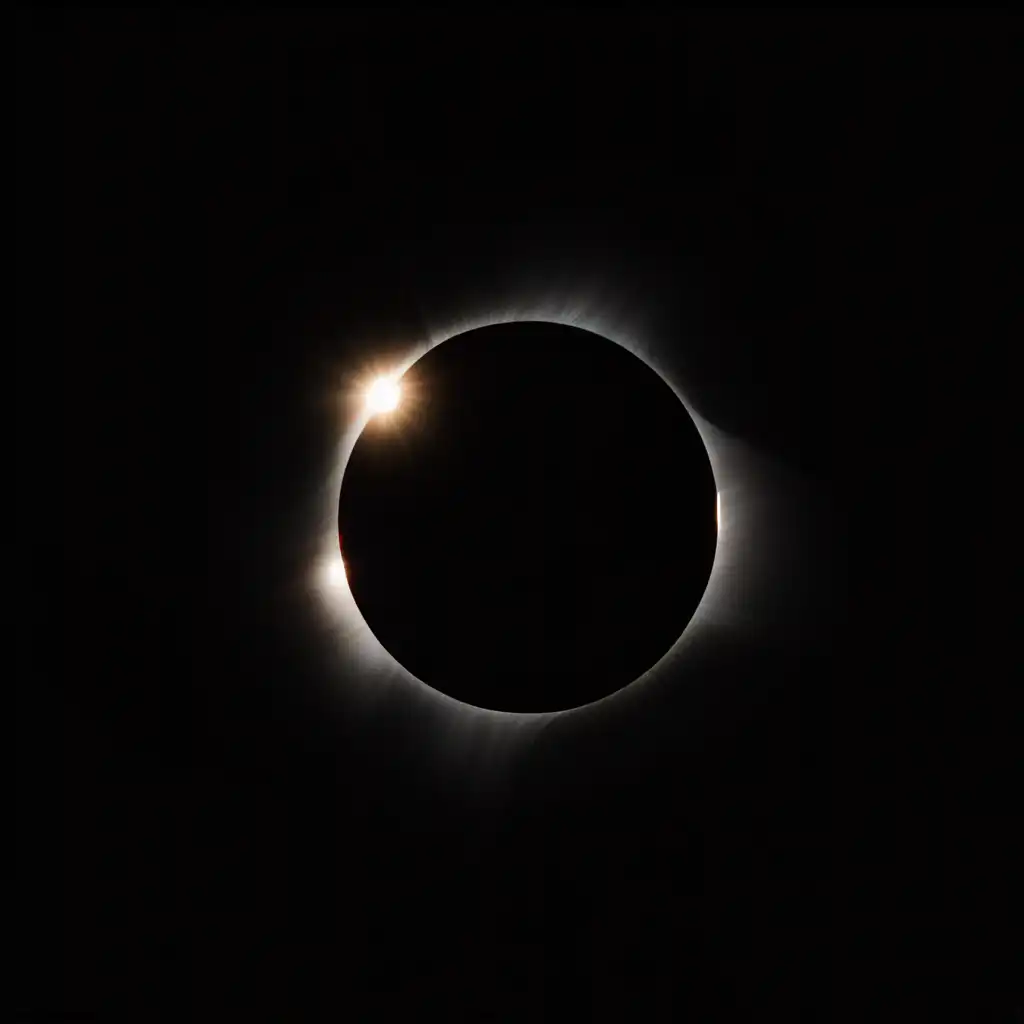
The word 'penumbra' refers to the partial shadow that is created when an object blocks some but not all of the light source. This word can be used in various contexts such as during an eclipse of the sun or moon, in photography when casting shadows or in a courtroom as a legal term to refer to the gray area or ambiguous interpretation of a law.
Ambiguity refers to situations, words or phrases that can be interpreted or understood in multiple ways, leading to confusion or uncertainty.
So, while ambiguity refers to confusion or uncertainty in language or understanding, penumbra refers to an area of transition between light and shadow.
Border refers to the line or edge that separates one thing from another. For example, the border between two countries, the border of a picture, or the border between two colors on a page.
In simpler terms, border means the clear line between two things, while penumbra refers to the fuzzy or shadowy edges around something.
Borders are more commonly used in everyday language, while penumbra is a more technical or scientific term.
Certainty refers to something that is definite, factual and undeniable. It is applicable to situations where there is no doubt or uncertainty about the truth or accuracy of a statement or fact.
For example, "It is a certainty that the sun will rise tomorrow morning."
Penumbra refers to an area of partial shadow or uncertainty surrounding a central area of full light or certainty. It is applicable to situations where there is a lack of clarity or ambiguity surrounding a concept, idea or decision.
For example, "There is a penumbra of uncertainty surrounding the outcome of the election."
Obscurity refers to the state of being unknown, unclear, or indistinct. Penumbra refers to a partially shaded area between light and dark.
Obscurity is often used to describe something that is hard to understand, find, or see clearly. For example, an obscure reference in a book might be difficult to decipher or a relatively unknown artist might be described as living in obscurity.
Obscurity refers to a lack of clarity or visibility, while penumbra refers to a specific type of shadow.
Periphery refers to the outer edge or boundary of an object or area. It is applicable when referring to the surrounding areas or secondary components that are less important than the central focus.
In simpler terms, penumbra refers to the gray area between light and dark, while periphery refers to the edges of something.
Shade refers to an area where direct sunlight is blocked by an object like a tree or a building, resulting in a darker and cooler environment.
Shade can provide relief from the heat of the sun and is often sought after during hot weather.
Penumbra refers to a partial shadow caused by an object partially blocking a light source, while shade refers to a complete or near-complete absence of direct sunlight caused by an object fully blocking a light source.
A shadow is the dark area that is formed when light is blocked by an object. It is the complete absence of light.
A penumbra is the partial shadow that is formed when an object partially blocks light. It is the area of only partial darkness.
In other words, a shadow is a total absence of light, while the penumbra is the area with only partial darkness. Shadows are more commonly used to refer to the darkest area where there is no light, while penumbras are used to describe the areas surrounding these dark spots that are partially lit.