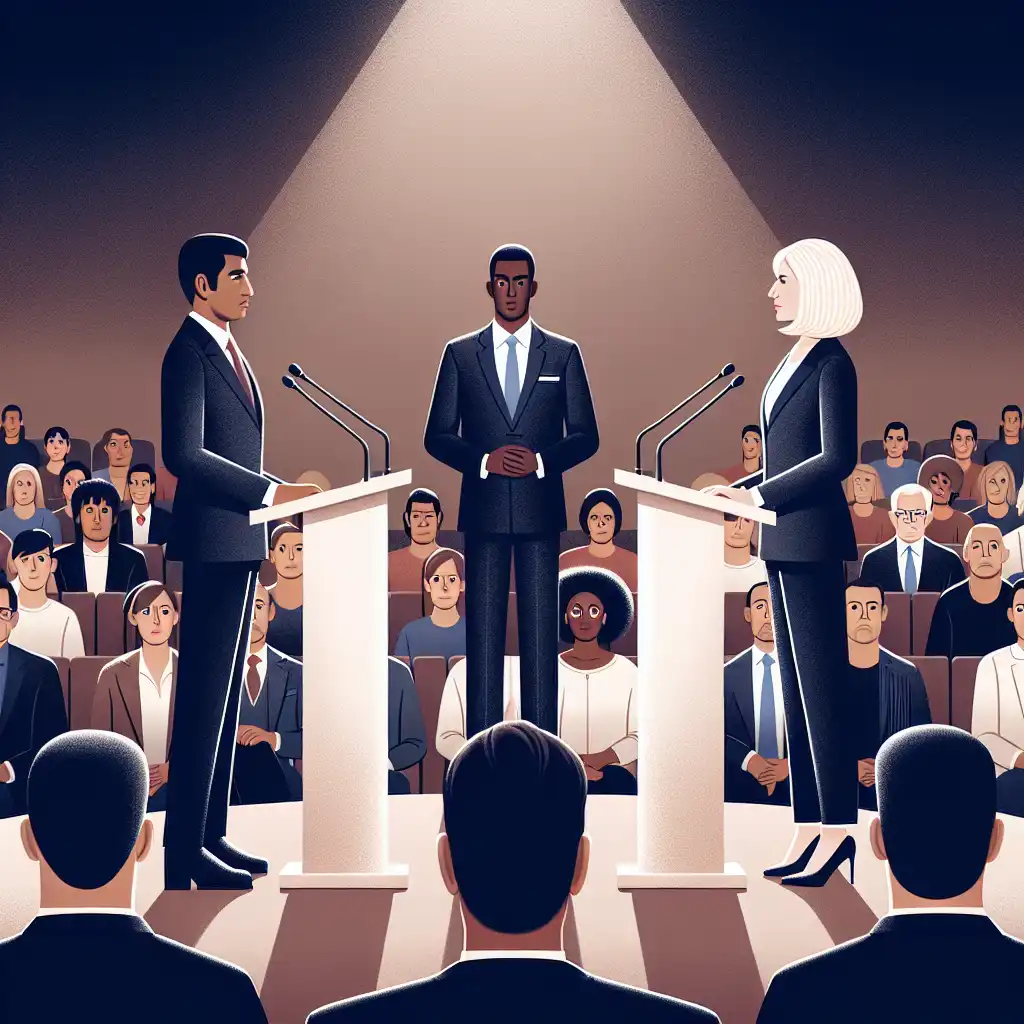
debate
noun debate
dɪˈbeɪt
A formal discussion between people who have different views.
The presidential debate was televised nationally.
debate
dɪˈbeɪt
लोड हो रहा है…
dɪˈbeɪt
A formal discussion between people who have different views.
The presidential debate was televised nationally.

dɪˈbeɪt
The activity of discussing something in a serious way before making a decision.
There is still much debate over the new policy.

dɪˈbeɪt
To discuss something in a serious and detailed way before making a decision or forming an opinion.
The committee will debate the matter next week.
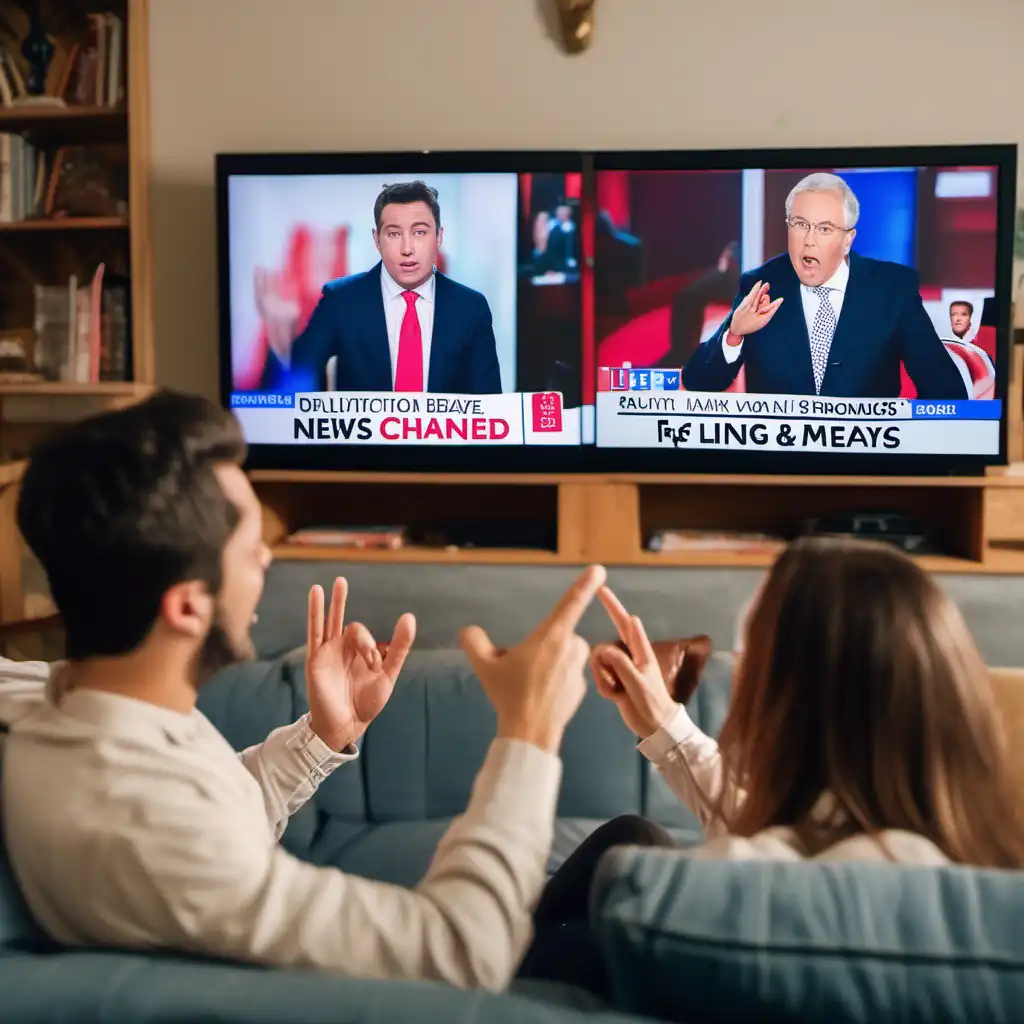
dɪˈbeɪt
To argue or discuss different opinions.
They spent the entire evening debating politics.
ऑडियो लोड नहीं हो सका। कृपया बाद में फिर कोशिश करें।
A debate is a discussion between two sides that have different opinions on a topic. It’s like a conversation where people try to persuade each other by using facts, arguments, and reasoning. You might see debates in school when students argue about a topic or in a political election where the candidates argue about their platforms. It’s important to listen carefully to what the other side is saying, and to try to understand their point of view, even if you disagree. In a debate, there is no winner or loser but it helps everyone to learn and understand different perspectives on an issue.
An argument is a disagreement between two or more people. It's when people have a different opinion about something and are trying to convince the other person that their opinion is right.
An argument can be emotional and might not be based on facts.
A debate is a structured discussion where two sides present their arguments and evidence to prove their point. Unlike an argument, a debate involves research, logic and critical thinking.
Debates are held to reach a conclusion or persuade the other side to agree with their argument.
Overall, arguments are more informal and happen spontaneously, while debates are more structured and organized. Debates are typically seen in academic and political settings, while arguments can happen anywhere.
शब्द खोलें: Argument →Contention refers to a disagreement or dispute between two or more people or groups. It implies a more hostile or aggressive disagreement, with each side firmly holding onto their own position.
Contention is a more negative term that implies conflict and hostility, while debate is a more constructive term that implies a desire to learn from each other and engage in productive discussion.
शब्द खोलें: Contention →Controversy refers to a disagreement or argument between people or groups that has a lot of strong emotions and often involves personal beliefs or values.
In a nutshell, controversy is more intense and involves personal opinions and emotions, while debate is more analytical and seeks to find the best solution or conclusion through logical reasoning.
Controversy can be seen in political or social issues, while debates can also occur in academic or professional settings.
शब्द खोलें: Controversy →Disagree means to have a difference in opinion or perspective. This happens when people do not share the same opinion on a particular topic.
Disagreement is more informal and can happen in any casual conversation where two or more people have varying opinions on a topic.
शब्द खोलें: Disagree →Discourse is a more casual and inclusive form of communication. It involves exploring and exchanging ideas and perspectives in an open-minded and respectful way.
Discourse does not have a winner or a loser, and the focus is on understanding various perspectives rather than proving one's argument to be superior to the others.
A debate is more formal, structured, and competitive, while discourse is more informal, open-minded, and focused on understanding different perspectives.
शब्द खोलें: Discourse →A discussion is a casual conversation where two or more people express their opinions about a topic without a right or wrong answer.
Both debate and discussions can be applied to various situations, but debates are more suitable for a formal and structured setting like a courtroom or a parliament, while discussions are more fitting for open and informal environments like workplaces and classrooms.
शब्द खोलें: Discussion →Dispute usually involves an argument or disagreement between two parties over a specific issue or topic.
It can be a heated argument that may or may not have a resolution. Disputes are usually not as formal as debates and can occur in everyday life, such as between two friends or coworkers.
To simplify, a debate is a formal discussion where people argue to arrive at a conclusion, while a dispute is a disagreement that can be formal or informal between two sides without a structured plan.
शब्द खोलें: Dispute →Since ancient times mankind has hotly debated whether mathematics was discovered or invented. Did we create mathematical concepts to help us understand the universe around us, or is math the native language of the universe itself,
YouTube पर देखें ↗There would be no debate about who was the best footballer the world had ever seen - me or Pele. Everyone would say me.
about having just engaged with our character we did we did debate whether it was too much whether the audience were too far into that story to be able to take the death of the young one but in the end we decided because there were hundreds of others and because actually it's our duty to
YouTube पर देखें ↗Debating religious beliefs are a red line, a deep red line.
For fear of disagreement we shrink from these questions. But once we see that markets change the character of goods, we have to debate among ourselves these bigger questions
YouTube पर देखें ↗I have always said that the debate about who should play in goal is part of the game, but I never play in order to silence anyone.
the entire world scientific community considers that there's no debate about climate change or the fact that human beings how about the major role in it those who try to spread misinformation about climate change are simply wrong and are doing that for some other aim
YouTube पर देखें ↗How you frame a debate is very important. When you call someone an 'illegal alien,' you've already stacked the deck against them.
people out there who are willing to lend me a helping hand so that's some where I walked into open AI with a mission let's figure out how to put the intelligence into AI well I did a lot of thinking at my desk on but the next step in AI could be I did a lot of scribbling on paper and debating over
YouTube पर देखें ↗I'm all for a passionate debate, and sometimes things can be heated, which is fine, up to a point. As long as we remember that we are human beings.
But while the debate between prescriptivism and descriptivism continues, the two are not mutually exclusive. At its best prescriptivism is useful for informing people about the most common established patterns at a given point in time. This is important not only for formal contexts, but it also makes communication easier between non-native speakers
YouTube पर देखें ↗If I've helped fuel the debate on loneliness in some small way, that is wonderful.
has been around for thousands of years. And across that span of time, it's raised the same questions we debate Is it art? Is it vandalism?
YouTube पर देखें ↗The number of children is not growing any longer in the world. We are still debating peak oil, but we have definitely reached peak child.
Few of us think about civic life in the abstract. We think about things in relief compared to something else. Powerful citizens set the terms of that contrast. This doesn't mean being uncivil. It simply means thinking about a debate you want to have on your terms
YouTube पर देखें ↗Ultimately if you're a journalist, one day you're writing about figure skating, one day a political debate. I loved that about reporting. I like throwing my energies into various corners of the world.
Or perhaps more simply, trains planes and automobiles. Which one is most important, the best or the greatest? Which one has had the most impact on society? Today the debate would probably be in favor of computer technology, but is it?
YouTube पर देखें ↗Well, to tell you truth, I have learned a long time ago that the trick when doing a debate, any kind of debate, is to just turn off the judgment switch in my head.
They'd then convert radiation into useful energy while protecting our DNA. This sounds pretty sci-fi, but may actually be achievable with current technology. But technology isn't the only obstacle. There are ongoing debates on the consequences
YouTube पर देखें ↗In my books I might hold the mirror to my own face. If others would like to borrow the mirror, they're welcome. The books aren't there to accuse others - merely to raise issues and keep the debates alive.