grasp
verb grasp
ɡræsp
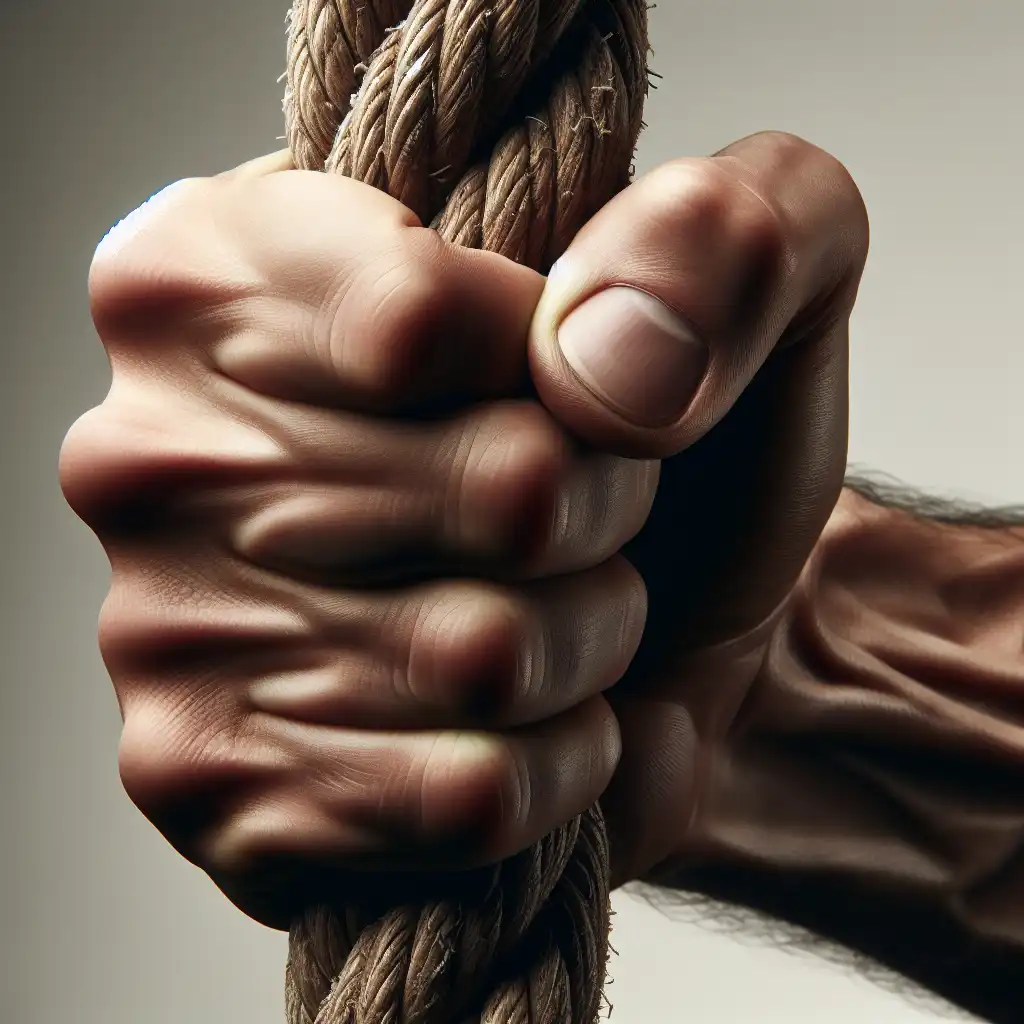
To hold something tightly with your hand
She grasped the rope and pulled herself up.
grasp
ɡræsp
Loading…
ɡræsp
To hold something tightly with your hand
She grasped the rope and pulled herself up.

ɡræsp
To understand something
Are you able to grasp the concept of this physics theory?

ɡræsp
A firm hold or grip
She has a strong grasp of the tennis racket.

ɡræsp
Understanding or comprehension
You need to have a solid grasp of mathematics to excel in engineering.

ɡræsp
To try to take hold of something
He grasped for the lifebuoy in the water.
Audio could not be loaded. Please try again later.
The word 'grasp' means to hold onto or understand something. For example, you can grasp a pencil or grasp someone's hand. You can also grasp an idea or concept, which means you understand it fully. So, if you're reading a difficult book or listening to a complex lecture, you can say that you're trying to grasp the information. The word 'grasp' can be used in many different situations, but always involves the idea of holding onto or understanding something.
Clasp means to hold something tightly with your hands.
It is often used when referring to jewelry or bags that have a mechanism for being clasped shut, like a button or magnet.
Clasp is used when something can be closed or secured together, while grasp is used when holding something firmly or understanding something difficult.
Open word: Clasp →Clench refers to the action of holding onto something tightly or gripping it with force.
It is usually associated with a physical or emotional response in which one's muscles become tense and rigid. Clenching often involves the hands, but can apply to other parts of the body as well, such as the jaw or fists.
The word grasp is used to indicate the act of securing something in one's hand or understanding an idea or concept. Grasping something can be done with varying degrees of force or intensity, whereas clenching typically involves a strong grip or tight hold.
Clench describes a more forceful or intense hold, often accompanied by tension or emotion, while grasp is a more general term for holding something with one's hand or understanding something mentally.
Open word: Clench →Clutch means to hold onto something tightly with your hands, almost like you're grabbing onto it for dear life.
Clutch is more about holding onto something tightly in a difficult or dangerous situation, while grasp is more about holding onto something firmly, with purpose or intention.
Open word: Clutch →The words comprehend and grasp both refer to understanding something, but in slightly different ways.
Comprehend generally means fully understanding or grasping the significance of something. It implies that you have a deep understanding of the subject matter and can explain it in your own words.
For example, if you comprehend a complex math problem, you not only know the answer, but you also understand how to arrive at that answer.
Both words have their own uses, but generally, comprehend is used for a deeper level of understanding, while grasp is used for a more general understanding.
Open word: Comprehend →Grapple means to struggle or wrestle with something, while grasp means to hold onto something firmly with your hand or understanding.
Grapple is typically used when there is a difficulty or obstacle to overcome, such as grappling with a difficult math problem or grappling with a challenging opponent in a sport.
Open word: Grapple →Grasp refers to holding something firmly with your fingers or hands, while grip refers to the strength or force with which you hold something.
For example, you would grasp a pencil when trying to write with it, while your grip on the pencil would determine how firmly you hold it while writing.
Grasp can also be used figuratively to mean understanding or comprehending something, while grip is typically used in physical contexts.
Open word: Grip →Both words refer to physically holding something, but there is a slight difference in their meaning.
Grasp means to hold something tightly and firmly, usually with the fingers. For example, you might grasp a basketball tightly while dribbling down the court.
Hold can refer to holding something with a variety of body parts or tools, and it doesn't necessarily imply a tight grip.
For example, you might hold a pencil lightly with your fingertips while writing a note.
Grasp suggests a strong and intentional hold, while hold is a more generic term for physically keeping something in place.
Open word: Hold →Both grasp and seize mean to take hold of something, but they are used in different situations.
Seize implies taking hold of something quickly and forcefully. For instance, a police officer might seize control of a dangerous situation.
You can also seize an opportunity, meaning to take advantage of it before it's gone.
Grasp is used when taking hold of something firmly and securely, whereas seize is used when taking hold of something quickly and forcefully.
Open word: Seize →Grasp means to physically hold onto something, or to mentally comprehend or understand something. It is applicable when we want to convey the idea of holding onto a concept, idea or thing and making it our own.
Understand means to gain knowledge, insight or comprehension about something. It is applicable in situations where we want to convey the idea of having a mental model or structure of the underlying concepts or ideas.
For example, a person who has learned to play chess can be said to understand the game and how it is played.
In summary, while both words are used to describe the act of comprehending something, grasp is more focused on the idea of holding onto something, while understand is more focused on the idea of gaining knowledge or comprehension about something.
Open word: Understand →the scenarios faced by the ever-diligent and maybe too hospitable night manager serve to remind us of just how hard it is for our relatively finite minds to grasp a concept as large as infinity. Maybe you can help tackle these problems after a good night's sleep. But honestly we might need you
Watch on YouTube ↗Sometimes it takes years to really grasp what has happened to your life.
The skill with which she picks things up. The way that she can grasp a tool like that. How she uses her brain to imitate what she's seen others doing. But the most important thing we share is our big brain.
Watch on YouTube ↗The world can only be grasped by action, not by contemplation.
is driven by the things you can control. The things you can control are the temperature difference between the inside and the outside. There's this remarkable technology called a you grasp it rotate it to the left, and your energy consumption in the home will decrease. I've tried it. It works. Some people call it a lifestyle change.
Watch on YouTube ↗There's opportunities you get that you want to grasp with both hands and you have to cherish them.
all the time. Oh would you like to do that? You're like yes for sure. MAN So you got a girlfriend now I heard. MAN It's awesome pretty much makes life better in every way. WOMAN It's really hard for me to grasp why he wants this.
Watch on YouTube ↗I'm just grasping everything, getting as much knowledge as I can, and continuing to learn and not being afraid to take challenges and actually take action.
describes that wedge-shaped stone at the top of an arch remove that stone and the arch collapses it is a powerful metaphor elephants termites bees are a keystone species now to get a grasp of the bigger picture it is important that you learn how to understand just a little
Watch on YouTube ↗A sense of humor... is needed armor. Joy in one's heart and some laughter on one's lips is a sign that the person down deep has a pretty good grasp of life.
sometimes even outwitting the researchers and manipulating their partners. And they've grasped basic arithmetic keeping track of the relative amounts of fruit in two baskets after multiple changes. The rare combination of memory and problem solving can explain some of elephants' most clever behaviors,
Watch on YouTube ↗I had difficulty in grasping how music was made for films. It was a huge learning curve and the toughest phase of my life.
We dream to solve problems. Unconstrained by reality and the rules of conventional logic, in your dreams your mind can create limitless scenarios to help you grasp problems and formulate solutions that you may not consider while awake.
Watch on YouTube ↗My mother often mailed me articles from 'Reader's Digest' about advances in DNA chemistry. No matter how I tried to explain it to her, she never grasped the concept that I could have been writing those articles, that something I had invented made most of those DNA discoveries possible.
can cause massive ecological disruption. This is why the second graph, which show the average temperature variation each year, is far more significant. When they're used well graphs can help us intuitively grasp complex data. But as visual software has enabled more usage of graphs throughout all media,
Watch on YouTube ↗If our governments are so compromised that they will not tell us the truth, then we must step forward to grasp it.
the way that she can grasp a tool like that the way she uses her brain to imitate what she's seen others doing but the most important thing we share is our big brain it's that that has produced so many of the talents and
Watch on YouTube ↗Getting a good grasp of your life and what's going on around you is so important.
for communication between the nose and brain, and the striatum which helps manage movement. Scientists don't yet have a good grasp on exactly what role neurogenesis plays in any of these regions,
Watch on YouTube ↗Politicians have been downplaying the importance of history as a subject in our schools but, if they had bothered to have a better grasp of history themselves, they might have avoided costly wars. Instead they act like children. The only time that they think matters is their own.