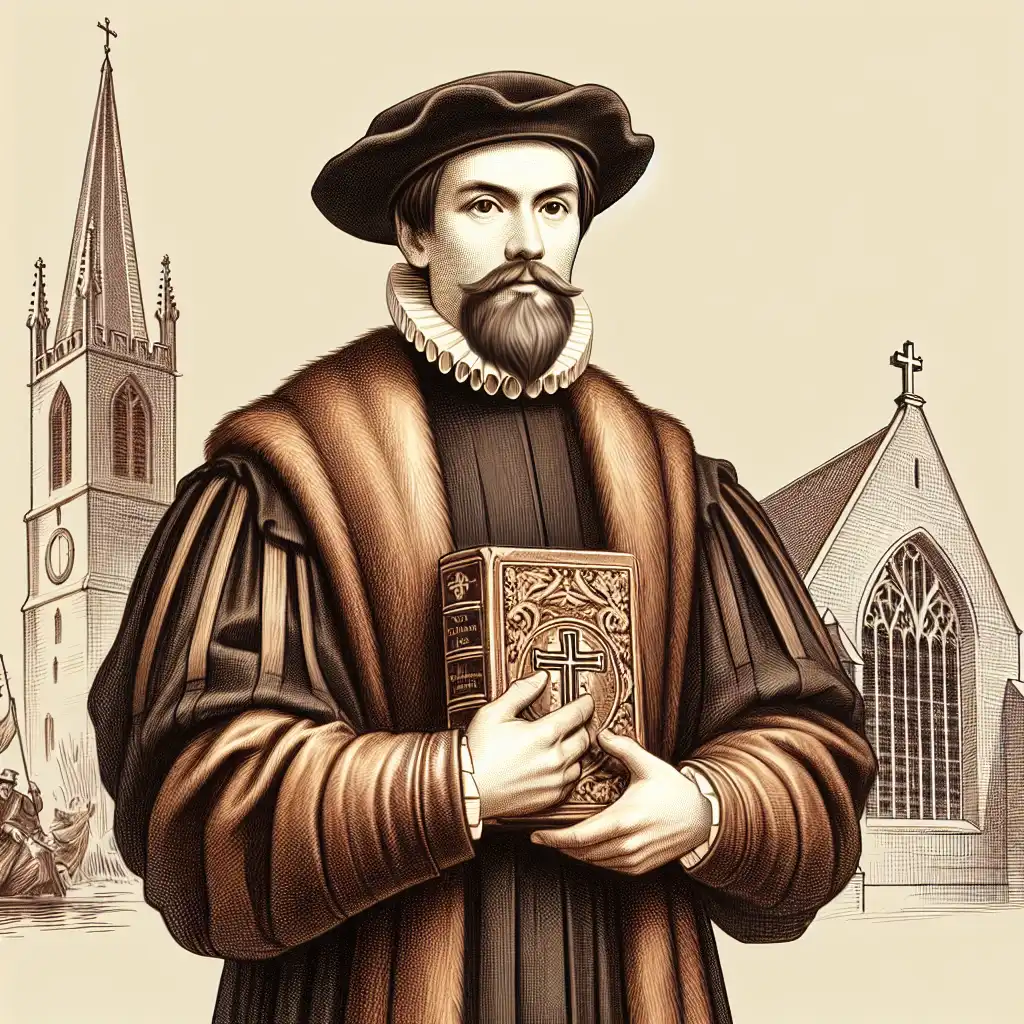
The word 'Protestant' refers to a person or a type of Christianity. Protestants are people who follow a Christian religion and believe that the Bible is the most important source of guidance. The word was first used during the Reformation period in Europe, when some Christians protested against certain practices of the Catholic Church. Nowadays, Protestants are found around the world, and there are many different kinds of Protestant churches. You might use this word when talking about different kinds of Christianity or when talking about someone's religious beliefs.
Anglican refers to a specific Christian denomination that originated in England and is also known as the Church of England.
Protestant is a broader term used to describe any Christian denomination that originated from the Protestant Reformation in the 16th century, including Anglicanism.
Therefore, Anglicans can be considered a type of Protestant, but not all Protestants are Anglican.
Dissenter is a general term that refers to anyone who disagrees with or challenges an established authority, tradition or belief.
A dissenter is someone who disagrees with any established authority or belief, while a Protestant is someone who specifically belongs to the branch of Christianity that emerged from the Protestant Reformation.
Evangelical refers to a type of Christianity that emphasizes personal conversion and sharing the Christian message with others.
Evangelical is more specific and describes a particular emphasis within Protestant Christianity, while Protestant is a broader term that includes various denominations and beliefs.
Iconoclast refers to someone who challenges or criticizes traditional beliefs, ideas, or institutions. This term is often used to describe someone who tries to change the way people think or act.
An iconoclast is a person who challenges established ideas or institutions, while a Protestant is a member of a Christian movement that split from the Roman Catholic Church.
Nonconformist, on the other hand, is a broader term that can refer to any group or individual who does not conform to established norms or rules.
In a religious context, nonconformists are those who do not conform to the doctrine or practices of the dominant religious group.
Protestant is specific to a certain religious denomination, while nonconformist is a broader term that can apply to any individual or group that does not conform to established norms or beliefs.
Protestant refers to a group of Christians who broke away from the Catholic Church during the Reformation. They protested against certain practices and beliefs of the Catholic Church and formed their own churches.
Reform means to make changes in something in order to improve it. It is a general term that can be applied to any type of organization, institution or system, not just religion.
Reform can be applicable to any situation where a change is needed to make something better.
In summary, Protestant is a specific term that refers to a group of Christians who broke away from the Catholic Church, while reform is a broader term that refers to making improvements in any type of system or organization.
Sectarian refers to an attitude or behavior that promotes division and conflict between different religions or factions within a religion.
In short, Protestant refers to a specific branch of Christianity, while sectarian describes an attitude or behavior that can be applied to any religion or ideology.
Separatist refers to a group that seeks to separate or break away from a larger group of people, such as a religious denomination or a country.
The term separatist can be used in various contexts, such as political or social movements. In short, Protestant refers to a specific religious group while separatist refers to a group seeking separation or independence from a larger group.
but his thoughts ended up splitting the church in two the catholic church and the protestant church and that soon becomes important for many other things than the church
They were the victims of paranoia about the supernatural, misdirected religious fervor— and a justice system that valued repentance over truth. Salem was settled in 1626 by Puritans a group of English protestants.
I think awards are good for the movie. They can bring a new audience to the movie. I've always claimed that things like that don't get you work. Work gets you work. That's my blue-collar, protestant work ethic.
Protestantism became identified with the republican presumption in liberty as an end in itself. This presumption was then reinforced by an unassailable belief in the common sense of the individual.
Protestants in France are under intolerable despotism. Although open persecution does not now exist, yet it depends upon the whim of the king, queen, parliament, or any of the ministry.
In boxing we're allowed to come togethwe. Protestants and Catholics, the north and south, everyone. I'm in an Irish vest, even on a mural in Tiger's Bay, because boxing brings the communities together.
Protestants attacked Catholics during the 1844 Nativist riots in Philadelphia. Guess what that was about? Anti-immigrant sentiment. Back then, it was the influx of Irish Catholics into the city. Now, it's Donald Trump clinging to a bygone notion of Protestant ascendancy and nativist sentiments, when mainline Protestantism is on the wane in the U.S.
The cultural contrast I saw between religions... Catholics have a lot of mediators, going through saints and Mary or whatever. Protestants in general say things to God directly.
Protestantism has actually put a man in the position of a country governed by secret police. The spy and eavesdropper, 'conscience,' watches over every motion of the mind, and all thought and action is for it a 'matter of conscience,' i.e. police business.
America is the first great experiment in Protestant social formation. Protestantism in Europe always assumed and depended on the cultural habits that had been created by Catholic Christianity.
Protestantism came to America to make America Protestant. It was assumed that was to be done through faith in the reasonableness of the common man and the establishment of a democratic republic.