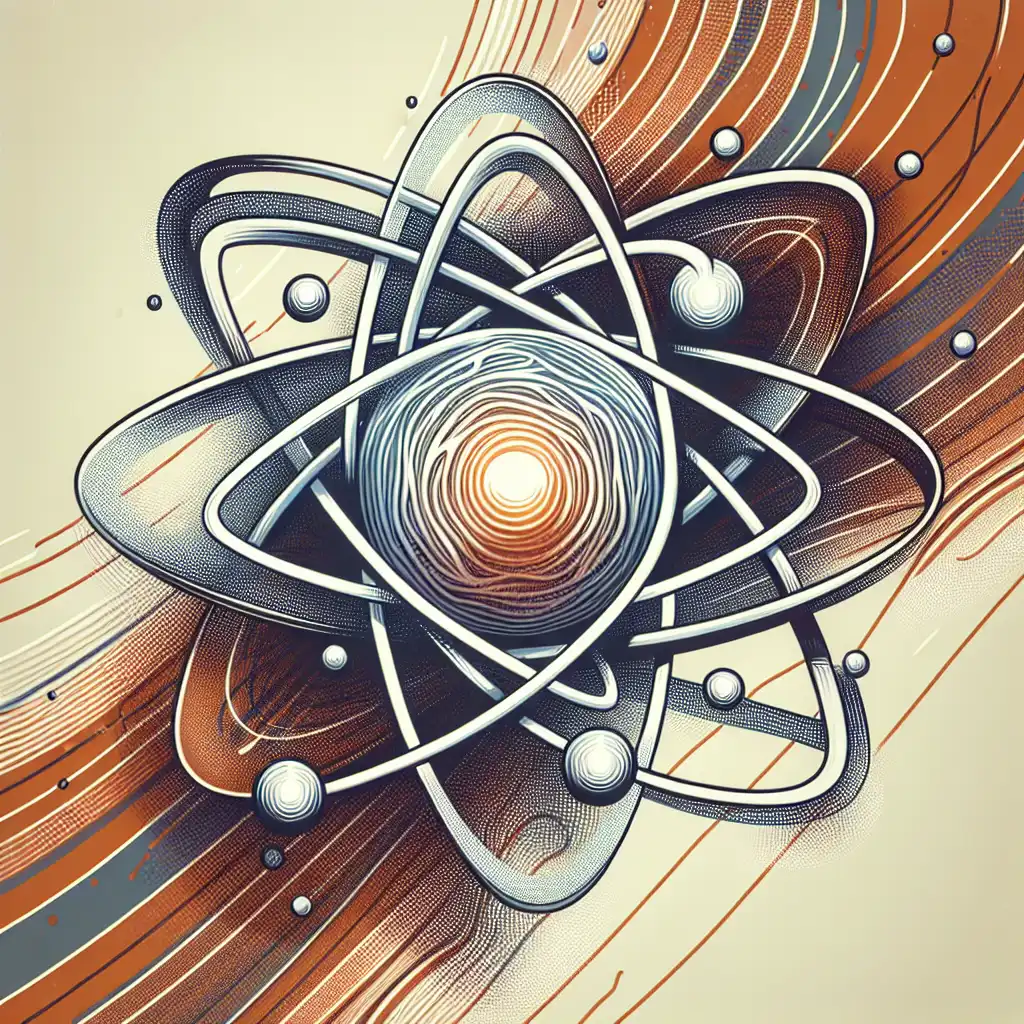
subatomic
adjective subatomic
ˌsʌbəˈtɑːmɪk
Related to or smaller than an atom
A proton is a subatomic particle.
subatomic
ˌsʌbəˈtɑːmɪk
加载中…
ˌsʌbəˈtɑːmɪk
Related to or smaller than an atom
A proton is a subatomic particle.
音频无法加载,请稍后再试。
The word 'subatomic' refers to things that are smaller than an atom, which is the basic unit of matter. It is used in science to talk about tiny particles that make up atoms, such as protons, neutrons, and electrons. It is also used to describe energy levels and other properties related to these particles. So, if you are studying science or talking about very small things, you might use the word 'subatomic'.
Atomic refers to something related to an atom. An atom is the smallest unit of matter that has the properties of an element.
Atomic is applicable when we talk about the properties of elements, the structure of the atom, or nuclear reactions.
The word subatomic refers to things that are smaller than an atom. It deals with the particles that make up the atom, such as protons, neutrons, and electrons.
Subatomic is applicable when we are discussing the behavior of particles like electrons, the structure of the atomic nucleus, or particle physics.
Atomic is concerned with the properties of atoms, while subatomic is concerned with the particles that make up atoms.
打开单词: Atomic →Elementary refers to particles that cannot be broken down into simpler particles. These are called 'elementary particles' such as electrons, protons, and neutrons.
Elementary is applicable when talking about particles that are the building blocks of matter.
Subatomic is applicable when talking about particles that make up elementary particles, as well as the interactions between these particles.
Elementary refers to the simplest building blocks of matter, while subatomic refers to particles that are even smaller than atoms.
打开单词: Elementary →Microscopic refers to something that is too small to be seen with the naked eye, while subatomic refers to particles that are even smaller than atoms, such as protons, neutrons, and electrons.
Microscopic can describe things like tiny organisms, cells, or particles that are too small to be seen without a microscope.
Microscopic describes things that are too small to see with the naked eye, while subatomic describes particles that are even smaller than atoms.
打开单词: Microscopic →Molecular refers to things that are made up of molecules, which are groups of atoms bonded together. This can refer to things like compounds and complex substances.
For example, water is a molecular substance because it is made up of molecules of two hydrogen atoms and one oxygen atom bonded together.
Molecular refers to things on a larger scale, made up of molecules, while subatomic refers to things on a very small scale, smaller than atoms.
打开单词: Molecular →Nuclear refers to the nucleus of an atom. This can include processes such as nuclear fusion and nuclear fission, which involve the splitting or joining of atomic nuclei.
Nuclear is applicable to processes involving the nucleus of an atom, while subatomic is applicable to processes involving particles smaller than an atom.
打开单词: Nuclear →A particle refers to any small, indivisible unit of matter, such as an atom, molecule or elementary particle.
Subatomic refers specifically to particles that are smaller than atoms, such as protons, neutrons and electrons, as well as smaller particles like quarks and leptons.
In essence, all subatomic particles are particles, but not all particles are subatomic. The term particle is applicable in all fields of science, while the term subatomic is mostly used in the field of particle physics.
打开单词: Particle →Quantum refers to the study of how energy and matter behave at a very small scale, such as at the level of atoms and subatomic particles.
Quantum is a term used to describe the nature of things at a very small scale and how they work, while subatomic describes the particular things that exist at that scale.
You could say that quantum is a broader term, while subatomic is more specific to the size and type of particles being studied.
打开单词: Quantum →What can Schrödinger's...
在 YouTube 上观看 ↗We seem gradually to be groping toward an understanding of the world of subatomic particles, but we really do not know how far we have yet to go in this task.
Why is our universe...
在 YouTube 上观看 ↗And if you're singing to someone, or if they're singing along, and suddenly you're in harmony, then it's actually making a huge difference on a subatomic level that is actually transforming the world.
Origins of the Universe...
在 YouTube 上观看 ↗String theory has the potential to show that all of the wondrous happenings in the universe - from the frantic dance of subatomic quarks to the stately waltz of orbiting binary stars; from the primordial fireball of the big bang to the majestic swirl of heavenly galaxies - are reflections of one, grand physical principle, one master equation.
Is it possible to create...
在 YouTube 上观看 ↗A careful analysis of the process of observation in atomic physics has shown that the subatomic particles have no meaning as isolated entities, but can only be understood as interconnections between the preparation of an experiment and the subsequent measurement.
Is there a limit to...
在 YouTube 上观看 ↗Most theorists suspect that space has an intricate structure - that it is 'grainy' - but that this structure is on a much finer scale than any known subatomic particle. The structure could be of an exotic kind: extra dimensions, over and above the three that we are used to (up and down, backward and forward, left and right).
Three ways the universe...
在 YouTube 上观看 ↗Is our universe the only...
在 YouTube 上观看 ↗How Quantum Biology...
在 YouTube 上观看 ↗Are we living in a...
在 YouTube 上观看 ↗The search for dark...
在 YouTube 上观看 ↗