woodland
noun woodland
ˈwʊdlənd
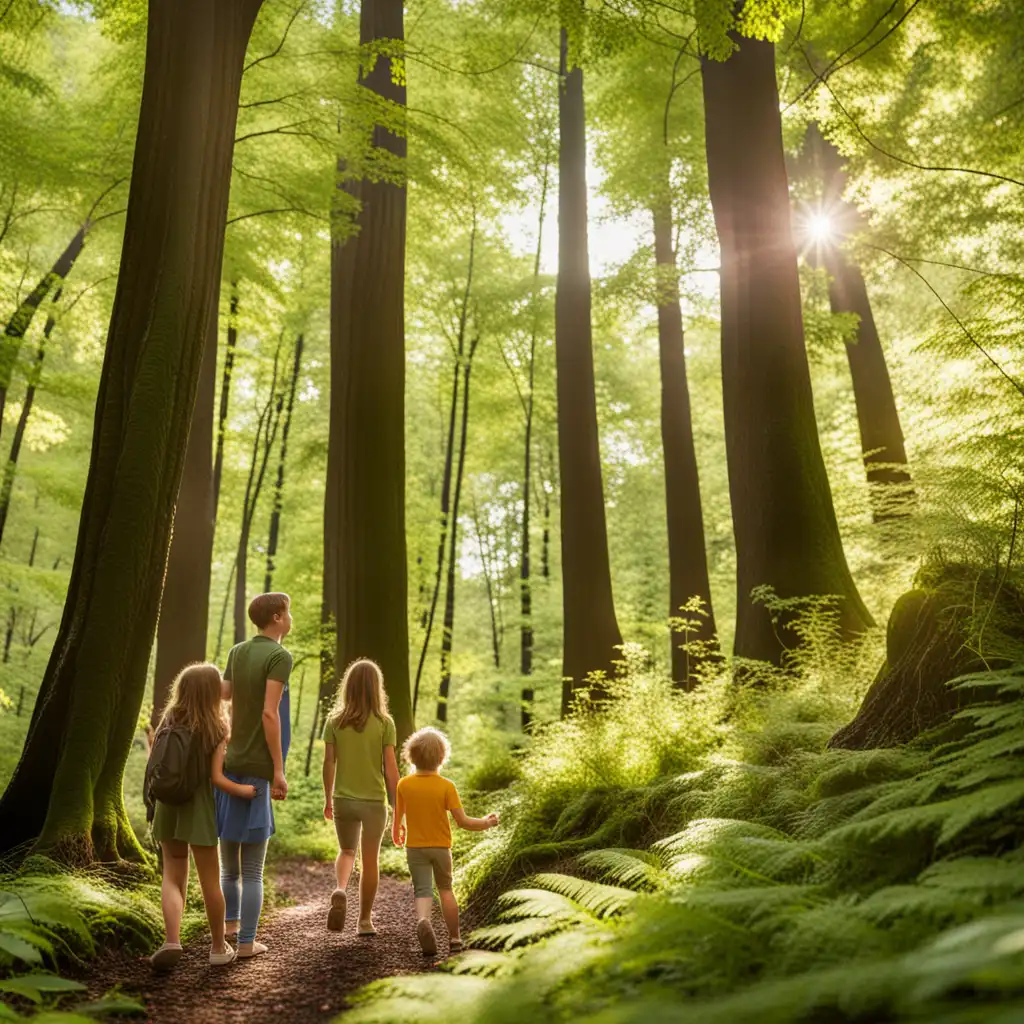
Woodland is an area covered with trees
The family enjoyed spending their weekends exploring the nearby woodland.
woodland
ˈwʊdlənd
불러오는 중…
ˈwʊdlənd
Woodland is an area covered with trees
The family enjoyed spending their weekends exploring the nearby woodland.
오디오를 불러오지 못했어요. 잠시 후 다시 시도해 주세요.
The word 'woodland' is used to describe an area of land covered with trees. It can be used to talk about a forest or a small group of trees. When you are talking about a place that has a lot of trees, you can say that it is a woodland. For example, "We went for a walk in the beautiful woodland near our house."
Brush refers to small trees, shrubs, and other plants that grow closely together, while woodland refers to an area covered with trees that are not very closely spaced.
Brush is usually found in areas that have been cleared or burned, while woodland is found in areas that have not been disturbed.
Brush is often used for cover or shelter by small animals, while woodland provides habitat for larger animals such as deer and bear.
단어 열기: Brush →A copse refers to a small group of trees that are clustered together, while woodland refers to a larger area of land covered in trees.
A copse might be applicable when describing a small area of trees within a larger landscape, whereas woodland describes a forested area with many trees and possibly wildlife.
Think of a copse as a small grove of trees and woodland as a larger forested area.
단어 열기: Copse →Forest refers to a large area of trees and vegetation, which is often densely populated and complex in structure.
Forests are usually considered to be vast tracts of land, often covering entire mountains or regions, and may include a variety of trees and other plants, and many different types of animals.
The word woodland generally refers to a smaller area of trees and vegetation, usually less dense and less complex than a forest.
Woodlands are typically considered to be smaller patches of land, often found clustered around lakes, streams, or other bodies of water, and may not contain as many different types of trees or other plants as a forest.
In summary, forests are large areas of densely populated trees, while woodlands are smaller patches of land with a simpler structure of trees and vegetation.
단어 열기: Forest →A grove is typically a small group of trees or a collection of trees that are planted close together in a defined area, often for ornamental or fruit-bearing purposes.
Groves can be found in parks, gardens, or orchards. A woodland is a larger area of trees and other vegetation, typically covering a larger area than a grove.
단어 열기: Grove →Jungle usually refers to a dense, tropical forest that receives a lot of rain and sunlight. It is home to many diverse species of plants and animals, and can be difficult to navigate due to the density of vegetation.
Jungle is typically used to describe the rainforests of South America and Southeast Asia.
Woodland refers to an area covered in trees that is not quite as dense as a jungle.
A woodland is typically easier to navigate than a jungle.
A jungle is a very dense tropical forest, while a woodland is a less dense forest that can be found in a variety of climates.
단어 열기: Jungle →A thicket is a dense group of bushes or shrubs that are closely spaced together, often making it difficult to walk or see through.
Thickets are usually smaller than woodlands and are often found in open areas such as fields or along the edges of forests.
A woodland is a larger and more extensive area of trees, usually with a mix of deciduous and coniferous trees, that are more widely spaced than those in a thicket.
A thicket is a dense group of bushes while a woodland is a larger area of trees that are more widely spaced. Thickets are typically found in open areas while woodlands are more extensive and often used for recreational activities.
단어 열기: Thicket →Wilderness refers to a natural environment that has been left undisturbed by humans and is often characterized by rugged terrain, minimal human presence, and limited access.
It can be a remote mountain range or a vast desert. Wilderness areas are typically protected from development or human impact in order to preserve their natural state.
Wilderness is a natural, untouched environment that is isolated from human development or influence, whereas woodland is a forested area that may or may not be disturbed by humans and can be found in various settings.
단어 열기: Wilderness →Wood refers to a small area of trees, such as a group of trees in a park or a patch of forest. Woodland refers to a larger area of trees and vegetation, often used to describe a forest or a wooded area.
To simplify, imagine a wood as a small group of trees in a backyard or a small forested area, while a woodland is a much larger area of trees and vegetation such as a national park or a large forested area.
단어 열기: Wood →which they raise whenever they're alarmed. They usually prefer to live in dense thickets of woodland, but the small trees and shrubs growing inside the barracks seems to be given this Owl all the cover it needs Absolute proof. And it was here. Beautiful feather. Yeah it's gorgeous right?
YouTube에서 보기 ↗There is a serene and settled majesty to woodland scenery that enters into the soul and delights and elevates it, and fills it with noble inclinations.
England an unusual forest is growing nut trees fruit trees shrubs and perennials are planted in a way that mimics a natural woodland this forest garden is the life's work of Martin Crawford an unconventional gardener who
YouTube에서 보기 ↗This is a truth that should be repeated like a mantra: to have any chance of a ful - filling life, we require not only clean air and a steady climate, but also an abundance of meadows and woodlands, rivers and oceans, teeming with life and the mass existence of other living creatures.
theatrical settings I had directed a little bit differently I'm Mohegan we're a northeastern Woodlands people on the shoreline in Connecticut my tribe is matriarchal and our stories ways of understanding for my culture affect the way I lead I was taught a worldview without a living language my tribes language like many
YouTube에서 보기 ↗Research gathered over recent years has highlighted the countless benefits to people, wildlife and the environment that come from planting trees and creating new woodland habitat. It's obvious trees are good things.
In the first millennium, a large group of tribes spread through the dense woodlands of Eastern Europe. Because they had no writing system, much of what we know about them comes from three main archaeological evidence,
YouTube에서 보기 ↗My motivation to compete was always about improving one year to the next. At 34, I realised I'd never run any quicker, so why hang on? But I love running and still run along woodland trails and beaches every few days.
like woodland caribou and grizzly bears, and it consumes even more energy more water, and produces at least as much greenhouse gas. So these in situ developments are at least as ecologically damaging as the mines. The oil produced from either method
YouTube에서 보기 ↗Allowing for suburbanization of California's ranches and farmlands would still allow for strong protections of California's truly natural areas like Yosemite, the redwoods, and oak woodlands and green spaces near cities.
in trees and so woodland wildlife prospered more than half the batter's diet consists of earthworms so deep rich devon soils make this a particularly
YouTube에서 보기 ↗A woodland in full color is awesome as a forest fire, in magnitude at least, but a single tree is like a dancing tongue of flame to warm the heart.
interest. It's what's known as a Celtic rainforest and it's one of the rarest habitats in the world. Forests like this one are thought to be even more threatened than tropical rainforests. But in these woodlands you're never more than a step away from the past.
YouTube에서 보기 ↗The more people share woodland, absorb it and regard it as part of their personal heritage and culture, the richer our society will be. The more people can work in woods and use them practically rather than go through the motions as a kind of ersatz exercise, the more they will care for the places themselves rather than the political idea of them.
thanks to people resurrecting traditional ways of managing the woodland but butterflies are also giving us vital information about another threat to our wildlife
YouTube에서 보기 ↗While planting woodlands along rivers has been shown to work in small areas, it has been unclear whether it would be effective on a larger scale. But computer modelling indicates that restoring forests on floodplains could slow floodwaters and reduce the height of the flood downstream.
we've seen how managing woodland and farmland for butterflies can preserve the countryside we love and also how butterflies can inspire the next generation to protect it but if you still have doubts about whether butterflies can make our countryside a
YouTube에서 보기 ↗I feel very at home in woodlands and could easily live there. I should have been one of Robin Hood's men.
onto the heath where the woodland has been kept at bay for centuries equine teeth have shaped this world but the
YouTube에서 보기 ↗Heartless though it may seem to some, among the least harmful things to eat are sustainably culled wild animals. In the absence of natural predators, deer populations in parts of Britain have reached such dense numbers that the woodlands they browse fail to regenerate.