
iconoclast
noun iconoclast
aɪˈkɑːnəklæst
A person who criticizes or opposes beliefs and practices that are widely accepted.
In the field of economics, he is known as an iconoclast due to his unorthodox theories.
iconoclast
aɪˈkɑːnəklæst
Đang tải…
aɪˈkɑːnəklæst
A person who criticizes or opposes beliefs and practices that are widely accepted.
In the field of economics, he is known as an iconoclast due to his unorthodox theories.
aɪˈkɑːnəklæst
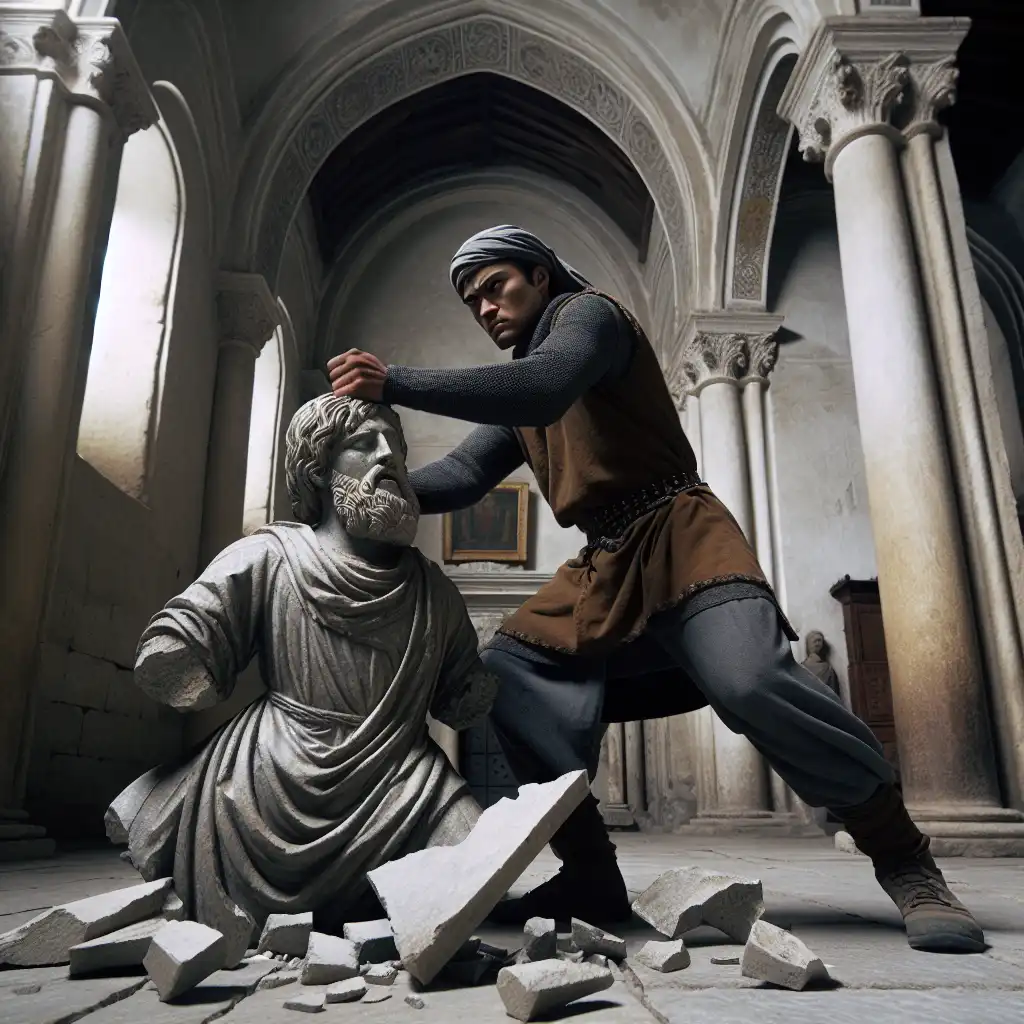
A person who destroys religious images or opposes their worship.
During the 8th century, the Byzantine Empire was divided by the issue of iconoclasm, with some iconoclasts even destroying religious artwork in churches.
Không tải được âm thanh. Vui lòng thử lại sau.
The word 'iconoclast' is used to describe someone who challenges traditional beliefs or values. It is often used to describe people who do not conform to the norm, and who are willing to challenge society's beliefs in order to bring about change. For example, a politician who proposes a radical new policy could be described as an iconoclast, as could an artist who creates controversial works of art that challenge the status quo. Essentially, an iconoclast is someone who is not afraid to go against the prevailing wisdom, and who has the courage to push for change.
A dissenter is someone who disagrees with the commonly accepted beliefs or practices of a group, organization or government.
They voice their disagreement and may actively work to change the belief or practice. For example, a dissenter might speak out against a particular policy of the government or a doctrine of a religion.
A dissenter disagrees with a specific belief or practice while an iconoclast seeks to challenge and overthrow the entire system of beliefs and practices.
A dissenter is applicable in situations where there is disagreement within a group while an iconoclast applies to situations where there is a desire to completely change the established order.
Mở từ: Dissenter →A freethinker is someone who forms their opinions based on reason and logic, rather than relying on tradition or authority.
While both may appear similar, a freethinker focuses on forming their opinions based on rational thinking while an iconoclast focuses on challenging traditional norms.
A freethinker can be someone who quietly holds different opinions, while an iconoclast is someone who actively seeks to disrupt established systems.
Mở từ: Freethinker →Heretic refers to a person who believes or teaches something that goes against the accepted beliefs or teachings of a particular religion or belief system.
This term can be used more broadly than heretic and isn't limited to religious contexts.
So, in short, heretic describes someone who challenges established religious beliefs, while iconoclast refers to those who challenge any type of established belief or tradition.
Mở từ: Heretic →A maverick is someone who is independent-minded, and often goes against the typical or expected behavior of a certain group or organization.
For example, a business leader who takes risks and breaks rules to achieve success would be considered a maverick.
An iconoclast is often viewed as someone who intentionally seeks to challenge the accepted way of doing things, while a maverick is someone who operates outside of established norms but may not be actively attempting to change them.
Mở từ: Maverick →A nonconformist is someone who does not conform to the norms or rules of society. They may reject traditional values or beliefs, but they may also reject any form of authority or social convention.
Nonconformists are often seen as rebels, but they may be driven by a desire to express their individuality or to challenge the status quo.
While both words describe individuals who challenge established ideas, iconoclasts tend to focus more on specific beliefs or institutions, while nonconformists reject broader societal norms in general.
Mở từ: Nonconformist →A radical is someone who advocates extreme, fundamentally new, or revolutionary changes or reforms. They believe in drastic and far-reaching changes to the established order of things.
For example, a political activist who demands a complete overhaul of the government system, or a social reformer who calls for a significant shift in the way society is structured can be called a radical.
An iconoclast challenges established norms, while a radical proposes and advocates for fundamental changes.
Mở từ: Radical →A rebel is a person who resists authority and established rules, often through disobedience, protest, or even violence.
For example, a rebel might participate in civil disobedience to protest against an unjust law or government policy.
Overall, while both iconoclasts and rebels challenge established norms and conventions, the difference between the two lies in their methods and goals.
Iconoclasts seek to challenge and change ideas and beliefs through intellectual or creative means, while rebels seek to overthrow or disrupt established authority through more direct and often confrontational means.
Mở từ: Rebel →A renegade is someone who has rebelled or broken away from an established system or authority. They have left behind the norms and expectations of a group, often with the intent of challenging or pursuing their own goals.
An iconoclast is someone who challenges established ideas, while a renegade is someone who breaks away from established groups or systems.
Mở từ: Renegade →Scott McCloud:...
Xem trên YouTube ↗I think that every artist dreams of renewing the forms which came before, but I think very few can be considered to have achieved that. We are all dwarves standing upon the shoulders of the giants who preceded us, and I think we must never forget that. After all, even iconoclasts only exist with respect to that which they destroy.
Until you prove yourself, modeling the behavior of iconoclasts is dangerous.
I love iconoclasts. I love individuals. I love people that are true to themselves, whatever the cost.