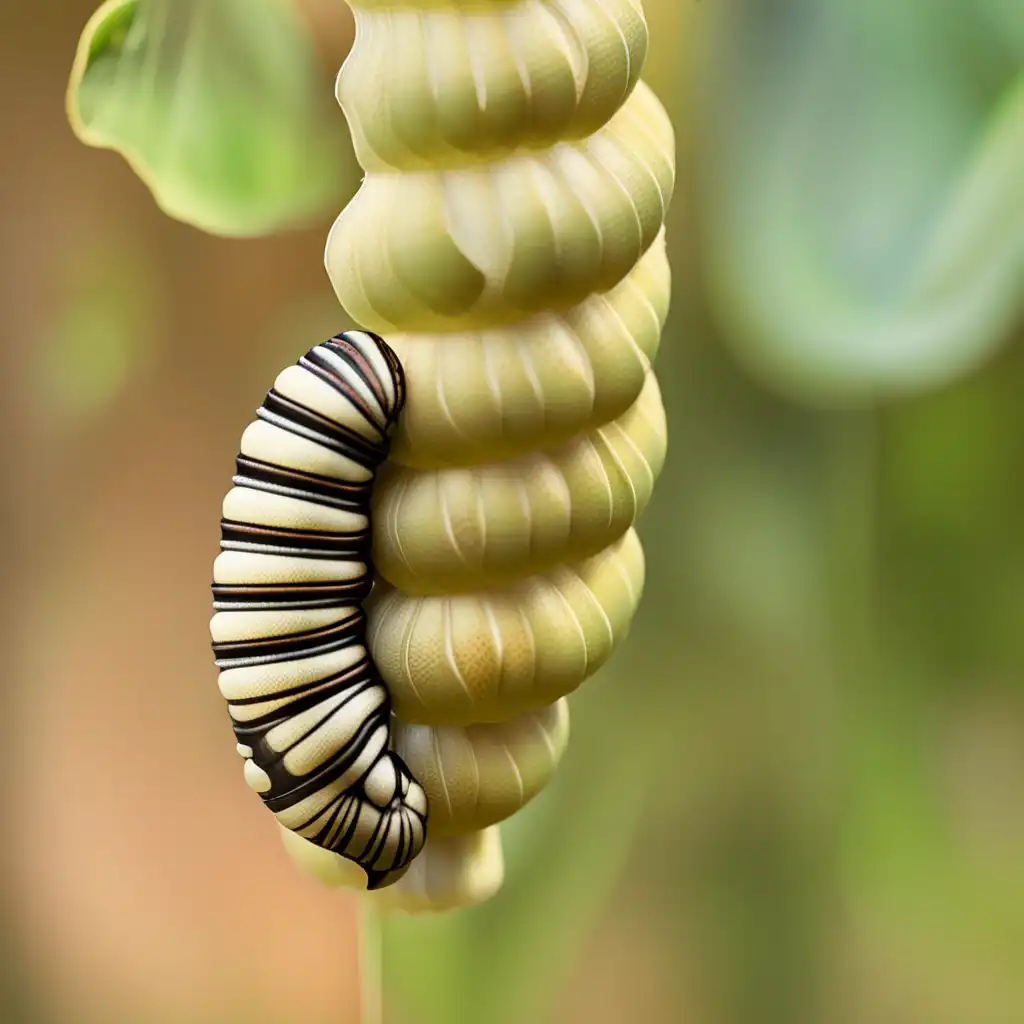
pupa
noun pupa
ˈpjuːpə
The stage in an insect's life after it is a larva and before it is an adult.
The caterpillar forms a pupa before becoming a butterfly.
pupa
ˈpjuːpə
Loading…
ˈpjuːpə
The stage in an insect's life after it is a larva and before it is an adult.
The caterpillar forms a pupa before becoming a butterfly.
Audio could not be loaded. Please try again later.
A pupa is a stage in the life cycle of certain insects, such as butterflies or moths. It is a protective cocoon or casing where the insect undergoes metamorphosis and transforms into its adult form. For example, a caterpillar spins a cocoon around itself and becomes a pupa before it emerges as a butterfly. The word pupa would be used in this context to refer to the stage of development where the insect is inside the cocoon or casing.
Both chrysalis and pupa refer to the same stage in the lifecycle of certain insects, such as butterflies or moths.
However, chrysalis is specifically used to describe the protective casing formed by a butterfly or moth's cocoon, while pupa is a more general term that refers to the entire developmental stage during which an insect undergoes metamorphosis.
Chrysalis is applicable when talking specifically about butterflies or moths, and pupa can describe any insect undergoing metamorphosis.
Open word: Chrysalis →A cocoon and a pupa are both related to the process by which certain insects transform from a larva to an adult.
A cocoon is a protective casing spun by moths and butterflies around themselves as larvae. Inside the cocoon, the larva undergoes metamorphosis and transforms into an adult.
The pupa can be inside a cocoon, but it can also be exposed in the environment. During the pupa stage, the insect's body transforms from a larva to an adult.
A cocoon is a protective casing made by certain insects during the pupa stage, while a pupa is the actual life stage where the insect undergoes metamorphosis.
Open word: Cocoon →Imago refers to the adult stage of an insect's life cycle, while pupa refers to the stage just before the insect becomes an adult.
The pupal stage is next, where the insect transforms into its adult form. Finally, the insect reaches the imago stage, where it becomes sexually mature and is able to reproduce.
Applying this knowledge, we can say that an imago is the fully developed, mature insect that is able to reproduce, while a pupa is the transformative stage where the insect undergoes rapid changes to mature into an imago.
Open word: Imago →A larva is the immature stage of an insect or amphibian that hatches from an egg and looks completely different from the adult form.
For example, a caterpillar is a larva of a butterfly or moth.
A pupa is the transformative stage between the larva and adult stage. During this stage, the organism undergoes metamorphosis and transforms into its adult form.
Larva is the immature form that hatches from eggs and looks different from the adult form, while pupa is the transformative stage where the organism undergoes metamorphosis to become an adult.
Open word: Larva →A nymph is a young stage of an insect that undergoes incomplete metamorphosis. In this stage, the insect looks very similar to its adult form but is smaller and has underdeveloped wings.
Nymphs continue to grow and molt until they reach their final adult stage.
In summary, nymphs are a young stage of insects undergoing incomplete metamorphosis, while pupae are a stage of complete metamorphosis that represents a transformative period from larva to adult insect.
Open word: Nymph →Ants Ingenious Survival...
Watch on YouTube ↗Why isn't the world...
Watch on YouTube ↗Morgan Spurlock: The...
Watch on YouTube ↗Maggot Medicine %\PIPE%...
Watch on YouTube ↗Encouraging curiosity-dri...
Watch on YouTube ↗5 Reasons Ants Are...
Watch on YouTube ↗Beautiful Butterfly...
Watch on YouTube ↗Weirdest Animal...
Watch on YouTube ↗Ant Nest Made Entirely...
Watch on YouTube ↗Ants Adopt a Butterfly %\PIPE%...
Watch on YouTube ↗