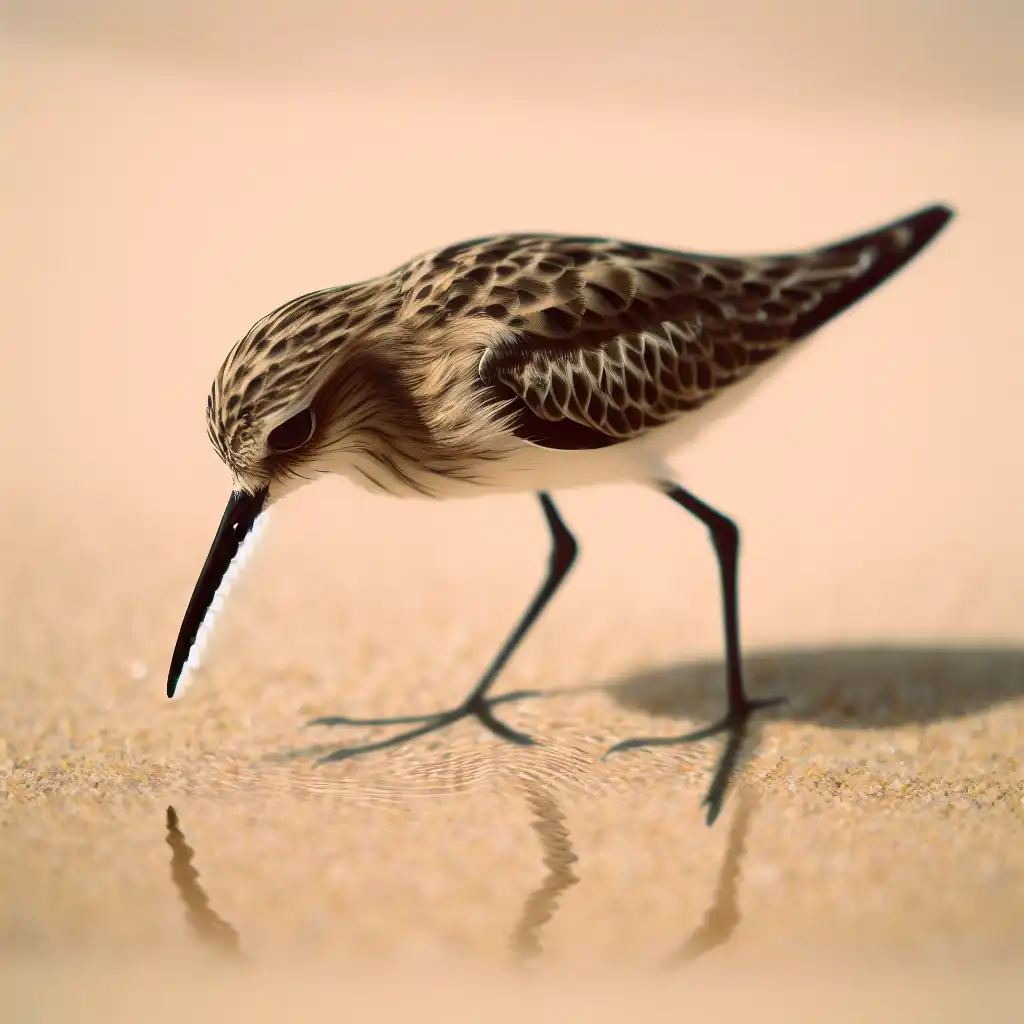
sandpiper
noun sandpiper
ˈsændpaɪpər
A small bird with long legs and a long bill, often found near water.
The beach was full of sandpipers searching for food.
sandpiper
ˈsændpaɪpər
लोड हो रहा है…
ˈsændpaɪpər
A small bird with long legs and a long bill, often found near water.
The beach was full of sandpipers searching for food.
ऑडियो लोड नहीं हो सका। कृपया बाद में फिर कोशिश करें।
A sandpiper is a type of bird that lives near water, such as on a beach or near a lake or river. They have long legs and a long beak, and they like to run along the water's edge and poke their beaks into the sand to find food. You might use the word sandpiper if you're talking about a bird watching trip, or if you want to describe a bird you saw at the beach.
A curlew and a sandpiper are both wading birds commonly found near water bodies. The main difference is in their appearance and behavior.
Curlews are larger birds with long, curved bills that they use to probe deep into mud to find insects and crustaceans. They are found in open coastal areas and mudflats.
They are found in a variety of habitats including beaches, rivers, and marshes. In summary, curlews are larger birds with curved beaks that forage by probing deep into mud, while sandpipers are smaller birds with straight beaks that forage by picking insects and small invertebrates from the surface of mud, sand, or water.
शब्द खोलें: Curlew →Dunlin and sandpiper are both types of small wading birds that live near bodies of water, but the main difference lies in their physical characteristics.
Dunlins tend to have longer bills that are slightly curved downward, and they usually have black belly patches during breeding season.
Sandpipers have straight, slender bills and tend to be smaller overall. They typically have longer wings and shorter legs than dunlins.
The terms dunlin and sandpiper are often used interchangeably to refer to various small wading birds, but there are subtle differences in their physical characteristics that can help you identify them more accurately.
शब्द खोलें: Dunlin →A knot is a unit used to measure the speed of a ship or aircraft relative to the air around it.
The term knot is applicable in the context of navigation and transportation, while sandpiper is applicable in the context of wildlife and nature.
A knot is a unit of measure for speed in transport, while a sandpiper is a type of bird found in coastal areas.
शब्द खोलें: Knot →Plovers and sandpipers are both types of shorebirds, but they are different in several ways.
Plovers are larger-bodied birds with shorter bills and more robust legs. They tend to feed on insects, crustaceans, and other small animals found on sandy or rocky shores, and they nest on the ground in open areas near the water.
In summary, plovers are larger-bodied birds that live on sandy or rocky shores and feed on insects and small animals, while sandpipers are smaller, more slender birds that live in mudflats and shallow water habitats and feed mostly on invertebrates.
शब्द खोलें: Plover →Sandpipers and snipes are both small, long-legged birds with long beaks that feed on insects and small invertebrates found in marshy areas.
1. Appearance - Sandpipers are typically smaller and more slender than snipes. They have a straight beak and a tapered tail.
Snipes have a longer bill that curves downwards and a short tail.
2. Flight - Snipes are known for their erratic, zigzagging flight patterns, while sandpipers tend to fly in a more direct path.
3. Habitat - Sandpipers can be found in a variety of wetland habitats, including beaches, estuaries, and mudflats. Snipes prefer marshes and swampy areas, particularly those with tall grasses.
In summary, sandpipers are typically smaller and found in a wider variety of wetland habitats, while snipes are larger and prefer marshy areas with tall grasses.
शब्द खोलें: Snipe →Sandpiper and stint both refer to small shorebirds, but they are different in a few ways.
Sandpipers are generally larger and have longer bills than stints. They can be found in a variety of habitats, including beaches, mudflats, and marshes.
Stints are smaller birds that prefer wetland habitats such as bogs, marshes, and shallow ponds. They feed mainly on insects and other small invertebrates.
- Sandpipers are larger and have longer bills than stints.
- Stints are smaller and found mainly in wetland habitats, where they feed on insects.
शब्द खोलें: Stint →Rare Video of Endangered...
YouTube पर देखें ↗All my life I have lived and behaved very much like the sandpiper - just running down the edges of different countries and continents, 'looking for something'.