fossil
noun fossil
ˈfɑːsl
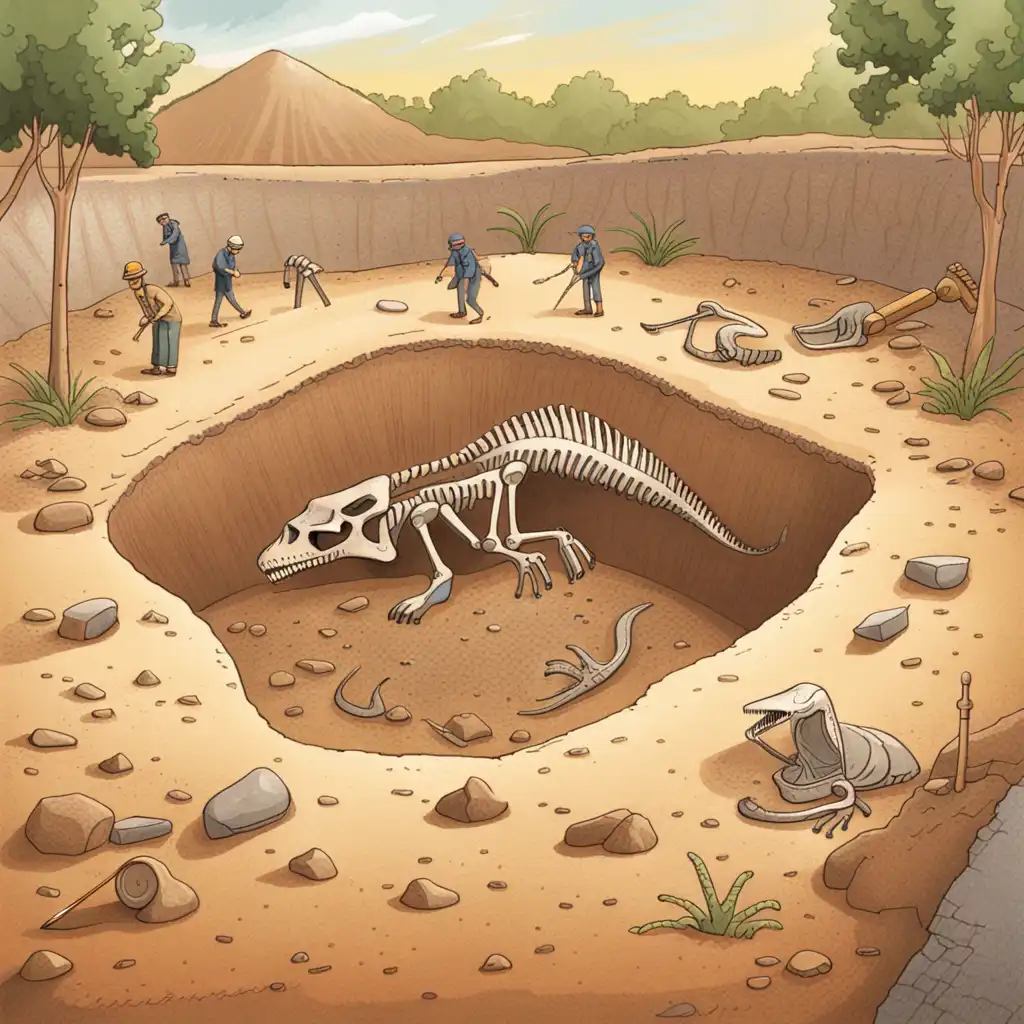
The hardened remains or imprint of a plant or animal that lived long ago.
They found a dinosaur fossil at the archaeological dig.
fossil
ˈfɑːsl
Đang tải…
ˈfɑːsl
The hardened remains or imprint of a plant or animal that lived long ago.
They found a dinosaur fossil at the archaeological dig.

ˈfɑːsl
A person or thing that is outdated or has not changed when everything else has.
With the advanced technology available today, my old computer feels like a fossil.
ˈfɑːsl
Based on or preserved from an earlier period or time.
Fossil plants and animals are those preserved from an earlier period in Earth's history.
Không tải được âm thanh. Vui lòng thử lại sau.
The word 'fossil' is used to describe the preserved remains or traces of plants or animals that lived millions of years ago. Fossils are usually found in rocks, and can help scientists learn about the earth's history, including what kinds of creatures used to live here and how they evolved over time. The word 'fossil' can also be used more broadly to describe anything that's outdated or that people don't use anymore. For example, you might hear someone say that an old rotary phone is a "fossil" of a bygone era.
Antiquity refers to something that is ancient, old, or from a distant past.
Fossils can be used to understand the evolution and history of life on earth. While antiquity applies to any object or civilization that is old, fossil specifically applies to the remains of living things.
Mở từ: Antiquity →The word ‘petrify’ means to turn something into stone. This can happen to living organisms, such as trees or plants, when they are buried in sediment and their organic material is replaced with minerals over time.
Mở từ: Petrify →A relic is something that has survived from an earlier time or era and is considered to be of historical or cultural significance.
Relics can be objects, buildings, or even traditions that have been passed down through generations.
In short, fossils are primarily used in the scientific study of evolutionary history, while relics are more often associated with cultural or historical preservation.
Mở từ: Relic →A fossil is the remains or traces of a plant or animal that lived a long time ago, which have been preserved in the ground.
Remain refers to any part of an organism or object that has been left behind but may not necessarily have been preserved.
Remains can be old or new and may be found in a variety of contexts.
In summary, fossils are specifically the remains of ancient plants or animals that were buried and preserved, while remains can refer to any part of an organism or object that has been left behind, preserved or not.
Mở từ: Remain →A trace is evidence of an animal's existence such as footprints, burrows, or tooth marks. While fossils are solid remains, traces are indirect or subtle markings left behind by animals.
Fossils provide direct evidence of what an organism looked like, while traces allow scientists to infer how an organism lived or moved.
Therefore, fossils and traces are applicable in different fields of study, with fossils being more important in paleontology, and traces being more important in the study of animal behavior and habitats, also known as ichnology.
Mở từ: Trace →A vestige is a trace or evidence of something that is no longer present or has become obsolete.
A fossil is a scientific term used to describe physical remains of an organism while a vestige refers to traces or evidence of something that is no longer present.
Fossils are applicable in the field of paleontology while vestiges are applicable in history and anthropology.
Mở từ: Vestige →It now seems clear that the instinct to nurture and care for a nest of eggs had its origins with the dinosaurs. It's a behaviour that was so successful it's still widespread today with birds. But the fossils show something else.
Xem trên YouTube ↗I said that if an alien came to visit, I'd be embarrassed to tell them that we fight wars to pull fossil fuels out of the ground to run our transportation. They'd be like, 'What?
Let's return to the microraptor fossil. When scientists examined its feather imprints under a powerful microscope, they found nanostructures that look like melanosomes. X-ray analysis of the melanosomes further supported that theory.
Xem trên YouTube ↗My object will be, first, to show by what connections the history of the fossil bones of land animals is linked to the theory of the earth and why they have a particular importance in this respect.
and it's very difficult to find good fossils there. But our hard work paid off. We discovered many incredible specimens. There's the largest dinosaur bone that had ever been found in this part of the Sahara.
Xem trên YouTube ↗World leaders need to realize that the cost of transforming the global energy system is far less than coping with the consequences of burning the planet's remaining fossil fuels.
However several dinosaur species survived. And some of which evolved to become today's birds. The world has never again seen land creatures as great as the dinosaurs. But through their descendants and fossils left behind,
Xem trên YouTube ↗I think that the world is in the middle of a huge transition that we have to make to renewable energy. We have to transition away from fossil fuels very, very quickly.
what we do need to do is to spend and encourage them to dramatically ramp up investment in green energy innovation fundamentally if we can innovate the price of green energy down below fossil fuels we'll have won everyone will buy
Xem trên YouTube ↗We have to be reminded that we still live in a world that relies a lot on fossil fuels, and that transition to new and renewable sources is not always and in all cases possible from one day to the next.
The most rare and sought after fossils of all. Tiny preserved bones of baby dinosaurs, still curled up inside their shell.
Xem trên YouTube ↗Most importantly, I agree that the truth of these matters should be determined by interpretation of scientific evidence - experiments, fossil studies and the like.
it now seems clear that the instinct to nurture and care for a nest of eggs had its origins with the dinosaurs it's a behavior that was so successful it's still widespread today with birds but the fossils show something else
Xem trên YouTube ↗Renewable energy is not more expensive than fossil fuel when you factor in life-cycle costs.
feathers aren't for keeping warm or for show their structure is plainly visible from the fossils they are very long veined and most importantly their shape creates a perfect aerodynamic surface
Xem trên YouTube ↗You'd save millions upon millions of lives by making fossil fuels available to parts of the world that don't have it.
and although such events may be rare, paleontologists have been able to identify several of them through dramatic changes in the fossil record, where lineages that persisted through several geological layers suddenly disappear. In fact these mass extinctions are used to divide the Earth's history
Xem trên YouTube ↗I can't think of any other region in the world which is such a vast source of fossils.
nurture and care for a nest of eggs had its origins with the dinosaurs it's a behavior that was so successful it's still widespread today with birds but the fossils show something else these animals all died sitting on their nests
Xem trên YouTube ↗Fossils have richer stories to tell - about the lub-dub of dinosaur life - than we have been willing to listen to.