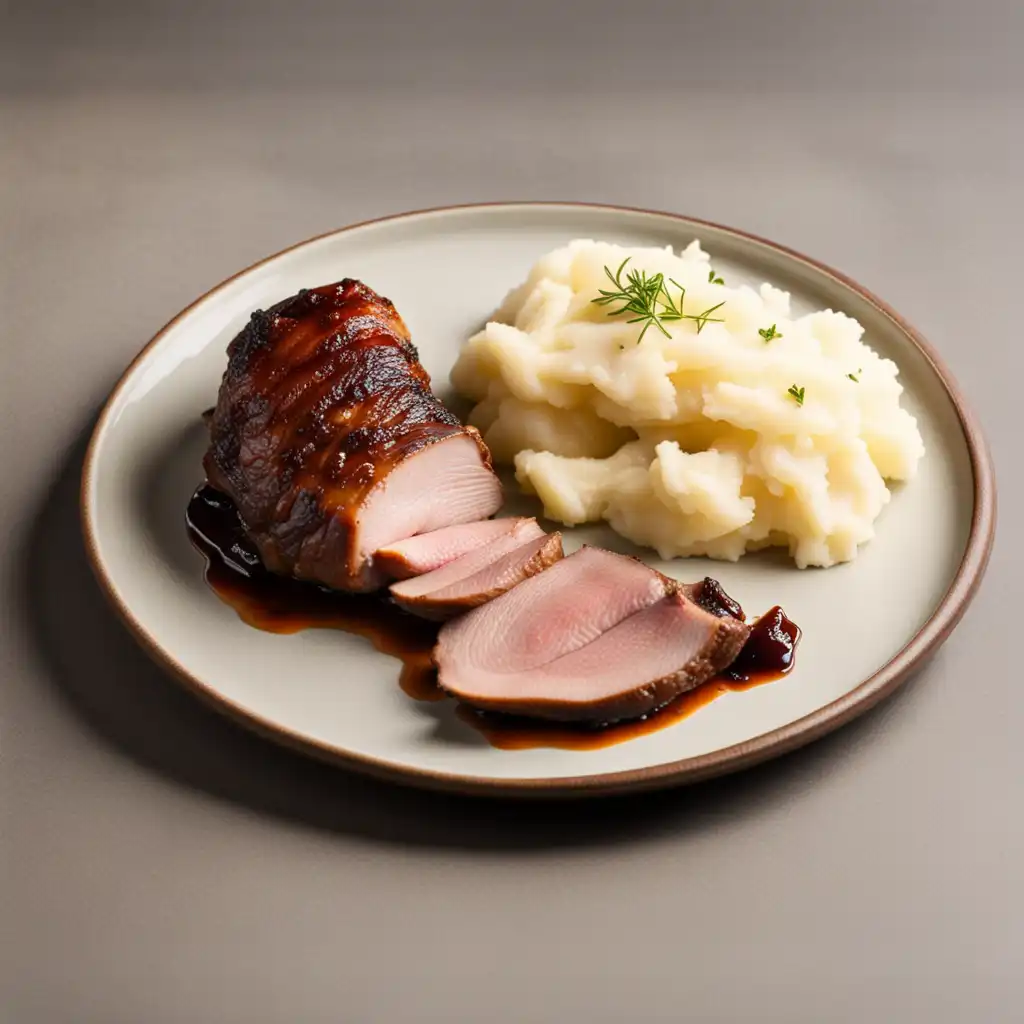
gammon
noun gammon
ˈɡæmən
A type of meat, which is the hind leg of a pig that is cured or smoked.
For dinner, we will have roast gammon with mashed potatoes.
gammon
ˈɡæmən
Loading…
ˈɡæmən
A type of meat, which is the hind leg of a pig that is cured or smoked.
For dinner, we will have roast gammon with mashed potatoes.

ˈɡæmən
A deceptive or insincere talk or behavior.
I can't believe he fell for that old gammon.

ˈɡæmən
To speak deceptively or insincerely.
He was gammoning about his achievements.

ˈɡæmən
A move in backgammon where a player removes all their pieces from the board before their opponent gets any pieces out.
With some good throws, I managed to score a gammon.
Audio could not be loaded. Please try again later.
The word 'gammon' is often used in British English to describe a person who is middle-aged or older and has a conservative political view. It can also be used to describe a type of cured meat that is usually served with eggs or other breakfast foods. It's important to note that the political context is generally the more commonly used meaning of the word.
Bacon is usually prepared from pork belly and is sliced and cured, while gammon comes from the hindquarter of a pig and is a cured and uncooked ham.
Bacon is usually eaten for breakfast, in sandwiches, or as a topping on pizza or salads. Gammon is usually served as a main dish and can be boiled, baked, grilled, or roasted.
Bacon is prepared from pork belly and is sliced and cured, while gammon is cured and uncooked ham from the hindquarter of a pig.
Bacon is usually eaten for breakfast, in sandwiches, or as a topping on pizza or salads, while gammon is usually served as a main dish in a variety of ways.
Open word: Bacon →Deception is when someone intentionally tries to make someone else believe something false or misleading. For example, if someone tells a lie to get out of trouble, that is deception.
Gammon is a slang term used in the UK to describe older white men who are conservative and pro-Brexit. While gammon can sometimes be used to imply that these men are hypocritical or insincere, it is not necessarily related to intentional deception like the word deception is.
So in short, deception is when someone is intentionally misleading, while gammon is a slang term for a certain group of people.
Open word: Deception →Flattery is when someone falsely compliments or praises someone else to gain their favor or approval.
It is often cured, smoked, and served as a tasty meat for meals. Gammon is not applicable in the same way as flattery since it is a food item, not a behavioral characteristic.
Open word: Flattery →Gammon and ham are both types of meat that come from a pig's hind leg, but they are different in the way they are prepared and cooked.
It is usually cured in salt or brine and sometimes smoked. It has a slightly salty taste and a firmer texture than ham.
Ham can be sold cooked, raw, smoked or cured.
It is usually prepared by smoking or dry-curing and can be eaten as a cold cut or heated up. Ham has a distinct salty, smoky flavor and is often used as a sandwich filling or incorporated into dishes like salads or quiches.
Gammon is a raw, cured piece of meat that needs to be cooked before eating, while ham can be bought cooked or uncooked and has a smoky, salty flavor.
Open word: Ham →Gammon refers to a type of cured, smoked ham, often served as a meal. Jargon refers to specialized vocabulary used by a particular group, such as professionals or enthusiasts.
Gammon is applicable in the context of food and cooking, while jargon is applicable in the context of communication and language within specific fields or industries.
Open word: Jargon →Nonsense means something that is foolish, untrue, or ridiculous. It is applicable in situations where someone is saying something that doesn't make sense or is obviously not true.
In summary: Gammon means insincere/false, while nonsense means foolish/untrue.
Open word: Nonsense →Gammon and pork both refer to meat from pigs, but there is a difference in how they are prepared and used in cooking.
Pork typically refers to the meat from the carcass of a pig.
It can be prepared in a variety of ways, such as roasting, pan-frying, or grilling, and is commonly used in dishes like pork chops, sausages, and pulled pork.
Gammon refers to a specific cut of pork which has been cured or smoked.
Pork is a general term for meat from a pig, while gammon refers to a specific cut of pork that has been cured or smoked.
Pork can be cooked in many different ways, while gammon is typically boiled or roasted and served for breakfast or during special occasions.
Open word: Pork →Pretence refers to the act of pretending or the appearance of something that is not true.
Gammon is applicable when talking about food or cooking, while pretence is applicable when discussing human behavior or interactions.
Open word: Pretence →I can eat beef, provided it's minced in disguise. I couldn't eat a gammon steak. Forget it.