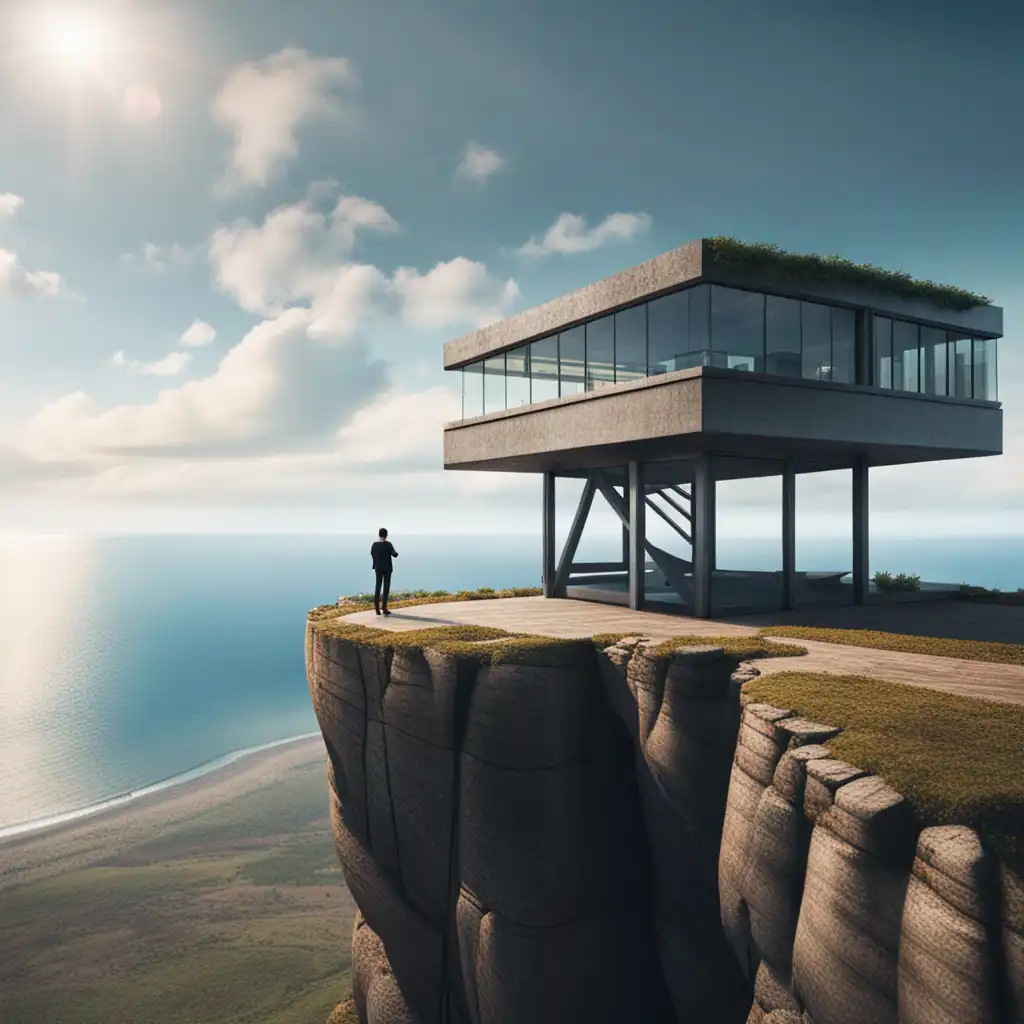
promontory
noun promontory
ˈprɑːməntɔːri
A high point of land sticking out into the sea
From the top of the promontory, we could see the entire coastline.
promontory
ˈprɑːməntɔːri
Chargement…
ˈprɑːməntɔːri
A high point of land sticking out into the sea
From the top of the promontory, we could see the entire coastline.
Impossible de charger l’audio. Réessayez plus tard.
A promontory is a part of land that sticks out into the water or over a lower area of land. It is like a hill or a point that extends out into the sea or overlooks a valley. You might use the word promontory to describe a place you visited, such as a rocky headland, or to describe the geography of a particular area. For example, you might say "The town was located on a promontory, with beautiful views of the ocean."
A bluff is a steep cliff or bank that rises abruptly from a flat or gently sloping surface.
Bluffs can be natural or man-made and are sometimes used as lookout points.
It is usually a natural formation and is larger and more prominent than a bluff. Promontories are often rocky and may be used as landmarks or navigational aids for ships or boats.
A bluff is a steep, vertical face of land, while a promontory is a high point of land that juts out into the water. Bluffs are usually found along river banks or coastlines and can be man-made or natural, while promontories are natural formations that are often used as landmarks or navigational aids.
Ouvrir le mot: Bluff →A cape is a piece of land that extends out into the sea and usually has a curved or rounded shape.
It can vary in size and may be connected to a larger peninsula or mainland. Examples of capes include Cape Cod in Massachusetts and Cape of Good Hope in South Africa.
It is typically larger than a cape and may be more rugged in appearance. Examples of promontories include Point Reyes in California and Cabo Girão in Madeira, Portugal.
A cape is a more general term for a piece of land extending into the sea, while a promontory is a specific type of land formation that is more elevated and often steeper.
Ouvrir le mot: Cape →A cliff is a steep, vertical or near-vertical slope or rock face, while a promontory is an elevated mass of land that projects out from a coastline into the sea.
Cliffs are often found on rocky coasts and can be formed through erosion or tectonic activity. They can be dangerous to approach because they are often unstable and can collapse or crumble.
Promontories are typically formed by the same geological processes as cliffs, but they extend out into the sea and can provide spectacular views of the surrounding coastline.
In summary, cliffs are steep rock faces found along coastlines, and promontories are elevated masses of land that extend out into the sea from the coast.
Ouvrir le mot: Cliff →Escarpment refers to a steep slope or cliff that is usually caused by erosion or faulting.
Essentially, an escarpment is a long, steep slope on land, while a promontory is a high point of land that extends into water.
Examples of escarpments include the edge of a plateau or a cliff on the side of a mountain, while examples of promontories include headlands along coasts or bluffs overlooking valleys.
Ouvrir le mot: Escarpment →A headland and a promontory both refer to a piece of land that juts out into the sea or another body of water.
However, a headland is generally a smaller piece of land, while a promontory is usually bigger and more dramatic in shape.
Headlands are often found along coastal areas and can be made up of cliffs or softer, more gently sloping land. They may be small or large and are often used as landmarks for sailors navigating the water.
Promontories are typically larger and more noticeable features than headlands. They are often found at the end of a peninsula or protruding out from a larger landmass.
To sum up, a headland is smaller and less imposing, while a promontory is larger and more impressive, and they each have slightly different uses and applications depending on their size and location.
Ouvrir le mot: Headland →A peninsula is a piece of land that is surrounded by water on three sides. It is connected to the mainland and extends out into a body of water.
Examples of peninsulas include Florida in the US, the Iberian Peninsula in Europe, and the Arabian Peninsula in the Middle East.
A peninsula is connected to the mainland and surrounded by water on three sides, while a promontory is not connected to the mainland and juts out into a body of water.
Ouvrir le mot: Peninsula →A ridge is a long, narrow, elevated section of land that rises above the surrounding area.
Both promontories and ridges can be used for hiking and outdoor activities, but promontories are more commonly used as lookout points while ridges are used for hiking trails and recreational activities.
Ouvrir le mot: Ridge →A spit is a narrow strip of land that extends from a coast into the sea.
A spit is formed by sediment that is carried by longshore currents and deposited at the mouth of a river or in a bay.
Spits can be sandy or rocky.
In simpler terms, a promontory is a big rock sticking out into the sea, while a spit is a little finger of sand sticking out into the sea.
Promontories are natural and made by rocks, while spits are mostly artificial and made by sediments.
Ouvrir le mot: Spit →Kevin Hand: Exploring...
Voir sur YouTube ↗Genius is a promontory jutting out into the infinite.
A poetic experiment:...
Voir sur YouTube ↗The white sail of his soul has rounded the promontory - death.
I got married at the lighthouse , the 16th-century Forte de Sao Miguel Arcanjo, on the edge of the promontory of Sitio.