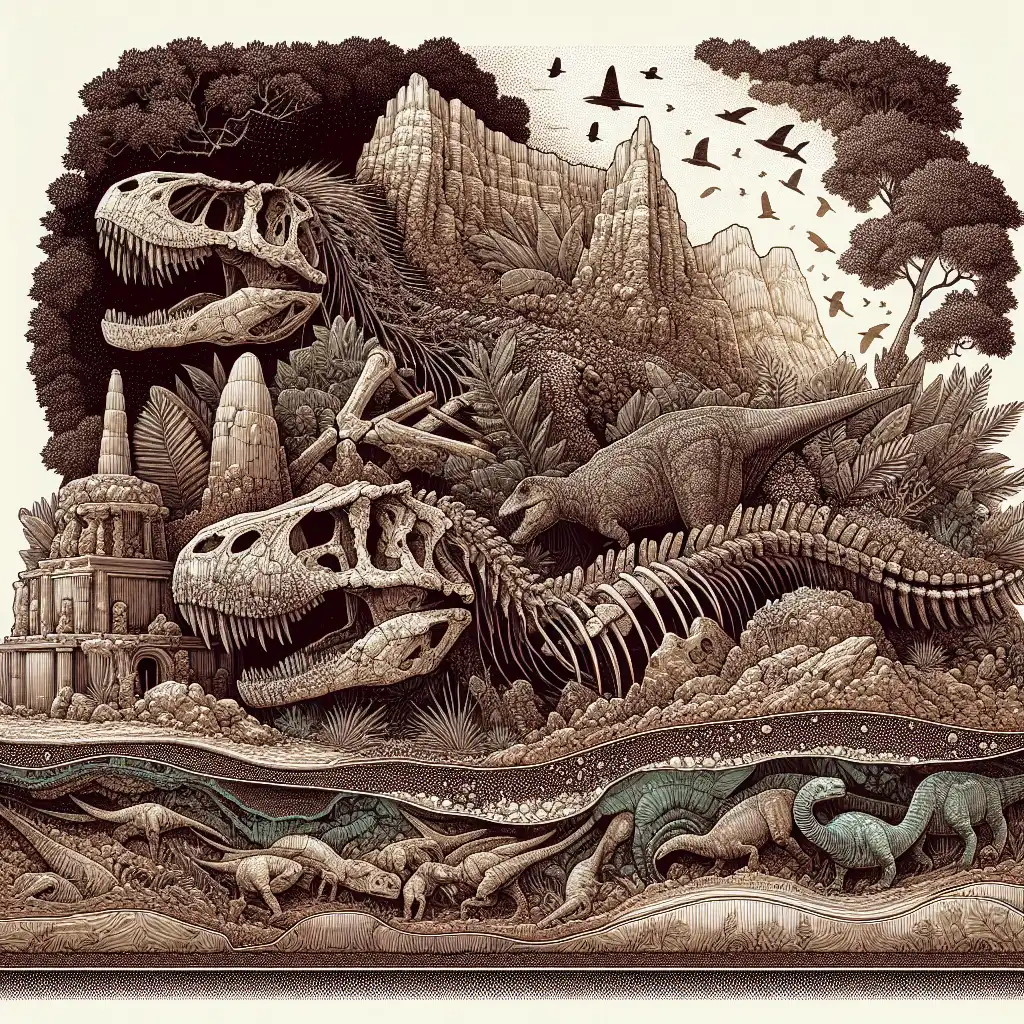
fossilization
noun fossilization
ˌfɑːsələˈzeɪʃn
The process where animal or plant remains turn to stone over many years.
The fossilization of plants and animals gives us clues about the Earth's history.
fossilization
ˌfɑːsələˈzeɪʃn
Chargement…
ˌfɑːsələˈzeɪʃn
The process where animal or plant remains turn to stone over many years.
The fossilization of plants and animals gives us clues about the Earth's history.

ˌfɑːsələˈzeɪʃn
The process in learning a language where mistakes become a permanent part of the person's way of speaking or writing.
Even after living in the U.S. for many years, his fossilization caused him to make the same grammar mistakes.

ˌfɑːsələˈzeɪʃn
The process where something old and outdated continues to exist or be used.
The fossilization of old technologies can hinder progress towards more efficient solutions.
Impossible de charger l’audio. Réessayez plus tard.
Fossilization refers to a process of becoming unchanged over time. It is usually used to describe things that have been preserved for a long time, such as the remains of animals or plants that have been turned into fossils. In language learning, fossilization refers to a habit or mistake that has become so ingrained in a learner's speech or writing that it is difficult to correct. For example, if a learner consistently uses the wrong grammar construction, it may become fossilized, making it hard to unlearn and correct the mistake.
Fixation refers to being stuck on one particular thing or idea and not being able to move on from it. It is applicable in psychology when talking about someone having an obsession or being fixated on a particular thought or action.
Fixation is being stuck on a particular thing mentally, while fossilization is being stuck in a particular way of doing something or speaking.
Ouvrir le mot: Fixation →Hardening refers to the process of the material becoming solid or tough. Fossilization is applicable to organisms that have become extinct, while hardening can refer to any material that has become solid or less malleable.
Ouvrir le mot: Hardening →Preservation means to keep something in its original condition or state. This can apply to anything, such as old documents, artifacts, and even food.
Preservation means the object remains the same but is protected from damage or decay.
Preservation is the process of keeping something in its original condition, while fossilization is the process by which organic remains are transformed into fossils over time.
Ouvrir le mot: Preservation →Fossilization and rigidity are two different concepts. Fossilization refers to the process of something becoming preserved over time, typically in the form of a fossil.
Rigidity refers to the state of being stiff or inflexible. This can describe anything from a physical object that is difficult to bend to a person who is set in their ways and resistant to change.
Fossilization refers to the preservation of something over time, while rigidity is a state of being inflexible or unyielding.
Ouvrir le mot: Rigidity →Solidification refers to the process of changing a substance from a liquid or gas to a solid state through cooling or drying.
Fossilization is a specific type of natural preservation process that applies to organic materials, while solidification refers to a more general process of changing from a liquid or gas to a solid state that can occur in many different contexts.
Ouvrir le mot: Solidification →Stagnate refers to something that has stopped progressing, growing, or developing. This term can be applied to many different areas, such as a stagnant economy, a stagnant relationship, or a stagnant pond.
Ouvrir le mot: Stagnate →Fossils 101 %\PIPE% National...
Voir sur YouTube ↗How to fossilize...yourse...
Voir sur YouTube ↗Hendrik Poinar: Bring...
Voir sur YouTube ↗