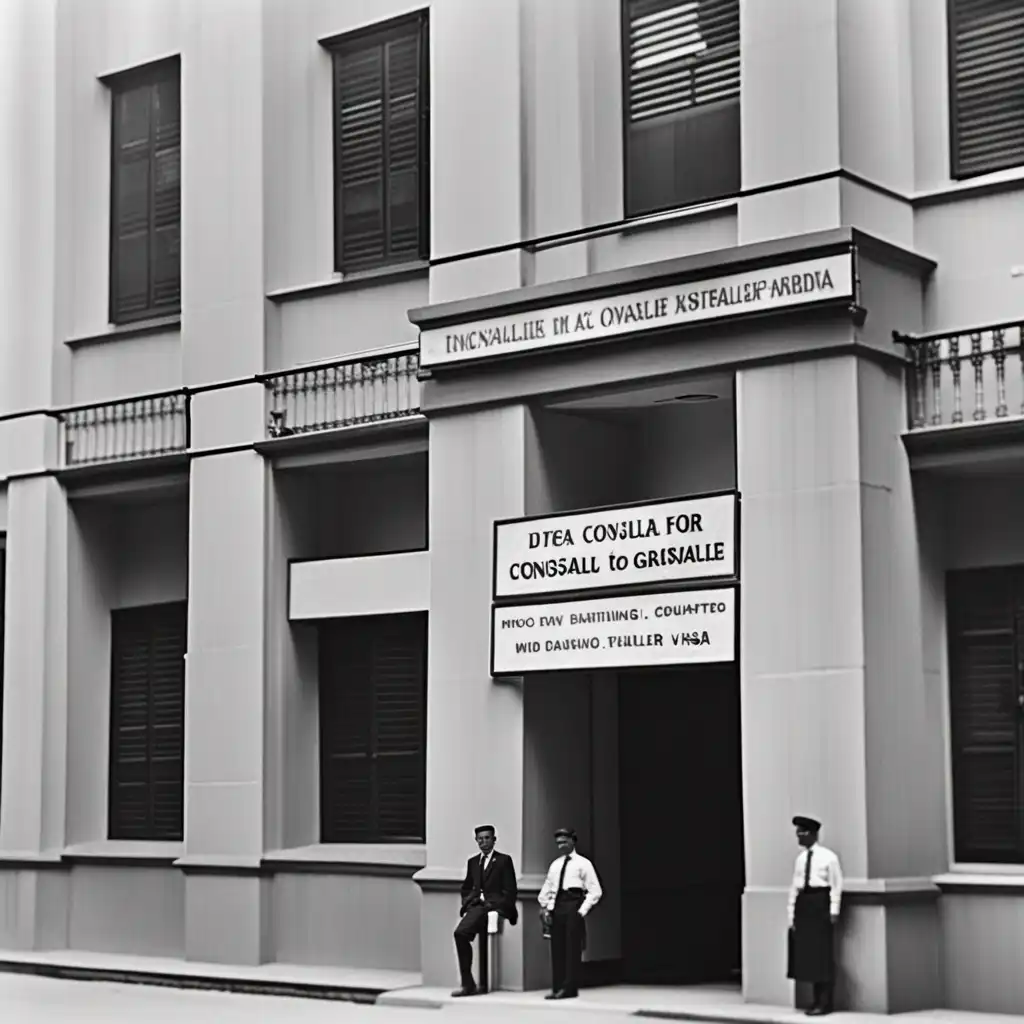
consulate
noun consulate
ˈkɑːnsələt
The place where a consul, an official representing a foreign country, works.
We had to obtain our visas from the consulate before we could travel.
consulate
ˈkɑːnsələt
読み込み中…
ˈkɑːnsələt
The place where a consul, an official representing a foreign country, works.
We had to obtain our visas from the consulate before we could travel.
音声を読み込めませんでした。しばらくしてからもう一度お試しください。
A consulate is a place where government representatives work to help people from their country who are away from home. They can help with things like visas, travel documents, and advice on local laws and customs. You might hear about a consulate if you are traveling or studying abroad, or if you need to contact your home country's government while you are outside of it.
A chancery is a building where the staff of a diplomatic mission works. A diplomatic mission is a group of people representing their country's government, which may include ambassadors, diplomats, and support staff.
The chancery is the administrative center of the embassy, where staff members work to offer diplomatic and consular services.
The main function of a chancery is to oversee the diplomatic relations between two or more countries.
A consulate is an office for assistance to citizens, while a chancery is a building where diplomatic and consular work takes place.
単語を開く: Chancery →Commission refers to a group of people appointed by an authority or organization to carry out a specific task or duty.
A commission can also refer to a percentage of a sale or transaction that is paid as a fee to a salesperson or broker.
Commission refers to a group of people appointed for a specific task or a percentage of a sale, while consulate refers to a government representation office in a foreign country.
単語を開く: Commission →Delegation refers to a group of people who are sent on a mission, often for negotiation purposes or to attend a conference.
If a group of leaders from a country visit another country for a meeting, they would be considered a delegation.
In simple words, consulate is a place where a government official is stationed to help, while delegation is a group of people sent on a mission.
単語を開く: Delegation →A consulate is a smaller version of an embassy that represents a country in a foreign city, often with a focus on promoting trade and providing assistance to citizens of that country.
Meanwhile, embassy is a larger representation of a country in a foreign capital city, that is responsible for a wider range of duties such as diplomatic relations and providing aid to countrymen abroad.
Embassies are typically located in the capital cities of foreign nations where they act as a liaison between the governments of two countries.
単語を開く: Embassy →A legation is a diplomatic mission of a government to a foreign country that is ranked lower in status than an embassy.
Legations generally deal with specific issues or negotiations, rather than serving as a permanent diplomatic presence.
In simpler terms, a consulate is a place where citizens go for help and support when they are abroad, while a legation is a group of diplomats sent to negotiate or represent a government in a foreign country for specific issues or periods of time.
単語を開く: Legation →Consulate and mission are both terms related to a country's representation in another country, but they serve different purposes.
A mission refers to a group of people who are sent by a government to represent their country in another country, usually for a specific purpose such as trade or diplomacy.
A mission can also refer to a diplomatic office or embassy.
A consulate is more focused on providing services to its own citizens while a mission is focused on representing a country's interests abroad.
単語を開く: Mission →Representation refers to the act of speaking or acting on behalf of someone or something, such as having representation in a political or legal setting.
Representation can also refer to a group of people who have been elected or appointed to represent a specific group or constituency.
A consulate is a specific type of representation that primarily deals with diplomatic and bureaucratic affairs, while representation can encompass a wider range of contexts and actions.
単語を開く: Representation →this passion comes in and he introduced himself as working for the British Consulate is there anything I can do to help now I'm hanging in a tree and as
YouTube で見る ↗I support legal immigration. I don't support amnesty because it is not fair to people standing in line at consulates around the world.
Singapore and Spain. In 1936 while Neruda was working at the consulate in Madrid, civil war broke out and the government was overthrown by a fascist military dictatorship.
YouTube で見る ↗The Congressman ascertained that the consulate in Havana had numbers to feed the pigs.
If refugees were simply allowed to travel directly and seek asylum in Europe, we would avoid that, and there's a way of doing that through something called a humanitarian visa, that allows people to collect a visa at an embassy or a consulate in a neighboring country
YouTube で見る ↗The president of the United States let the consulate in Libya become a death trap.
Constant pressure by Turkish consulates across the United States, as well as pervasive and continual harassment by the government in Turkey, has so far failed to stifle my dissent. As they increase the pressure, I raise my voice.
In case anyone needs reminding, it was the relentless drive of the tourism industry and kowtowing State Department bureaucrats that led to the Bush-era Visa Express Program, which relaxed visa policies, eliminated in-person consulate interviews and opened the door to the 9/11 hijackers.
We'd play at the Ambassador's house for an invited group of dignitaries from the government that might have gone to school in America; to the U.S. Consulate that invites certain people that they're trying to target.
The attack on the U.S. Consulate in Benghazi has become a political football in the presidential campaign, with all the grandstanding and misinformation that entails.
Despite the obvious intelligence and security failures that contributed to the attack against the U.S. Consulate in Benghazi, the reality is that in one night, an al Qaeda-affiliated group destroyed a diplomatic post, killed a U.S. ambassador and three other Americans, and forced an end to clandestine U.S. activity in the area.
Less than a year after the Sept. 11 attacks, al-Qaida attacks were continuing: the firebombing of a synagogue in Tunisia in April, a bomb outside the U.S. Consulate in Karachi in June.
I think that ISIS is a threat to our embassy, to our consulate, as well as potentially to the American people.