
wavelet
noun wavelet
ˈweɪvlət
A small wave or one that is seen as part of a larger wave.
He noticed a wavelet lapping at the shore of the lake.
wavelet
ˈweɪvlət
Đang tải…
ˈweɪvlət
A small wave or one that is seen as part of a larger wave.
He noticed a wavelet lapping at the shore of the lake.
ˈweɪvlət
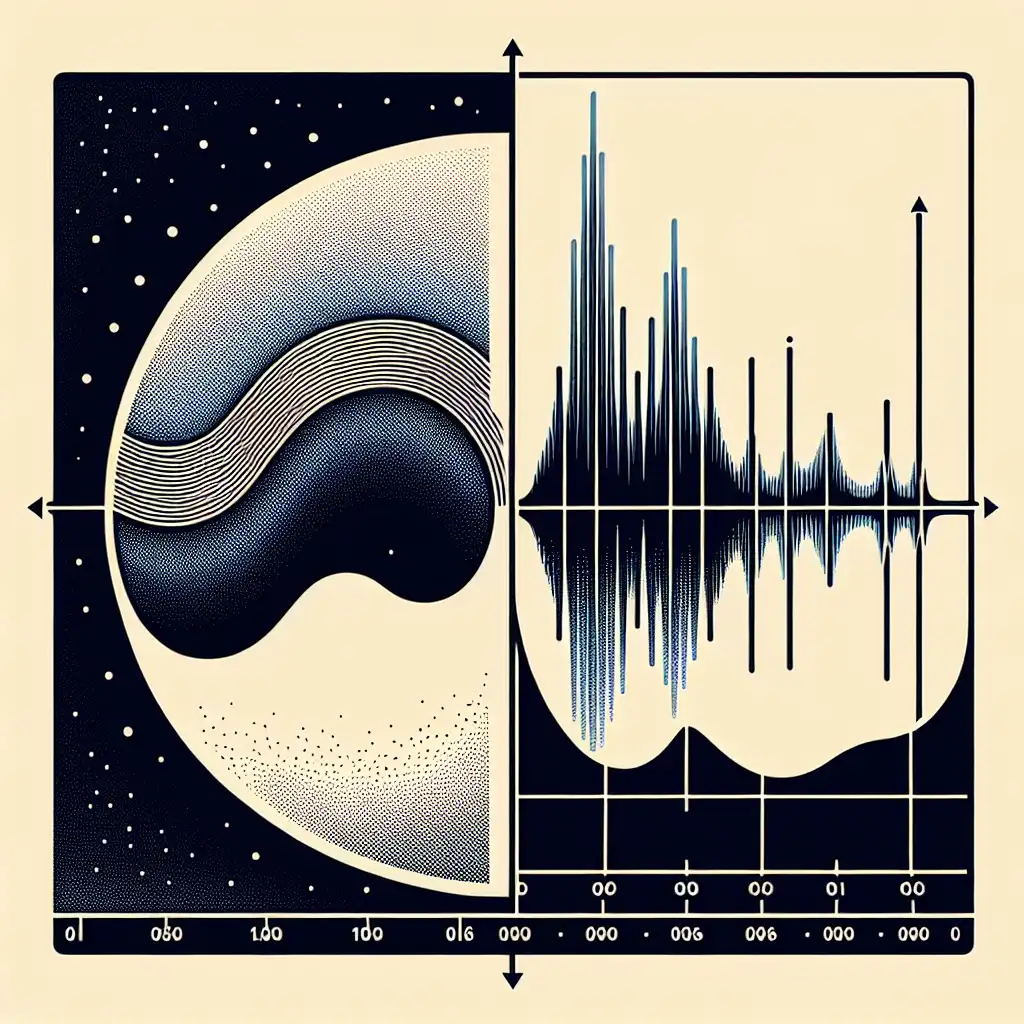
In mathematics, physics and engineering, a wavelet is a wave-like oscillation with an amplitude that begins at zero, increases, and then decreases back to zero.
Wavelet analysis can be used to detect and analyze abrupt changes in signals.
Không tải được âm thanh. Vui lòng thử lại sau.
A wavelet is a small wave. It is a mathematical concept used to analyze and process signals, such as sound and images. It is often used in fields such as computer science, physics, and engineering. Some examples of applications of wavelets include data compression, noise reduction, and pattern recognition. Wavelets can be represented by a series of numbers and have various properties that make them useful for solving different problems.
Fluctuate means to change frequently and unpredictably. For example, the stock market fluctuates up and down over time.
It can also refer to a small, brief fluctuation in a larger pattern. For example, a small dip or rise in a financial trend could be referred to as a wavelet.
Fluctuate describes frequent and unpredictable changes over time, while wavelet describes small, brief fluctuations within a larger pattern.
Mở từ: Fluctuate →Oscillation refers to a repetitive back-and-forth motion or movement around a central point or position. It could be a swinging pendulum or a vibrating guitar string.
So, while oscillation refers to a repetitive motion, a wavelet is a building block for creating complex waves. Oscillations are applicable in many physical systems, such as pendulum clocks and musical instruments, while wavelets are often used in digital signal processing, data analysis, and image compression.
Mở từ: Oscillation →Perturbation is when something is disturbed or changed from its normal state, usually by an external force. For example, when a planet's orbit is influenced by the gravitational force of another object.
Perturbation refers to a disturbance or change in a system, while wavelet refers to a small wave used in signal processing and image compression.
Mở từ: Perturbation →A ripple is a small wave observed on the surface of a liquid or water body. It is the result of a disturbance, such as a breeze or a small object being thrown into the water.
Rippling is the undulation of water where the crest and trough of the wave are of the same shape than a wavelet.
Generally, ripple describes the movement of water, while wavelet describes the movement of electromagnetic radiation or sound waves.
However, in some cases, ripple and wavelet can be used interchangeably to describe small waves or oscillations.
Mở từ: Ripple →A surge is a sudden and powerful movement of water, often caused by a large force such as a storm or earthquake.
Surge can also refer to a sudden increase in something like popularity or demand for a product.
Wavelets are much smaller and less powerful than surges.
Surges are usually used to describe large and sudden movements of water, while wavelets are used to describe smaller and more gentle movements.
Surges are often associated with natural disasters like hurricanes, while wavelets can be observed at the beach on a calm day.
Mở từ: Surge →A tremor is a shaking or involuntary movement of part of the body, often caused by a medical condition or emotional state.
In general, tremors are associated with larger and more intense movements, while wavelets are more subtle and gentle. Tremors are often a sign of something being wrong, while wavelets can simply be a natural occurrence.
Mở từ: Tremor →Undulation usually refers to a smooth, continuous, and relatively large up-and-down movement or shape, like the rolling motion of waves on the ocean or the undulating hills of a landscape.
In a nutshell, undulation is a large and smooth wave-like motion while a wavelet is a small, choppy, and rapid wave-like motion.
Mở từ: Undulation →Vibration refers to the rapid back-and-forth movement of an object or particle around its equilibrium point.
In summary, vibrations are physical movements that we can observe in everyday life, while wavelets are mathematical techniques used to analyze signals in more advanced fields.
Mở từ: Vibration →