civics
noun civics
ˈsɪvɪks
The study of the rights and duties of citizens in relation to their government.
In high school, he learnt about the workings of government in his civics class.
civics
ˈsɪvɪks
Cargando…
ˈsɪvɪks
The study of the rights and duties of citizens in relation to their government.
In high school, he learnt about the workings of government in his civics class.
No se pudo cargar el audio. Inténtalo de nuevo más tarde.
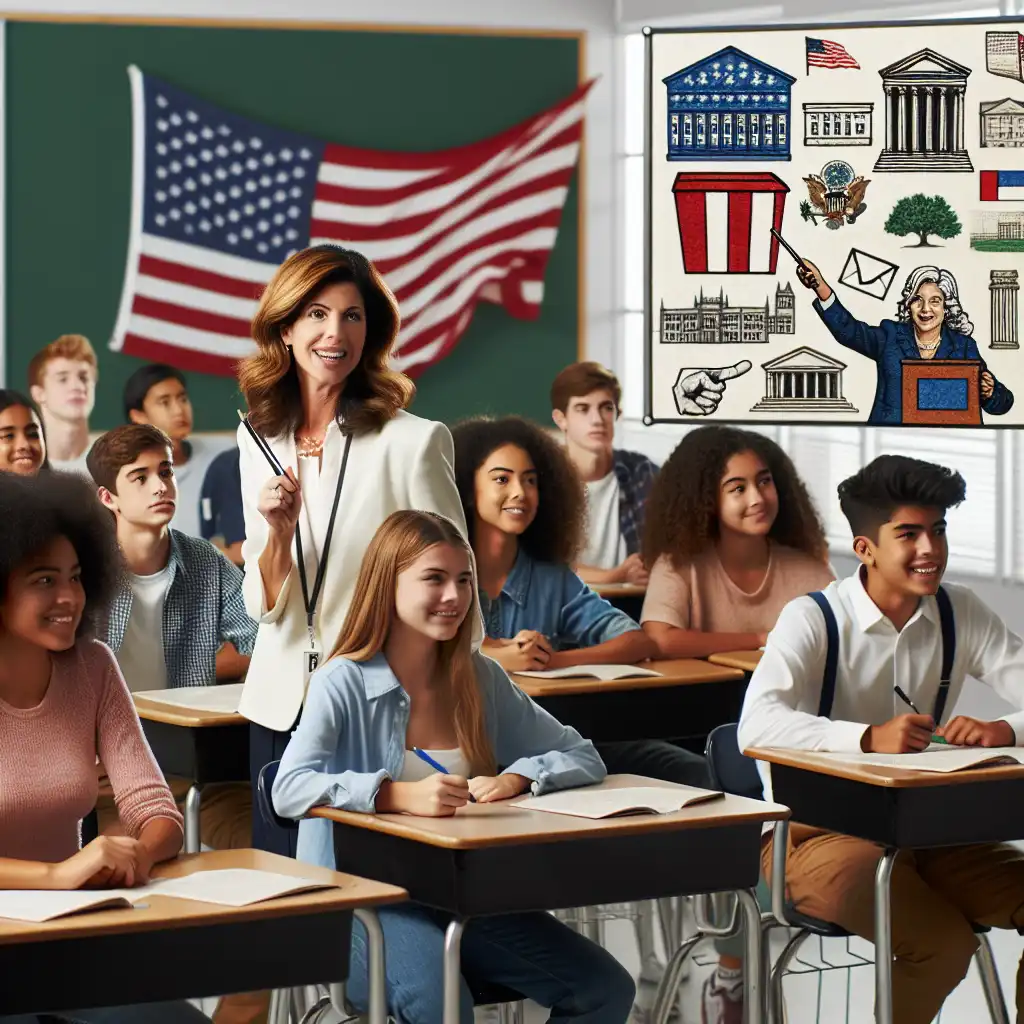
Civics refers to the study of government and how it works. It's about understanding the rights and responsibilities of citizens in a society. You might study civics in a social studies class at school, or when learning about how laws are made and enforced in your community or country. It's an important topic to understand if you want to be an active and informed member of society.
Citizenship refers to the status of being a member of a particular country or state and having the rights and privileges that come with that status.
Abrir palabra: Citizenship →Civics refers to the study of the rights and duties of citizens and how government works. It includes topics like citizenship, democracy, voting, and the Constitution.
Civics is applicable to every citizen, as it helps them understand their role in society and how they can participate in the government.
Government refers to the system or organization by which a country or community is governed. It includes branches of government, political parties, and officials who make decisions on behalf of the people.
Government is applicable to everyone who lives in the country, as it affects every aspect of their lives, including laws, regulations, and public services.
Civics is the study of how citizens interact with government, while government is the system that citizens interact with.
Abrir palabra: Government →Civics refers to the study of citizenship, government and how people interact with each other in society. Whereas, politics primarily involves the process of governing, the use of power, and the distribution of resources.
On the other hand, politics is more focused on gaining and maintaining power, influencing public policy, and making decisions on behalf of the government.
Civics is applicable in understanding how individuals can play an active role in society, and politics is applicable in understanding how governments are run and how they can affect our lives.
Abrir palabra: Politic →Eric Liu: Why ordinary...
Ver en YouTube ↗You learn about equality in history and civics, but you find out life is not really like that.
How do we reason for a...
Ver en YouTube ↗In an age when many of our citizens casually reveal information about themselves in social media wildly beyond anything imaginable only a decade ago, it would seem to be a useful exercise in civics to re-educate the public about the value and purpose of protecting against unwarranted government intrusion.
What in the World is a...
Ver en YouTube ↗I don't think I'm equipped enough to be giving anyone a civics lesson or any kind of message.
I had become increasingly concerned in recent years about the lack of civics education in our nation's schools. In recent years, the schools have stopped teaching it. And it's unfortunate.
We need to get back to reasoning and thinking things through. The future generation is being brought up in greed and without a true understanding of civics. There is no more emphasis on knowledge and time. As a society we need to process ideas and understand what certain principles are based upon.
I failed world geography, civics, Spanish and English. And when you fail Spanish and English, they do not consider you bilingual. They may call you bi-ignorant because you can't speak any language.
Isn't it blatantly racist to assume blacks can't pass a simple civics exam in the same rates as others?
In America, we divide federal power between the legislative, executive and judicial branches so that no one holds too much power. This is sixth-grade civics: Congress writes the laws; the president executes the laws; and the courts apply those laws fairly and dispassionately to cases.
The first lesson in civics is that efficient government begins at home.
I begin to feel like I was in the last generation of Americans who took a civics class.