diffraction
noun diffraction
dɪˈfrækʃn
A bending of light or sound around an object or corner
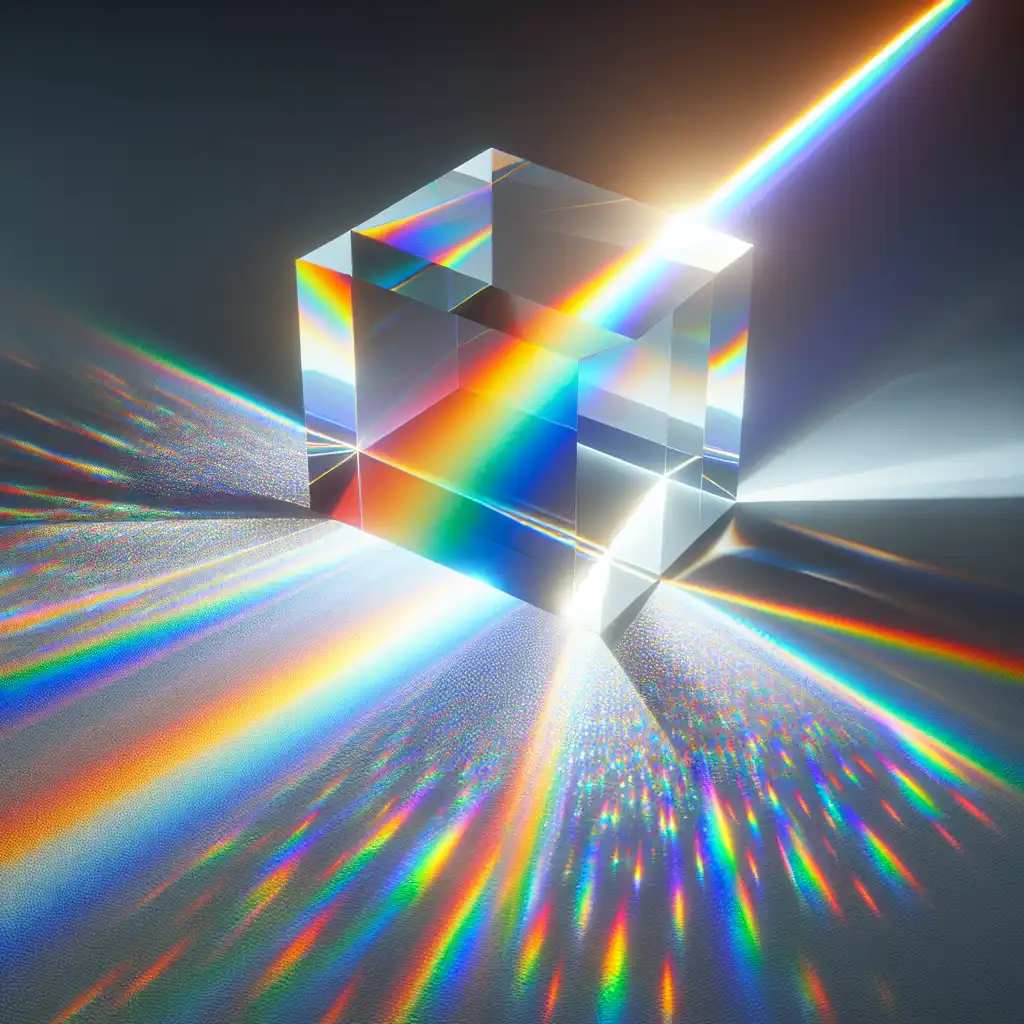
The diffraction of the sunlight through the glass caused a rainbow pattern on the floor.
diffraction
dɪˈfrækʃn
Loading…
dɪˈfrækʃn
A bending of light or sound around an object or corner
The diffraction of the sunlight through the glass caused a rainbow pattern on the floor.
Audio could not be loaded. Please try again later.
Diffraction is a word that is used to describe how light waves, sound waves or water waves can spread out and change direction when they pass through a small opening or around a barrier. For example, if you shine a flashlight through a small hole, you may notice that the light appears to spread out and create a fuzzy pattern on the other side. This is because the light waves are diffracting around the edges of the hole. Diffraction is also why you can hear sounds around corners or see the edges of objects through a narrow gap. Scientists and engineers use diffraction to create things like holograms, lasers, and lenses that can focus light into specific patterns.
Deflection refers to the bending or changing of direction of a beam or wave when it encounters an obstacle or passes through a medium with varying properties.
Deflection is applicable in optics, mechanical engineering, and civil engineering.
Deflection is the bending of a beam or wave while diffraction is the spreading out of a wave around an obstacle.
Open word: Deflection →Deviate means to depart from a planned or expected course. It is applicable in situations where someone or something moves away from its intended path or direction.
For example, if a student deviates from his study plan, it means he is not following the plan he has set for himself.
Deviate describes a change in direction or course, while diffraction describes the bending or spreading of waves.
Open word: Deviate →Diffraction and dispersal are both terms used in physics to describe the behavior of waves.
Dispersal refers to the separation of waves based on their wavelength. This can occur when waves pass through a material that causes different wavelengths to travel at different speeds, resulting in the colors of the spectrum being separated, as in a prism or rainbow.
Diffraction describes how waves change direction, while dispersal describes how waves separate based on their color or wavelength.
Open word: Dispersal →Dispersion refers to the separation of light into its constituent colors as it passes through a medium or material. It is applicable in situations where white light passes through a prism and is separated into its component colors.
Diffraction involves the spreading out of waves while dispersion involves the separation of a wave into its different components.
Open word: Dispersion →Diversion refers to a change in direction or course.
It can also mean a distraction or entertainment. Diversion is applicable in various contexts, including transportation (i.e.
a diversion route to avoid traffic), communication (i.e. a diversionary tactic to distract the enemy), and leisure (i.e. a diversion such as playing video games to unwind).
Diffraction is about the bending of light waves, while diversion is about a change in direction or distraction.
Open word: Diversion →Reflection refers to the bouncing back of waves off a surface. When waves encounter a surface, they can be reflected back in a different direction.
Diffraction occurs when waves bend and spread out as they pass through an opening or around an obstacle, while reflection occurs when waves bounce off a surface.
Diffraction is applicable in situations where waves encounter barriers or narrow openings, while reflection is applicable in situations where waves encounter surfaces that can bounce them back.
Open word: Reflection →Both diffraction and refraction refer to the way light waves behave when they interact with an object.
Refraction is the bending of light when it passes through a substance with a different density, like water or glass. This is why a straw appears to bend when you place it in a glass of water, and why a magnifying glass can focus light into a small point.
Diffraction is when light waves bend and spread out when passing through an opening or around an obstacle, while refraction is when light waves bend as they pass through a substance with a different density.
Open word: Refraction →Diffraction and scattering are both processes by which waves (such as light or sound) interact with obstacles in their path.
Scattering refers to the redirection of waves in many different directions as they encounter small obstacles. This is most commonly seen when light waves interact with small particles in the atmosphere or in liquids, causing the light to be scattered in many different directions.
Scattering can also occur when sound waves bounce off irregular surfaces, causing them to be redirected in multiple directions.
Scattering is often used in technologies such as sonar or radar to detect objects and measure distances.
Diffraction refers to the bending or spreading of waves around obstacles, while scattering refers to the redirection of waves in many different directions by small obstacles.
Open word: Scatter →The Mystery of the Jade...
Watch on YouTube ↗I got bored with the topic; I felt this was 19th century physics. I was wondering if there was still something profound that could be made with light microscopy. So I saw that the diffraction barrier was the only important problem that had been left over.
How to take a picture of...
Watch on YouTube ↗For X-rays, the phenomenon of diffraction by crystals was a natural consequence of the idea that X-rays are waves analogous to light and differ from it only by having a smaller wavelength.
The secret lives of...
Watch on YouTube ↗If diffraction or interference phenomena were to be sought it was therefore necessary, in accordance with the basic principles of wave theory, to select for the test arrangement far smaller decisive dimensions than those employed in corresponding tests with visible light.
The fundamental importance of the subject of molecular diffraction came first to be recognized through the theoretical work of the late Lord Rayleigh on the blue light of the sky, which he showed to be the result of the scattering of sunlight by the gases of the atmosphere.
I first met the subject of X-ray diffraction of crystals in the pages of the book W. H. Bragg wrote for school children in 1925, 'Concerning the Nature of Things.
I imagined there would be a way to crack the diffraction barrier. But of course I didn't know exactly how it would work, but I had a gut feeling that there must be something, and so I tried to think about it, to be creative.