
diagonal
adjective diagonal
daɪˈæɡənl
Something that is made, moved, or placed across position from one corner to the opposite corner.
He made a diagonal cut on the piece of fabric.
diagonal
daɪˈæɡənl
読み込み中…
daɪˈæɡənl
Something that is made, moved, or placed across position from one corner to the opposite corner.
He made a diagonal cut on the piece of fabric.

daɪˈæɡənl
A line that goes from one corner to another corner in a shape, object, or place.
Checkered patterns have diagonals in them.
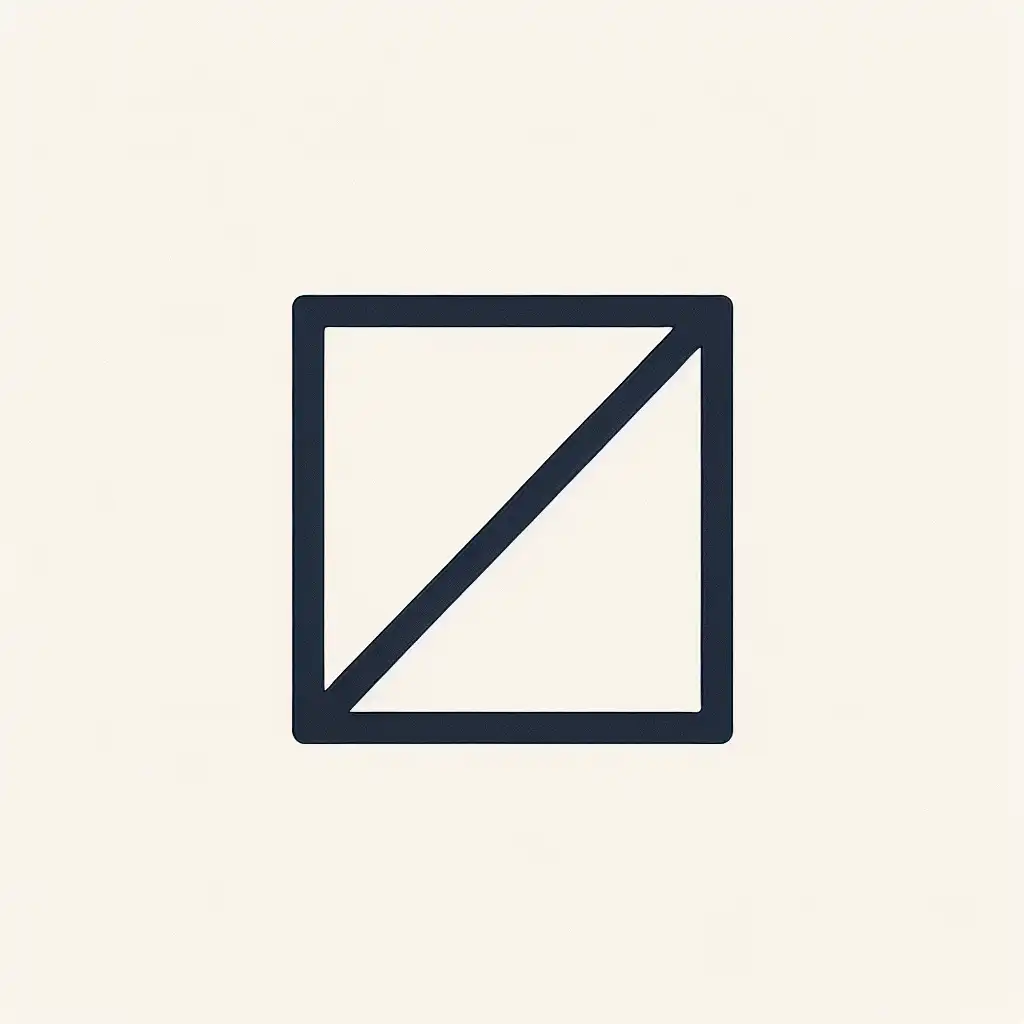
daɪˈæɡənl
Describes something or action that is not straight or direct, mainly used in mathematics.
The diagonal of a square connects its opposite corners.
音声を読み込めませんでした。しばらくしてからもう一度お試しください。
The word 'diagonal' is used to describe a straight line that goes from one corner of a shape to the opposite corner. It is often used to describe the shape of a square or rectangle, and can also be used in other contexts such as a diagonal cut or a diagonal direction. For example, if you are drawing a picture of a square, you might say that you need to draw the diagonals to create a cross in the middle. In sports, a player might make a diagonal run across the field to get past the defenders. Overall, the word diagonal is used to describe something that goes diagonally across a surface or shape.
An angle refers to the measure of the space between two lines that meet at a point.
A diagonal refers to a straight line that connects two non-adjacent corners of a shape, such as a square or rectangle. It is commonly used to determine the length of the sides or the area of the shape.
In summary, angles are used to measure the space between two intersecting lines, while diagonals are used to connect non-adjacent corners of a shape.
単語を開く: Angle →Askew means that something is not straight or not in a correct position. For example, if the picture frame is hanging askew on the wall, it means it is slightly crooked or lopsided.
Askew refers to something that is not straight or skewed, while diagonal refers to something that is at an angle or sloping between two points.
Askew is applicable for objects that are slightly crooked, while diagonal is applicable for objects that are aligned to corners.
単語を開く: Askew →Bias means a tendency or preference towards a particular idea or opinion, often resulting in unfair judgement or treatment.
Bias is related to opinions and judgement, while diagonal relates to lines and angles.
単語を開く: Bias →Crook generally refers to a person who is dishonest or a thief.
It can also refer to something that is bent or curved, especially in a way that is not intended. For example, a shepherd's crook is a bent walking stick used by shepherds to catch sheep by the neck.
So, while both words refer to something that is not straight, crook is generally used to describe something that is intentionally or unintentionally bent, while diagonal describes something that is simply at an angle.
単語を開く: Crook →Diagonal and oblique both refer to directions that are not straight up, down, left or right.
Oblique refers to a line or direction that is slanted or tilted, often at an angle that is not exactly 45 or 90 degrees.
単語を開く: Oblique →Slant refers to an angle that is not vertical or horizontal.
To sum it up, diagonal describes a straight line at a 45-degree angle, while slant describes a line that is not perfectly straight.
単語を開く: Slant →Slope refers to the steepness or angle of a line. It describes the rate at which a line rises or falls over a horizontal distance.
For example, a road that goes up a mountain has a steep slope, while a road that runs along a flat plane has a shallow slope.
Diagonal describes the position or direction of a line or shape, while slope describes its angle or steepness.
単語を開く: Slope →Tilt refers to the act of leaning or slanting something to one side or another.
Diagonal relates to the shape of an object, while tilt relates to its position or angle. For example, a picture frame may be hung on the wall at a diagonal to create a dynamic visual effect, while a table may be tilted slightly to balance on an uneven floor.
単語を開く: Tilt →Can you solve the Trojan...
YouTube で見る ↗The line of life is a ragged diagonal between duty and desire.
Alex Smith: An NFL...
YouTube で見る ↗I'm 6'7' and like to sleep diagonally.
Photographing Our Seas:...
YouTube で見る ↗The Bishop moves diagonally forwards or backwards, to the extent of the Board.
Making food transparent...
YouTube で見る ↗Or in other works I have also projected the sound in a cube of loudspeakers. The sound can move vertically and diagonally at all speeds around the public.
Orangutan understands 72...
YouTube で見る ↗A piece of wall can be visually disintegrated from the whole into a separate triangle by plunging a diagonal of light from edge to edge on the wall; that is, side to floor, for instance.
One of the most epic...
YouTube で見る ↗During rallies, it's always crucial to make Nadal cover the whole width of the court. He likes to camp out in his backhand corner, spearing that big off-forehand diagonally across the court. So the backhand down the line is a vital shot, because it moves Nadal out of his most favoured position.
The secret messages of...
YouTube で見る ↗It was just a typical London flat, but it was in a great neighborhood. It was across from the Playboy Club, diagonally. From one balcony you could read the time from Big Ben, and from the other balcony you could watch the bunnies go up and down.
What can we learn from...
YouTube で見る ↗I never saw war, so that is still my vision of manhood: Unitas standing courageously in the pocket, his left arm flung out in a diagonal to the upper deck, his right cocked for the business of passing, down amidst the mortals. Lock and load.
Scott McCloud:...
YouTube で見る ↗The Bar Room has a corner table placed strategically at a point diagonally across from the entrance. the table of tables in the setting of settings in the building of buildings. In the religion of lunch, this is the holy of holies.
Jeff Hancock: 3 types of...
YouTube で見る ↗If you direct your attention to the position of a bird with regard to the wave surface, it will speedily be noticed to be nearly always on the rising side or face of the wave and moving apparently at right angles to the wave's course, but really diagonal to it.