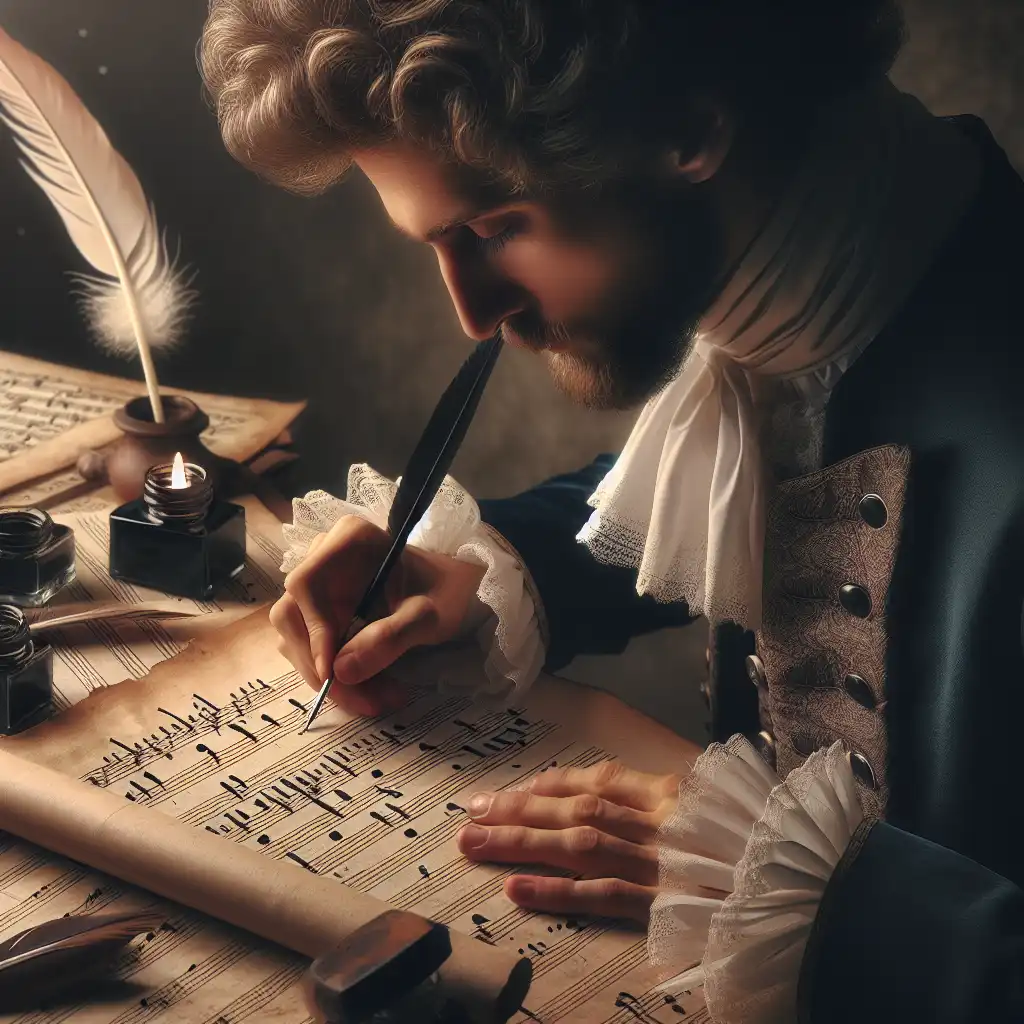
Counterpoint refers to a technique used in music where different melodies are played at the same time, creating a harmonious sound. However, outside of music, counterpoint can also refer to a contrasting or opposing idea or argument to balance or complement another idea. It can be used in discussions, debates, or even in writing, to bring out different perspectives and create a more well-rounded view of a topic.
Accompany means to play or sing a musical part that supports and enhances the main melody. It is applicable in music when there is a main melody that needs supporting chords, harmonies, or other instrumentation to make a complete sound.
Balance refers to a situation where things are equal or stable. For example, if you have two objects on opposite sides of a scale, and they weigh the same, the scale is balanced.
Balance refers to equality or stability, while counterpoint refers to a musical technique in which two or more melodies interact harmoniously.
Combination refers to putting two or more things together to make a whole. It is applicable in many areas such as cooking, math, and music.
For example, when you mix ingredients together in a recipe to make a dish, you are using combination. When you add two numbers together to get a sum, you are combining them.
In music, combination refers to playing different notes at the same time to create a chord or harmony.
Combination is used when putting things together to make a whole or when playing different notes together to create harmony.
Both contrapuntal and counterpoint refer to the musical technique of combining multiple melodies at the same time.
Counterpoint generally refers to the overall concept of combining multiple melodies, while contrapuntal is an adjective used to describe something that exhibits this technique.
For example, you might say "Bach's use of counterpoint in his fugues is impressive" or "The fugue is a contrapuntal composition."
So in short, counterpoint refers to the concept and contrapuntal describes something that utilizes that concept.
Counterpoint and harmony are two important concepts in music theory. Harmony refers to the combination of musical notes played at the same time to create pleasing chords and progressions.
It is used to create a sense of depth and richness in music. For example, if you play a C major chord on the piano (C, E, G), you are using harmony.
Harmony is used to create pleasing chord progressions, while counterpoint is used to create complexity and depth through the interaction of multiple melodies.
Interweave refers to the process of combining two or more things together in a way that creates a cohesive whole.
Counterpoint is specific to music and refers to multiple melodies working together, while interweave is a broader term that can be applied to a variety of situations where different elements are being combined.
Both counterpoint and polyphony refer to the combination of multiple musical lines, but they are different in significant ways.
Polyphony refers to the combination of multiple musical voices or parts that are all equally important. Unlike in counterpoint, where the different lines may have different roles, in polyphony, each part is equally important and contributes to the overall sound.
Polyphony is often used in choral music, where different voices (soprano, alto, tenor, bass) sing different parts, but together they create a harmonious sound.
Counterpoint refers to the relationship between distinct and independent melodic lines, while polyphony refers to the combination of multiple equally important musical parts or voices.
A round or a square product was easily made, except for an oval one, at that time when watch industry mainly relied on hand-made or semi-automatic equipments. It is like the printing and coat film of the mobile phone, which is difficult to realize counterpoint.
Color is a plastic means of creating intervals... color harmonics produced by special relationships, or tensions. We differentiate now between formal tensions and color tensions, just as we differentiate in music between counterpoint and harmony.
I spend time editing and massaging each note. Then I start layering with different instruments, adding harmonies, counterpoint, and whatever the song calls for. Then I arrange it into a whole piece, and decide where I need to add live musicians. It takes a lot of time, but it is very satisfying once it is complete.
I feel like there's a hunger in the culture now for the live experience maybe as a counterpoint to the more sort of synthetic lives that we've been living.
After a day of writing, I love nothing more than to go into my kitchen and start chopping onions and garlic on the way to cooking an improvised meal with whatever ingredients are on hand. Cooking is the perfect counterpoint to writing. I find it more relaxing than anything else, even naps, walks, or hot baths.
Being a boss takes guts and tenacity. Being a boss takes hustle and strength. Getting to the level of boss takes hard work - often times, harder than our male counterpoint because in many industries, we're fighting our way into a boys' club.
There's a sadness to the human condition that I think music is good for. It gives a counterpoint to the visual beauty, and adds depth to pictures that they wouldn't have if the music wasn't there.