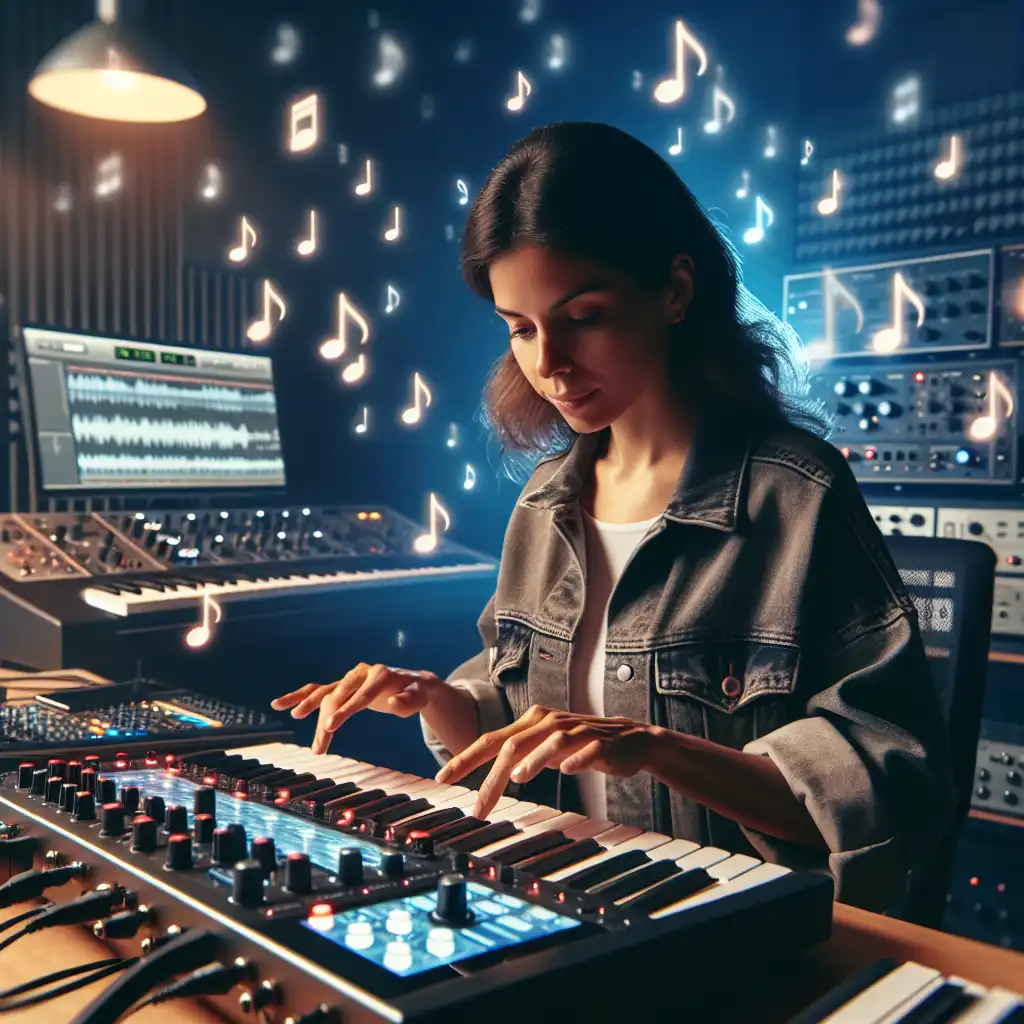
sequencer
noun sequencer
ˈsiːkwənsər
A device that plays a sequence of notes or chords, typically used in electronic music.
He used a sequencer to create the base rhythm for his song.
sequencer
ˈsiːkwənsər
Cargando…
ˈsiːkwənsər
A device that plays a sequence of notes or chords, typically used in electronic music.
He used a sequencer to create the base rhythm for his song.

ˈsiːkwənsər
A tool used in science that identifies the order of elements or substances inside a genetic or chemical sequence.
The DNA sequencer allowed researchers to map the complete human genome.

ˈsiːkwənsər
A device that controls the order in which a series of events happens, especially in a computer.
The sequencer in the computer program ensured the tasks were completed in the correct order.
No se pudo cargar el audio. Inténtalo de nuevo más tarde.
A sequencer is a device or software that helps to create music by sequencing and arranging sounds or notes in a specific order. It can be used in the recording studio or live performances to control and create different musical parts of a song. For example, a sequencer can be used to add drum beats, basslines, melodies, or synths to a track. It's a helpful tool for music producers and composers who want to create complex tracks by layering different sounds and effects.
An arranger is a person who takes a piece of music and makes it suitable for performance by a particular group of musicians or for a specific occasion.
So, arrangers are more applicable in traditional, live music settings where the music is being performed by a group of musicians, while sequencers are more applicable in electronic music production where the compositions are created digitally.
Abrir palabra: Arranger →A composer is a person who creates original music, either by writing it down on paper, playing it on an instrument or arranging it on a computer.
While both composers and sequencers create music, they do so in different ways. Composers generally work with a wider range of instruments and styles, while sequencers are used mainly for electronic music production.
A composer may use a sequencer as a tool to create electronic sounds, but a sequencer cannot replace the creativity and musical talent of a composer.
Abrir palabra: Composer →A controller is a device that is used to control other instruments or devices. It sends signals to these other devices to change their settings or to trigger specific actions.
A controller is used to control a variety of instruments or devices, such as keyboards, synthesizers, drum machines, or even lighting equipment.
A controller is like a remote control for other devices, while a sequencer is like a playlist that you can program and arrange.
Abrir palabra: Controller →A programmer is someone who writes code to create software programs or applications. They use programming languages like Python or Java to create instructions that tell a computer what to do.
So while a programmer creates software applications, a sequencer is used to create music. They are both applicable in different fields and require different skills.
Abrir palabra: Programmer →A synthesizer is an instrument that produces sound. It generates sounds electronically using various methods including oscillators, filters, and envelopes.
Synthesizers can create a wide array of sounds, from realistic instrument tones to abstract, futuristic noises.
Both sequencers and synthesizers are used in electronic music production. Sequencers are used to program and organize musical patterns, while synthesizers are used to create sounds that can be played by a sequencer or used in live performance.
Abrir palabra: Synthesizer →Live from Mars 360° %\PIPE%...
Ver en YouTube ↗I was starting to feel really suffocated, using the sequencer.
Why genetic research...
Ver en YouTube ↗You should approach a sequencer like you would a Dobro guitar.
If it's fast, no I don't have enough piano technique. In that case, it's probably been done on some kind of synthesizer or sequencer. Then the score can then be printed out and so forth.
In the late 1970s, when I was a professor at Caltech, I pioneered four instruments for analyzing genes and proteins that revolutionized modern biology - and one of these, the automated DNA sequencer, enabled the Human Genome Project.