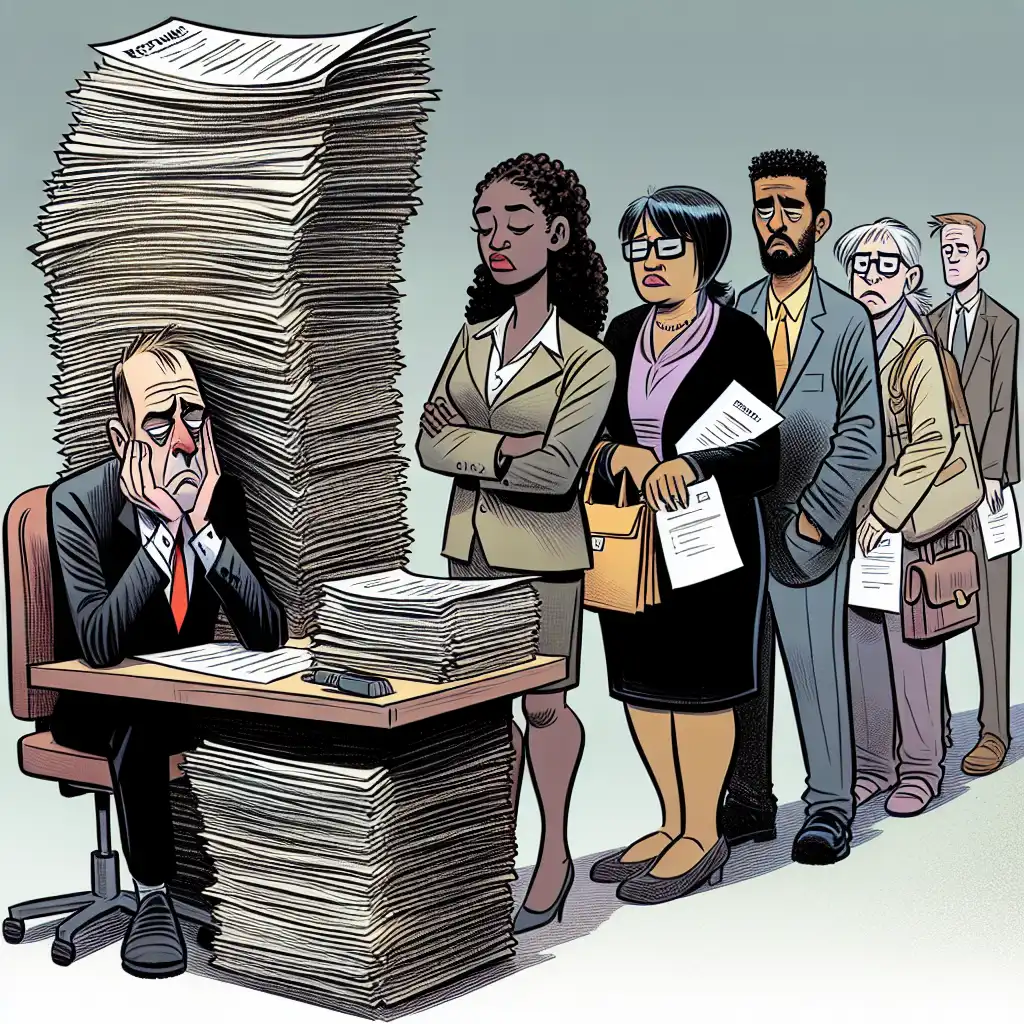
rigmarole
noun rigmarole
ˈrɪɡmərəʊl
A complex, needless process or procedure
Going through the rigmarole of interviews and tests for the job was draining.
rigmarole
ˈrɪɡmərəʊl
読み込み中…
ˈrɪɡmərəʊl
A complex, needless process or procedure
Going through the rigmarole of interviews and tests for the job was draining.

ˈrɪɡmərəʊl
Lengthy and confusing talk
Her explanation was a rigmarole and I couldn't understand anything.
音声を読み込めませんでした。しばらくしてからもう一度お試しください。
'Rigmarole' is usually used to describe a long and complicated process that is unnecessary or confusing. It can also refer to a long, rambling story or explanation that is difficult to follow or understand. You might hear someone say, "I don't have time for all this rigmarole" when they want to express frustration with a complicated task or explanation. It's a somewhat informal word, so you probably wouldn't use it in a very formal or academic setting.
Both balderdash and rigmarole mean something that is nonsensical or confusing.
However, balderdash typically refers to words or ideas that are clearly false or ridiculous, while rigmarole typically refers to a lengthy and confusing procedure or set of instructions.
For example, if someone tells you a story that is obviously untrue, you could say "that's pure balderdash!" If you're given a complicated set of instructions with lots of unnecessary steps, you could say "what a rigmarole!"
単語を開く: Balderdash →Blather means to talk excessively, especially in a meaningless or nonsensical way.
So, in short, blather describes excessive talking, while rigmarole describes a complicated and unnecessary process.
単語を開く: Blather →Chatter refers to casual and light conversation or talking in a quick and continuous manner. It's often used to describe someone who talks a lot about unimportant or trivial things.
For example, "the girls were chattering about their favorite TV shows."
In other words, chatter refers to someone talking a lot about non-important things, while rigmarole refers to a long and complicated process or speech.
単語を開く: Chatter →Gibberish refers to meaningless or nonsensical speech or writing.
Gibberish refers to nonsensical speech or writing, while rigmarole refers to a convoluted or unnecessarily complicated process.
単語を開く: Gibberish →Jargon refers to specialized language or terms used in a particular field or profession that may not be easily understood or recognizable to those outside of that field, while rigmarole refers to a lengthy and often unnecessary procedure or explanation.
Jargon is applicable in specific fields like medicine, law, engineering, etc. where technical or specialized language is used to convey professional information.
For example, medical professionals may use jargon such as “stat” to mean urgently, while engineers may use technical terms such as “analog input” to describe electronic inputs.
Jargon refers to specialized language in a specific field, while rigmarole refers to a lengthy and unnecessary procedure or explanation.
単語を開く: Jargon →Nonsense refers to something that lacks logical sense or is unreasonable.
It can be used to refer to something that is silly or untrue. For example, "The teacher's explanation for why the earth is flat is complete nonsense.".
Nonsense refers to something that lacks reason, while rigmarole refers to something that is unnecessarily complicated or lengthy.
単語を開く: Nonsense →Prattle refers to speaking in a childish or meaningless way, usually in a chatty or gossipy manner.
Both words are used to describe ineffective or pointless communication. Prattle refers to the way someone speaks, while rigmarole refers to the content or procedure being communicated.
単語を開く: Prattle →Twaddle refers to silly or foolish talk that lacks substance or meaning. It is applicable in situations where someone is saying things that are trivial, nonsensical, or just plain ridiculous.
Rigmarole describes a lengthy and possibly confusing process or explanation, while twaddle describes silly or foolish talk.
単語を開く: Twaddle →If any philosopher had been asked for a definition of infinity, he might have produced some unintelligible rigmarole, but he would certainly not have been able to give a definition that had any meaning at all.
I hate flying, airports and the whole rigmarole - queuing up, security and lost luggage.
Since I started my career very early, I have gone through the rigmarole of experiencing successes and failures.
This is fundamentally true of the media business, the rigmarole you go through while trying to make 25 movies while not seeing your kids.