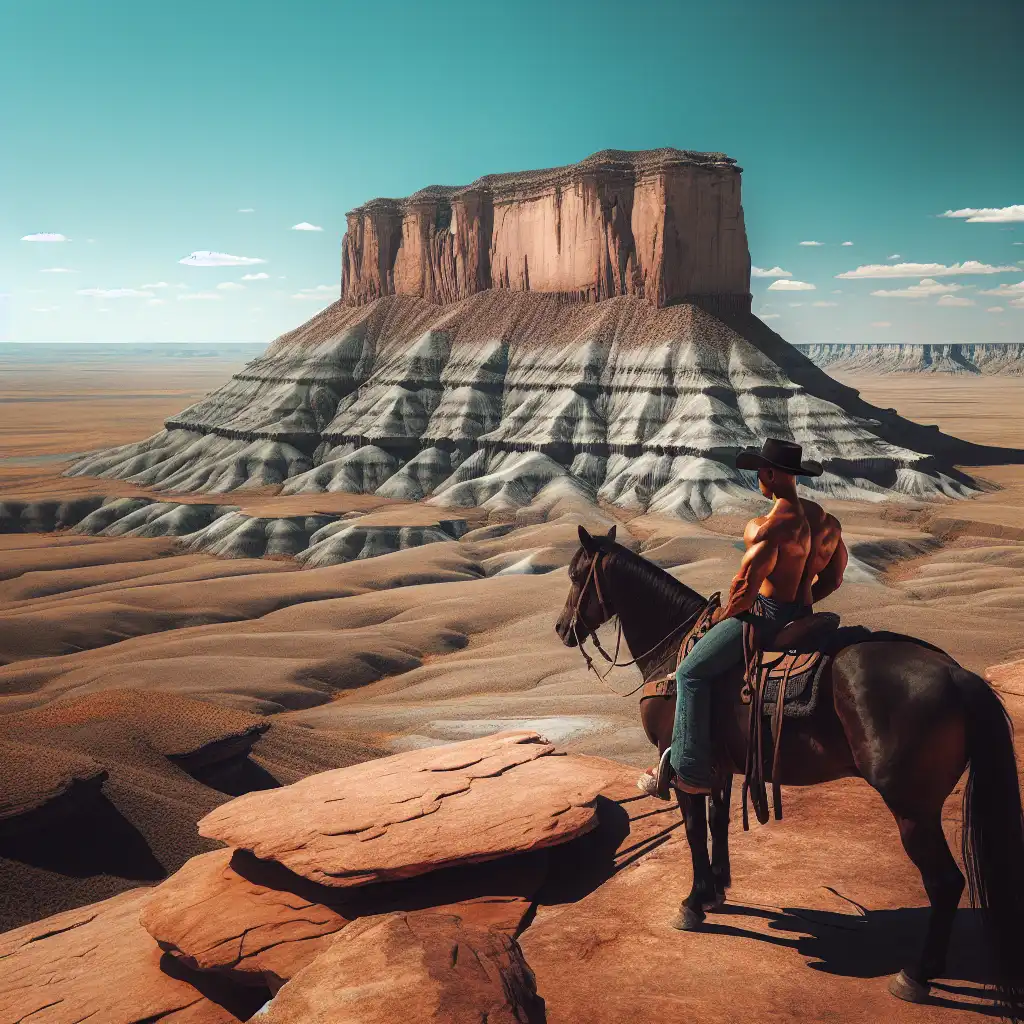
butte
noun butte
bjuːt
A high, flat hill with steep sides, smaller than a mesa.
The cowboy rode his horse to the top of the butte to get a better view of the landscape.
butte
bjuːt
Cargando…
bjuːt
A high, flat hill with steep sides, smaller than a mesa.
The cowboy rode his horse to the top of the butte to get a better view of the landscape.
No se pudo cargar el audio. Inténtalo de nuevo más tarde.
A butte is a type of hill with a steep, flat top and a steep slope on all sides. It is usually found in areas with dry climates, such as the American West. This word can be used in conversation or in writing to describe a specific geographical feature, such as "We climbed to the top of the butte and enjoyed the panoramic view."
A bluff is a steep cliff or bank that rises vertically from a body of water or a plain.
It is typically formed by erosion or geological processes. Bluffs are often found along coastlines and riverbanks.
In short, bluffs are steep cliffs that rise from bodies of water or plains, while buttes are flat-topped hills with steep sides that rise above the surrounding landscape.
Abrir palabra: Bluff →An escarpment is a long steep slope or cliff, often separating two areas of differing height or terrain.
Escarpments can be found in various landscapes, including coastal cliffs and mountain ranges.
An example of an escarpment is the Niagara Escarpment in North America.
A butte is a smaller hill with a flat top, while an escarpment is a longer and steeper slope or cliff. Buttes are typically found in desert areas, while escarpments can be found in various landscapes.
Abrir palabra: Escarpment →A butte is a steep hill with a flat top and steep sides; it is usually formed by erosion or volcanic activity.
A hill is a naturally elevated area of land that is typically lower and less steep than a mountain.
The main difference is that a butte has a very distinct, steep shape and is often found in arid or volcanic environments, whereas a hill is a more general term for any elevated landform that is not as steep or sharp in shape.
Applying these terms depends on the location and context. For example, if you were on a hike in a desert or rocky region, you might use the term butte to describe a distinctive peak or hill formation.
However, if you were describing the landscape of a rural area with rolling hills, you would use the term hill to refer to the general landform.
Abrir palabra: Hill →A knoll is a small, rounded hill or mound. It is less steep and smaller compared to a butte.
In simpler terms, a butte is a big hill with a flat top and steep sides, while a knoll is a small hill or mound. Buttes are formed through erosion and stand alone in a plain while knolls are usually found in groups or on the slopes of hills.
Abrir palabra: Knoll →A mesa is also a flat-topped hill with steep sides, but it is much larger and more broad than a butte.
A butte is typically smaller and has a distinct, narrow summit, while a mesa is larger and has a broader, flatter summit.
Buttes are often found in desert regions, formed by erosion, and are a common sight in the American Southwest. Mesas are typically found in areas of high plateaus, such as the Southwestern United States and the Andes in South America.
Abrir palabra: Mesa →A plateau is a large, flat area of land that is elevated above the surrounding land.
Buttes and plateaus are both types of landforms, but they are different in size and shape. Buttes are small hills while plateaus are large, flat areas of land.
Plateau is applicable to describe a large, flat area of land that is elevated above the surrounding land. Plateaus are commonly found in mountainous regions.
Abrir palabra: Plateau →A ridge refers to a long, narrow, elevated area of land that's typically higher than the surrounding terrain. It's formed by the movement of tectonic plates or from the accumulation of sediment.
Ridges often have sloping sides rather than steep cliffs.
A butte is a hill with steep sides and a flat top that's often found in dry, desert-like areas, while a ridge is a long, narrow elevated area of land that's typically higher than the surrounding terrain and often has sloping sides.
Abrir palabra: Ridge →Grave Secrets of...
Ver en YouTube ↗Butte was once a grand city. To me, that city is like one big stage for Edward Hopper. You could put your camera anywhere, and you felt you were looking at his paintings.
Experiments that point...
Ver en YouTube ↗The weird wonderful,...
Ver en YouTube ↗