Impossible de charger l’audio. Réessayez plus tard.
Comment l’utiliser
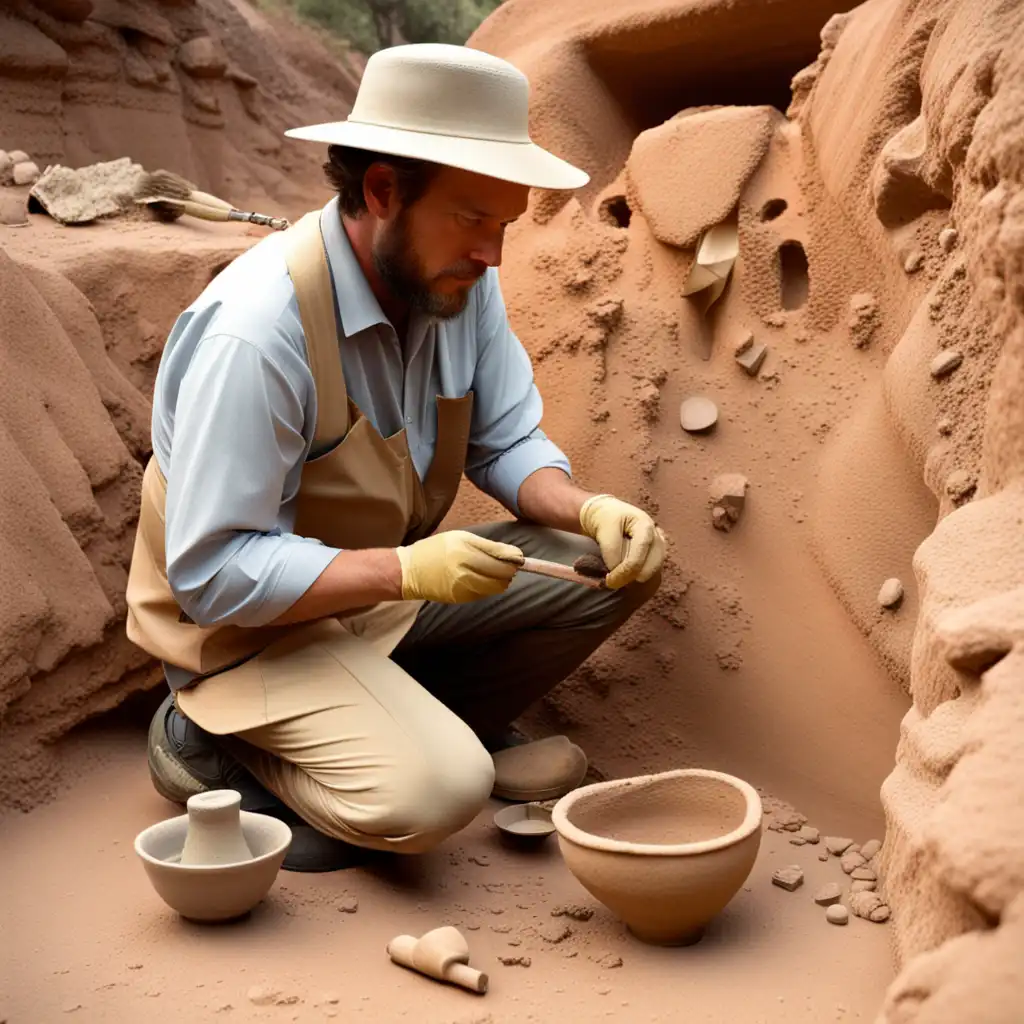
An archaeologist is a person who studies ancient civilizations and their artifacts, such as pottery, tools, and buildings. They work in different places like in museums, excavation sites, or historical sites. They use tools and techniques to carefully uncover and study these ancient objects, and use their findings to piece together a bigger picture of what life was like in the past. If you are interested in history and love exploring the past, being an archaeologist might be the job for you!
An anthropologist studies human culture, behavior, and societies in the past and present. They examine how different groups of people interact with each other and their environment.
Anthropologists may also analyze language, art, and social structures.
In simple terms, anthropologists focus more on the cultural aspect of people while archaeologists focus more on the physical remains left behind by people.
Antiquarian refers to a person who studies and collects objects and artifacts from the past, specifically objects that are of historical or sentimental value.
The difference between the two is that antiquarian focuses on objects that have historical or sentimental value, while archaeology focuses on the scientific study of human societies and their cultures through physical evidence.
Antiquarians are more likely to collect and showcase historical objects, while archaeologists analyze these objects to understand and reconstruct the cultures and societies that produced them.
An ethnographer studies the present-day social and cultural practices of groups of people. They immerse themselves in the group's culture, observe their behavior, interview them, and write about their experiences.
Ethnographers aim to understand the group's worldview, values, and social organization.
So, archaeologists deal with the physical remnants of past cultures, while ethnographers focus on the culture and social practices of present-day groups.
An excavator is a person who physically digs up artifacts, structures, and other remains from the ground. Their job is to carefully remove the soil and uncover buried artifacts.
Excavators can work in various fields, including construction, mining, or archaeological sites.
An archaeologist studies the past through the analysis of artifacts, while an excavator physically retrieves artifacts from the ground.
They often work together in archaeological excavations, with the archaeologist interpreting the artifacts and the excavator retrieving them.
Historians study past events, people, and societies through written records such as books, documents, and other forms of literature.
In summary, archaeologists study physical remains and artifacts to understand past cultures, while historians study written records to understand past events and societies.
like this one here, and this potentially large one here. Unfortunately we've also begun to uncover large-scale looting at sites, like what you see here. So many sites in Peru are threatened, but the great part is that all of this data is going to be shared with archaeologists on the front lines of protecting these sites.
As a field archeologist, one usually has to specialize in a particular part of the world or specific culture, whereas if one is a materials specialist, one can jump around to different areas. So I've had experience on excavations all over the place.
Archaeologists have spent decades exploring this dense jungle to find out about the people who lived here over 500 years ago. Digital technology will help them reveal more and faster.
What satellites help to show us is we've actually only found a fraction of a percent of ancient settlements and sites all over the world... It's the most exciting time in history to be an archaeologist.
archaeologist who I love so much I was wondering at her system can help me find the car keys I lost in the backyard I was thinking about my work and also I just want to let you know that when she took her hat hat off and threw it into the audience
And then there are shipwrecks. As ships grow too old for use they're usually abandoned near shore in out-of-the-way places like estuaries rivers and shallow bays. Archaeologists use these like a timeline to map a harbor's peaks and declines,
dynasty of the nubian hair some archaeologists in the late 19th and early 20th centuries refused to accept that a black African civilization could have achieved what it did they said the
I'm not an academic; I'm not an archaeologist. I'm a writer, communicating ideas to the public. There is a model of how the past is, and a lot of academic archaeology is about refining the model. It's not about changing the model radically. I'm not aware of any current which is about radically changing the model. It's just me, really.
first team of archaeologists to get into the deepest part of the cave tomorrow none of us have been into the final chamber yet we have all been to what's called base one which is at the top of Dragon's Back and it's sitting right above the final chute which has the the
world who are studying slave ships and document it as part of a narrative podcast series so we're going to spend an entire season going deep and letting people hear from the divers themselves hear from the archaeologists themselves and hear from the historians those
The things I wanted to be when I was a kid were an archeologist, because of dinosaur bones; a garbage man, because they got to ride on the side of the trucks; and a writer.
archaeologists have shown us that there were environmental problems underlying many of these past collapses. But there were also plenty of places in the world where societies have been developing for thousands of years without any sign of a major collapse,
I go back and research, say, every reference to the Gorgons, and I find what the classical writers said about them and it's so much richer than you might get in an average Greek mythology text. I feel like an archaeologist - I'm dusting off these things that people have not seen for thousands of years and bringing them into the modern world.
this city has been portrayed time and again as a place of sexual freedom even debauchery there is some truth in the idea the archaeologists who came here in
You should always carry string, according to my archaeologist father, because then you could at least make a trap to catch animals to survive. According to my grandmother, it was clean underwear.
things are falling out of the wall and as I said that an archaeologist reached down to lift a rock and I said stop because sticking out of the back of it was the proximal femur the thigh bone of that juvenile hominid I couldn't believe it it would be something that never crossed my mind I promise you yet it
Suppose you want to be a great archeologist, and you join a successful archeologist as a student assistant, and he tells you where to dig. You dig up a marvelous discovery. Now I ask you, who should get the credit: the director or the digger?