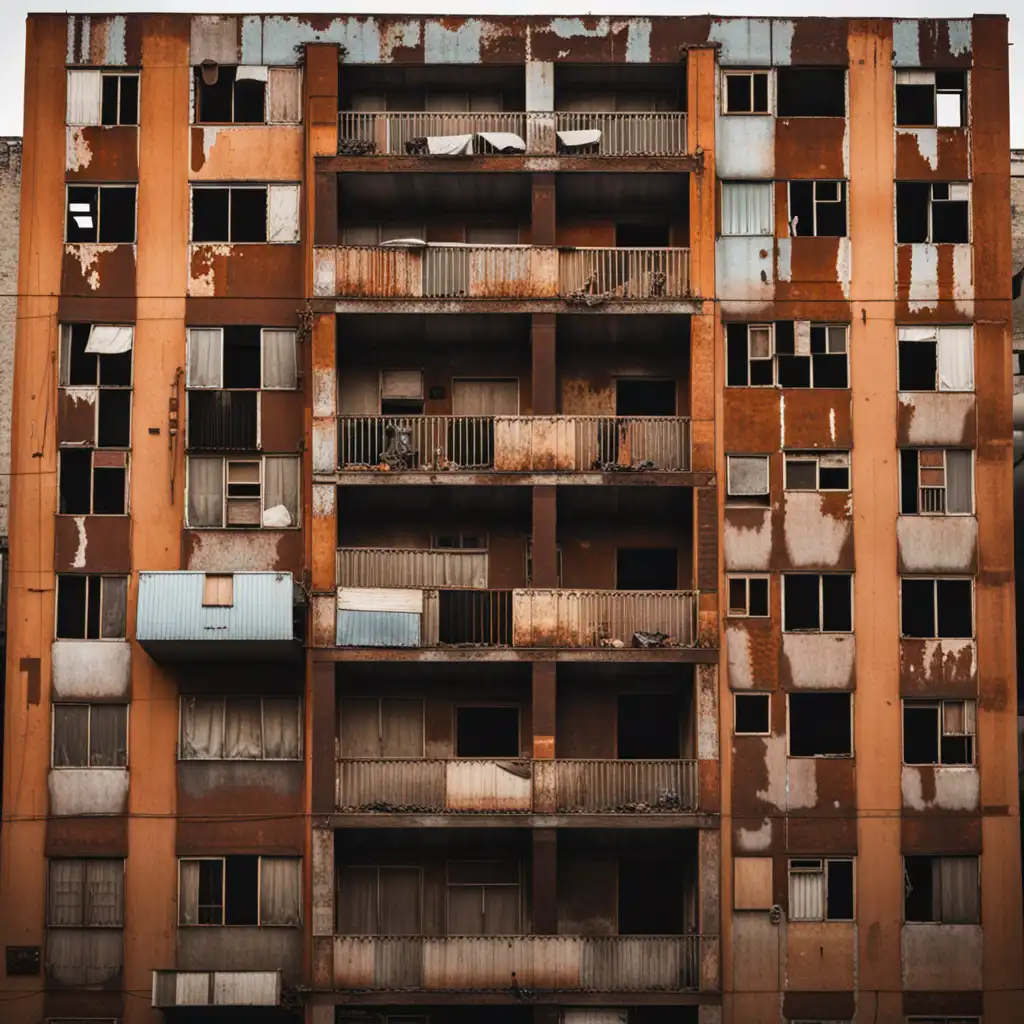
tenement
noun tenement
ˈtenəmənt
A large building divided into apartments, especially in a poor area of a city.
He grew up in a tenement in the lower part of the city.
tenement
ˈtenəmənt
Đang tải…
ˈtenəmənt
A large building divided into apartments, especially in a poor area of a city.
He grew up in a tenement in the lower part of the city.
ˈtenəmənt
A piece of land held by an owner.
The land tenement is leased to a mining company for extraction purposes.
Không tải được âm thanh. Vui lòng thử lại sau.
A tenement is a type of building that has many small apartments or rooms. These buildings are usually in cities and were built a long time ago. They were often used to house poor people or immigrants who needed a cheap place to live. Nowadays, the word tenement is sometimes used to describe any type of old or run-down building.
An apartment is a self-contained housing unit that is part of a larger building. It has a separate entrance, kitchen, bathroom, and living area.
Apartments are usually rented and tend to be more modern, equipped with amenities such as air conditioning and elevators.
A tenement refers to a type of old, run-down apartment building that was usually found in densely populated urban areas during the 19th and early 20th century.
Today, the word tenement is often used to describe any apartment building that is in poor condition or lacks modern amenities.
An apartment is a modern and self-contained unit in a larger building, while a tenement is an old, rundown apartment building.
Mở từ: Apartment →A building is a general term used to describe any structure that has walls and a roof.
Buildings can be residential or commercial and can have one or multiple floors.
A tenement is a specific type of building that is typically multi-unit and often associated with low-income housing. Tenements were originally built in cities during the 19th century to house working-class families in cramped, unsanitary conditions.
Today, the term tenement is often used to refer to old, run-down apartment buildings.
Building is a broad term used to describe any structure with walls and a roof while tenement refers to a specific type of multi-unit housing structure that historically was associated with poor living conditions.
Mở từ: Building →Dwell means to live in a particular place. For example, "I dwell in a house in the suburbs."
So, while dwell refers to living in a specific location, tenement refers to a type of housing that is often associated with poverty and difficult living conditions.
Mở từ: Dwell →Flat generally refers to a self-contained living area, often within a larger building.
Flat refers to a single living unit owned by a person or family, while tenement refers to a type of apartment building with multiple rented units typically in a lower-income area.
Mở từ: Flat →House generally refers to a building that is designed for one or more families to live in. Tenement refers to a building that has many small apartments or rooms, and is often used to house low-income or working-class families.
A house is usually owned by the person or family who lives in it, while a tenement is often owned by a landlord who rents out the individual units to tenants.
A house is applicable for families who own or rent a home, while a tenement is applicable for people who live in small apartments owned by a landlord.
Mở từ: House →Lodge usually refers to a temporary accommodation, like a hotel room or a small cabin.
A lodge is more of a temporary option while a tenement is a permanent option.
Mở từ: Lodge →Both residence and tenement refer to a place where people live, but there are some differences in their meanings.
A residence typically refers to a house or an apartment where someone lives permanently or temporarily.
A residence is usually associated with a sense of comfort and security, and people tend to take care of their residences because they see them as their homes.
A residence is a generally more desirable living situation than a tenement. Residences are associated with stability and comfort, while tenements are associated with poverty and difficult living conditions.
Mở từ: Residence →A shack is a small, crudely built and often temporary dwelling, often made of materials like wood, tin, or cardboard.
A shack is typically meant for one family or one person, and it usually lacks basic amenities like plumbing, electricity, and heating.
Shack refers to a simple, small, and temporary dwelling mostly found in rural or slum areas, while a tenement refers to a multi-unit apartment building that provides basic amenities for multiple families or individuals in urban areas.
Mở từ: Shack →or tenements they were small and rarely had windows so there was no light or ventilation houses are overcrowded they're working in factories that breathing on one another that contaminating one another with their
Xem trên YouTube ↗It was great being brought up in a Glasgow working-class tenement. It wasn't miserable, and it wasn't poverty stricken. It felt very safe, full of delights.
but there were these tenement buildings, and these women were always hanging out one of the windows, leaning on a pillow. They never left. I so help me God I grew up walking those streets, and they were always there. They never went to the bathroom. They never cooked. They never did anything.
Xem trên YouTube ↗I was saying as a joke the other day that I love film editing, I know how to cut a picture, I think I know how to shoot it, but I don't know how to light it. And I realize it's because I didn't grow up with light. I grew up in tenements.
case it was aunts who lived in all of these tenement buildings I don't know how many of you New Yorkers but there were these tenement buildings and these women were always hanging out one of the windows leaning on a pillow they never left I so help me God I grew up walking
Xem trên YouTube ↗I was raised poor, in a tenement building in Union City, New Jersey, the son of Cuban immigrants.
The words of the prophets are written on the subway walls and tenements halls and whispered in the sounds of silence.
Growing up in New York, there are a lot of tenement buildings and a lot of projects. You don't leave your projects too much. The laundry's there. The grocery store is there. Everything takes place right there. When I got knowledge of myself and thought about moving around the city, hip-hop was something that helped me.
I grew up in a slum neighborhood - rows of tenements, with stoops, and kids all over the street. It was a real neighborhood - we played kick-the-can and ring-a-levio.
When I was four years old, my mother owned some tenements in the Bronx.
I grew up on the south side of Chicago, most of that time on welfare. My mother and sister and I used to live with my grandparents and various cousins. We shared a two-bedroom tenement, and the three of us slept in one of those bedrooms and had a set of bunk beds.
Upon the clothes behind the tenement, That hang like ghosts suspended from the lines, Linking each flat, but to each indifferent, Incongruous and strange the moonlight shines.
Sunday Morning Coming Down' is probably the most directly autobiographical thing I'd written. In those days, I was living in a slum tenement that was torn down afterwards, but it was $25 a month in a condemned building, and 'Sunday Morning Coming Down' was more or less looking around me and writing about what I was doing.