fungus
noun fungus
ˈfʌŋɡəs
A simple type of plant that grows in damp places and does not have leaves or flowers.
Mushrooms and molds are types of fungus.
fungus
ˈfʌŋɡəs
読み込み中…
ˈfʌŋɡəs
A simple type of plant that grows in damp places and does not have leaves or flowers.
Mushrooms and molds are types of fungus.

ˈfʌŋɡəs
An infection or disease caused by a fungus.
He's suffering from a skin fungus.
音声を読み込めませんでした。しばらくしてからもう一度お試しください。
Fungus is a type of living thing that does not have flowers, leaves or roots. It is a small organism that often grows on plants, logs, soil, or other surfaces. Fungi can also grow inside the human body, causing infections. You might hear the word 'fungus' when discussing diseases like Athlete's Foot or when discussing the lifecycle of mushrooms.
Fungus and lichen are two different things, but they're often confused with each other.
On the other hand, lichens are not a single organism but rather a symbiotic relationship between a fungus and a photosynthetic partner such as algae.
Lichens can grow on rocks, trees, and other surfaces where other plants can't survive. They come in a variety of shapes and colors and are important indicators of air quality.
In summary, fungi grow by feeding on organic matter and can be good or bad. Lichens are a symbiotic relationship between a fungus and a photosynthetic partner, and they can grow on a variety of surfaces as important indicators of air quality.
単語を開く: Lichen →Fungus and mildew are both types of fungi, but they differ in their appearance and characteristics.
Mildew can be described as a type of fungus that grows in damp, humid conditions and appears as a thin, powdery or fuzzy layer on surfaces like fabric, leather, or walls.
Fungus refers to a large group of organisms that include both mildew and other types of fungi, such as mushrooms and yeasts.
Fungi are often larger and more complex than mildew, and they can take on a variety of shapes and colors depending on the species.
Mildew is a specific type of fungus that is commonly found on surfaces in damp environments, while fungus is a broader category of organisms that includes mildew and many other types of fungi found in various habitats.
単語を開く: Mildew →Mold is a specific type of fungus that grows in damp or humid conditions and can be recognized by its fuzzy appearance.
While both the terms are used interchangeably, molds are always fungi, but not all fungi are molds.
Mold is often found growing on surfaces in homes, such as walls or ceilings, and can have negative health effects when inhaled.
The term fungus applies to a vast group of living organisms, while mold is a type of fungus that grows in specific conditions and has a visible, fuzzy appearance.
単語を開く: Mold →Fungus is a group of living organisms that include mushrooms, molds, and mildews. It is a type of organism that grows in damp and dark places, and it can have a wide variety of appearances.
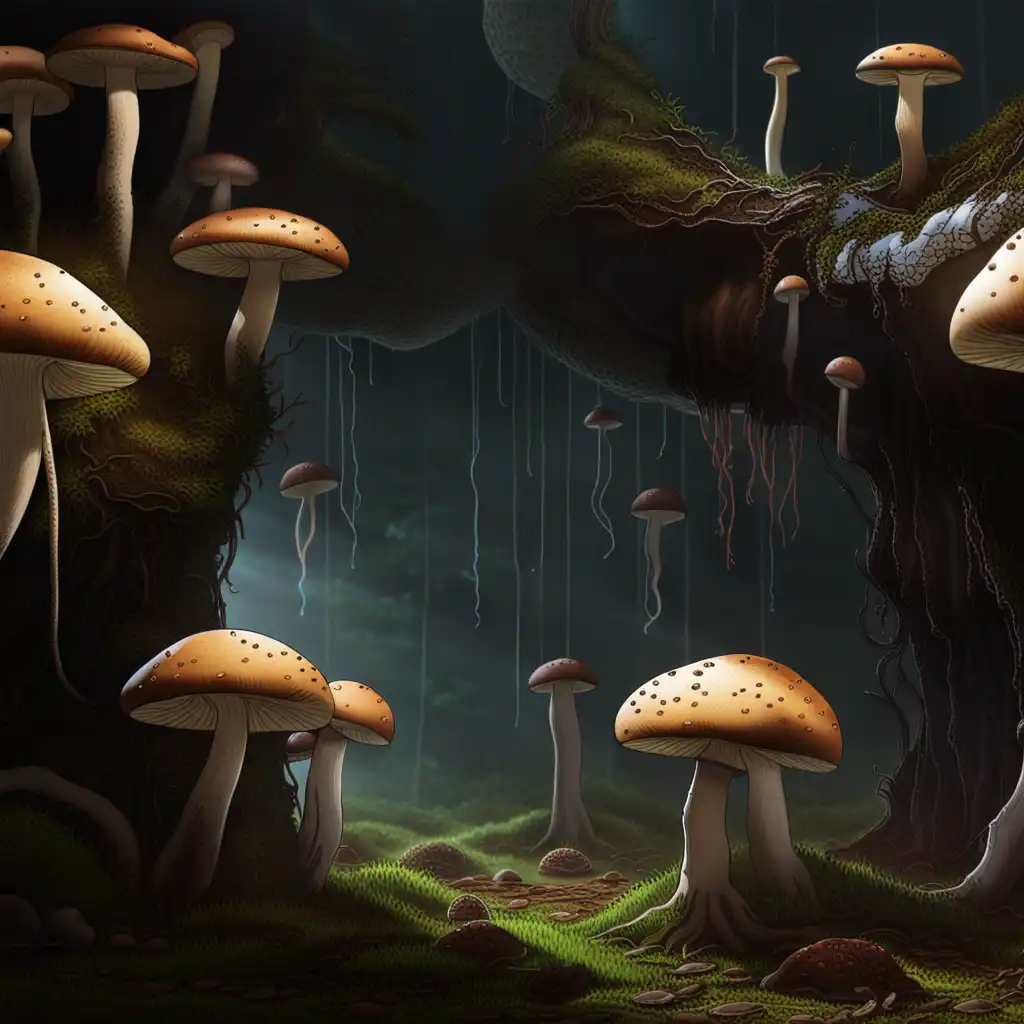
Mushroom refers specifically to the fruiting body of certain types of fungi. This means that while not all fungi are mushrooms, all mushrooms are fungi.
Mushrooms are usually visible above ground and have a recognizable shape, while other forms of fungus may be invisible or may look very different.
Mushrooms are most commonly associated with food and are used in many dishes around the world.
In summary, fungi are a broad group of living organisms that include many different types of organisms, while mushrooms are a specific type of fungus that have a recognizable and often edible fruiting body.
単語を開く: Mushroom →Parasites are organisms that live on or inside another organism, known as the host, and obtain food from the host's body.
Parasites usually harm their hosts in some way, feeding on their blood or tissues and causing disease or other health problems.
So, while fungi are a type of living organism that can grow on or inside other things, parasites are specifically organisms that live on or inside a host and harm it in some way.
Fungi can be beneficial or harmful, while parasites are usually harmful.
単語を開く: Parasite →Pathogen refers to any organism that can cause disease in another organism. This can include viruses, bacteria, and fungi that are harmful to humans.
In other words, all pathogens are not fungi, but some fungi can be pathogens if they cause disease in humans or other organisms.
単語を開く: Pathogen →Fungus is a type of organism that is composed of one or many cells and reproduces through spores. They are typically found in damp environments such as soil, decaying matter, or on the skin of plants and animals.
Spores are tiny structures that are produced by some organisms, including fungi, plants, and bacteria. Spores are usually reproductive structures that are dispersed by wind or water to germinate and grow into new organisms.
Fungi release spores, allowing them to reproduce and grow in new locations.
So, essentially, fungus is a type of organism, while spore is a structure produced by certain organisms for reproduction.
Spores are applicable in contexts where reproduction is the theme (a vital stage of plant and fungal growth).
単語を開く: Spore →Toadstool is a common name for a particular type of fungus, usually with a cap and stem, and sometimes possessing poisonous properties.
While both terms can describe different types of fungi, toadstool is typically used when referring to fungi that are poisonous and not suitable for consumption, while fungus can refer to any type of fungi, including those used in food or medicine.
単語を開く: Toadstool →Fungus and yeast are both types of microorganisms, but they are different in some important ways.
Yeast is a type of fungus that is commonly used in baking and brewing. It is a single-celled organism that reproduces asexually by budding.
Yeast can ferment sugars and convert them into alcohol and carbon dioxide, which makes it useful in the production of beer and bread.
In summary, fungi are a broad group of organisms that includes yeast, but yeast is a specific type of fungus that has unique properties that make it useful in food production.
単語を開く: Yeast →and the fungus parasitizes its body to build a tall thin stalk from its neck. Within several weeks the stalk shoots off spores, which turn more ants into six-legged leaf-seeking zombies. One of humanity's most deadly assailants is a behavior-altering parasite,
YouTube で見る ↗The world depends on fungi, because they are major players in the cycling of materials and energy around the world.
fungi spread across the world other creatures such as wasps moths and caterpillars have also fallen prey to these parasites ants are another notable victim of these killer fungi
YouTube で見る ↗It's the little details I love. How to fletch your arrows with owl feathers, because owls fly silently, so maybe your arrows will, too. How to carry fire in a piece of smouldering fungus wrapped in birchbark. These are the things which help a world come alive.
their eyes glaze over and they think I'm a little crazy. So I hope to pierce that prejudice forever with this group. We call it mycophobia, the irrational fear of the unknown when it comes to fungi. Mushrooms are very fast in their growth.
YouTube で見る ↗Bureaucracy is like a fungus that contaminates everything.
when it's inside of a cricket and that's when it knows, it can start developing. That's how the life cycle continues. This is an ant that has been infected by 'Ophiocordyceps'. And this fungus it gets the ant to crawl up the stalk of a plant
YouTube で見る ↗I'm like a fungus; you can't get rid of me.
different bacteria that are now part of us and these altogether bacteria viruses and even fungi and other microbes are called the human microbiota so these microbes as I said live on every exposed body surface but here are some numbers it's estimated that in the gut
YouTube で見る ↗The vice-president of an advertising agency is a bit of executive fungus that forms on a desk that has been exposed to conference.
hopefully unspoiled, thanks to preservatives. But what exactly are preservatives? How do they help keep food edible and are they safe? There are two major factors that cause food to go microbes and oxidation. Microbes like bacteria and fungi invade food
YouTube で見る ↗Our ancestors went to the woods to find fuel; they set snares there for birds and gathered nuts and fungi.
But what are they anyway, and are they actually bad for you? Those spots are evidence of an epic battle between plants and microbes. Like humans plants coexist with billions of fungi and bacteria. Some of these microbes are beneficial to the plant, suppressing disease and helping it extract nutrients.
YouTube で見る ↗Mycologists are few and far between. We are under-funded, poorly represented in the context of other sciences - ironic, as the very foundation of our ecosystems are directly dependent upon fungi, which ultimately create the foundation of soils.
Plants don't have to rely solely on those airborne broadcasts. Signals can travel below the soil surface too. Most plants have a symbiotic relationship with fungi, which colonize the plants' roots and help them absorb water and nutrients.
YouTube で見る ↗My body is sometimes this thing I look at and think, 'What strange, alien thing grew around my consciousness?' It's like this weird fungus that's just there.
Natural biofilms are like miniature jungles filled with many kinds of microbes from across the web of life. Bacteria and archaea mingle with other microbes like algae fungi and protozoa,
YouTube で見る ↗Marriage is a custom brought about by women who then proceed to live off men and destroy them, completely enveloping the man in a destructive cocoon or eating him away like a poisonous fungus on a tree.
Now we call this symbiosis a mycorrhiza, myco for fungus rrhiza for root. So the fungus and root get together, and they trade for mutual benefit. Now all trees in all forests all over the world depend on these mycorrhizas for their very survival.
YouTube で見る ↗I'm obsessed with broccoli, carrots, celery, string beans, snap peas, black kale, brussels sprouts, cabbage - I could go on! They used to call me 'rabbit' when I was a kid. I hate mushrooms, though. I apologize to fungi lovers, but this way, there's more for you!